Gastrointestinal stromal tumors (GIST)
GIST are rare tumors of the digestive tract, about 1.2 per 100,000 people a year. About 80% carry a mutation that switches on KIT or PDGFRA, two kinases. A 2021 review says tumors that have not spread can be cured and calls surgery their standard treatment; kinase blockers raised median survival in advanced GIST from 18 months to more than 70, though resistance arises. Imatinib blocks KIT.
- Where
- Stomach and intestines
- Body systems
- Cancer; Stomach, gut & liver
- Medicines
- 1 medicine
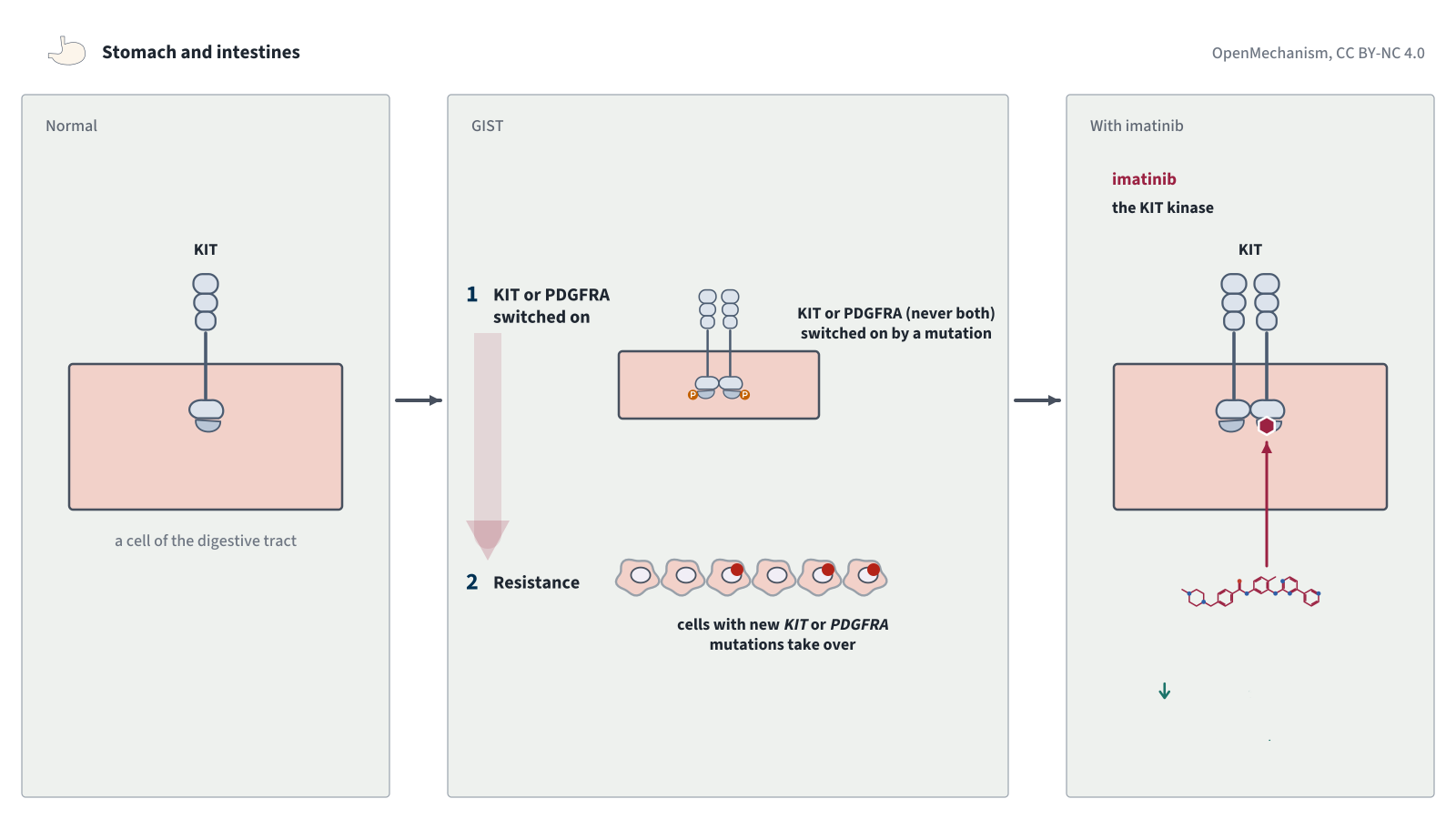
For teachers: download this drawing.
Key terms in this drawing
- GIST
- Gastrointestinal stromal tumor. A tumor of the gut; a 2021 review says around 80% of GIST have molecular changes, mainly activating mutations of KIT or of PDGFRA.
- KIT
- KIT gene. A gene with activating mutations in many gastrointestinal stromal tumors (GIST); a 2021 review says some of these mutations are sensitive to the kinase blocker imatinib.
- PDGFRA
- PDGFRA gene. A gene with an activating mutation in some gastrointestinal stromal tumors (GIST), instead of one in KIT.
What goes wrong
KIT or PDGFRA switched on. About 80% of carry gain-of-function mutations that switch on one of two kinases, or , which seldom occur together; rare kinds have other changes.1,2
Resistance. Resistance to kinase blockers arises mainly when cells with new resistance mutations in KIT or PDGFRA take over.1
What the source says
“Resistance to TKIs arise mainly from subclonal selection of cells with resistance mutations in KIT or PDGFRA when they are the primary drivers.”
Source 1
Where medicines act
- A
Imatinib: KIT blocked
Imatinib blocks the KIT kinase (and receptors); in the lab it stops GIST cells with an activating KIT mutation growing and makes them die. It treats KIT-positive GIST that cannot be removed or has spread, and is given after surgery; after surgery it improves survival in high-risk patients with sensitive mutations. In advanced GIST, median survival rose from 18 months to more than 70 months once kinase blockers (TKIs) arrived.1,3
What the source says
“Imatinib is also an inhibitor of the receptor tyrosine kinases for platelet-derived growth factor (PDGF) and stem cell factor (SCF), c-Kit, and inhibits PDGF- and SCF-mediated cellular events.”
Source 3“In vitro, imatinib inhibits proliferation and induces apoptosis in GIST cells, which express an activating c-Kit mutation.”
Source 3“Patients with Kit (CD117) positive unresectable and/or metastatic malignant gastrointestinal stromal tumors (GIST).”
Source 3“Adjuvant treatment of adult patients following resection of Kit (CD117) positive GIST.”
Source 3“Patients with GIST with KIT or PDGFRA mutations sensitive to the tyrosine kinase inhibitor (TKI) imatinib that are at high risk of relapse have improved survival with adjuvant imatinib treatment.”
Source 1“In advanced disease, median overall survival has improved from 18 months to >70 months since the introduction of TKIs.”
Source 1
See also
Body systems: cancer; and stomach, gut & liver.
Other conditions: acute lymphoblastic leukemia; chronic myeloid leukemia; chemotherapy nausea and vomiting; colorectal cancer; head and neck cancer; and pancreatic cancer.
Sources
- 1Gastrointestinal stromal tumoursBlay JY, Kang YK, Nishida T, von Mehren M. Nat Rev Dis Primers 2021 (abstract). Saved copy
- 2Gastrointestinal stromal tumours: origin and molecular oncologyCorless CL, Barnett CM, Heinrich MC. Nat Rev Cancer 2011 (abstract). Saved copy
- 3Gleevec (imatinib): FDA label1.8 and 1.9 GIST; 12.1 Mechanism of Action. Saved copy
Notes and limits
- A 2021 review says tumors that have not spread can be cured and that surgery is their standard treatment. Size, how fast the cells divide, a site outside the stomach and rupture raise the risk of relapse.1
- Rare kinds with changes in NF1, SDH genes, BRAF or NTRK usually do not respond to the standard kinase blockers.1
- The role of surgery in advanced GIST is unclear, and many questions remain.1
Notes that apply to every page are on How to read a page.
Spotted a mistake? Report an error (hello@openmechanism.com). Since launch, every published error we fix is listed on the corrections page.
Cite this page
Tran D. Gastrointestinal stromal tumors (GIST) [Internet]. OpenMechanism; 2026 [updated 2026 Nov 18; cited 2026 Nov 18]. Available from: https://openmechanism.com/conditions/gastrointestinal-stromal-tumors