Vincristine
Vincristine is an alkaloid from the periwinkle plant. How it works is still under investigation; its action has been related to stopping forming in the mitotic spindle, so dividing cells stop at metaphase. Within 15 to 30 minutes of an injection into a vein, over 90% moves from the blood into tissues, where it stays tightly bound. The liver clears it, with enzymes, and about 80% of a dose leaves in the feces.
- Acts on
- Microtubule formation in the mitotic spindle (the mechanisms remain under investigation)
- Where
- Dividing cells; cleared by the liver
- Medicine type
- Small molecule
- Used for
- Cancer
- Drug class
- Vinca alkaloids
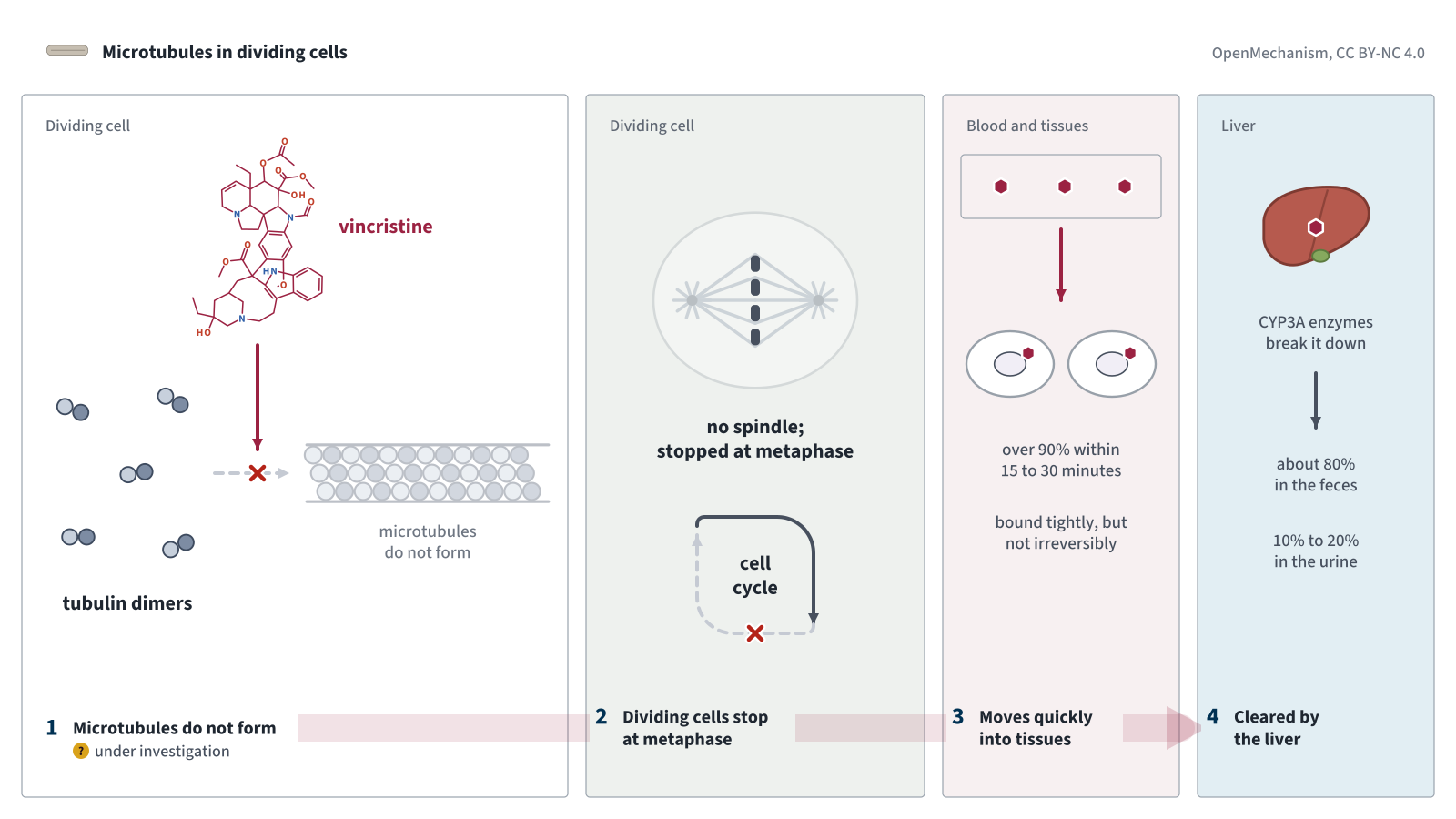
Step 1: under investigation
The vincristine label says: The mechanisms of action of vincristine sulfate remain under investigation. The mechanism of action of vincristine sulfate has been related to the inhibition of microtubule formation in mitotic spindle, resulting in an arrest of dividing cells at the metaphase stage.
Source 1: Vincristine sulfate injection (Hospira): FDA label, Description; Clinical Pharmacology
Clinical study: In an overview of randomised trials in childhood acute lymphoblastic leukaemia, 1300 children were in trials of pulses of vincristine and prednisone (VP) during maintenance treatment; the trials measured relapse and death, not how vincristine works: Total events (relapse or death) were significantly reduced by longer maintenance (23.3 percent vs 27.6 percent), VP pulses (31.2 percent vs 40.4 percent) and intensive reinduction (27.8 percent vs 35.8 percent) (each 2p<0.001). … Many of those who relapsed were successfully re-treated, however, and only for intensive reinduction was overall survival significantly improved (18.5 percent vs 22.3 percent; 2p=0.01).
Childhood ALL Collaborative Group, Lancet 1996 (PMID 8667921)
This study was picked with a literature search and is not yet checked by our reviewer.
Key terms in this drawing
- CYP3A
- Cytochrome P450 3A. Liver enzymes that break down several medicines; ritonavir blocks them for nirmatrelvir and darunavir, and cobicistat for darunavir.
- microtubule
- Microtubule. A structure inside the cell, built from the protein tubulin, that the cell needs for dividing and for other vital work.
How it works
Microtubules do not form. Vincristine is an alkaloid from the periwinkle plant (Vinca rosea). How it works is still under investigation; its action has been related to stopping microtubules forming in the mitotic spindle of dividing cells.1
Dividing cells stop at metaphase. As a result, dividing cells are arrested at the metaphase stage.1
Moves quickly into tissues. Within 15 to 30 minutes of an injection into a vein, over 90% of vincristine moves from the blood into tissue, where it stays tightly, but not irreversibly, bound.1
Cleared by the liver. The liver is the main organ that clears it: liver enzymes of the CYP3A subfamily metabolize vinca alkaloids, and about 80% of a dose appears in the feces and 10% to 20% in the urine.1
For teachers: download this drawing.
See also
Condition pages: acute lymphoblastic leukemia, B-cell lymphomas, Hodgkin lymphoma and neuroblastoma.
Explained: why vincristine can damage nerves.
Related drawings: paclitaxel (also acts on microtubules, but helps them form and stops them coming apart).
Body system: cancer.
Sources
- 1Vincristine sulfate injection (Hospira): FDA labelDescription; Clinical Pharmacology
- 2ChEMBL CHEMBL90555Target and action classification: Tubulin inhibitor
- 3Duration and intensity of maintenance chemotherapy in acute lymphoblastic leukaemia: overview of 42 trials involving 12 000 randomised childrenChildhood ALL Collaborative Group. Lancet 1996 (abstract)
Spotted a mistake? Report an error (hello@openmechanism.com). Since launch, every published error we fix is listed on the corrections page.
Notes and limits
- A schematic teaching drawing: not to scale, not exact structures, binding poses or a complete pathway, and not a guide to dosing, treatment or how a person will respond.
- The label says the mechanisms of action of vincristine remain under investigation, and that its mechanism of action has been related to the inhibition of microtubule formation in the mitotic spindle.
All recorded limits are on the evidence page, and notes that apply to every page are on How to read a page. Version 1.0.1, not yet medically reviewed.
Cite this page
Tran D. Vincristine [Internet]. OpenMechanism; 2026 [updated 2026 Nov 13; cited 2026 Nov 13]. Available from: https://openmechanism.com/medicines/vincristine