Bevacizumab
Bevacizumab is a humanized antibody that binds , the vascular endothelial growth factor, so VEGF cannot reach its receptors on the cells that line blood vessels. In lab models, VEGF on these receptors makes the cells multiply and form new blood vessels. In mice carrying human colon cancer, bevacizumab reduced the growth of small blood vessels and slowed the spread of the cancer.
- Acts on
- VEGF (vascular endothelial growth factor)
- Where
- The cells that line blood vessels
- Medicine type
- Antibody
- Used for
- Cancer
- Drug class
- VEGF blockers
Also called Avastin.
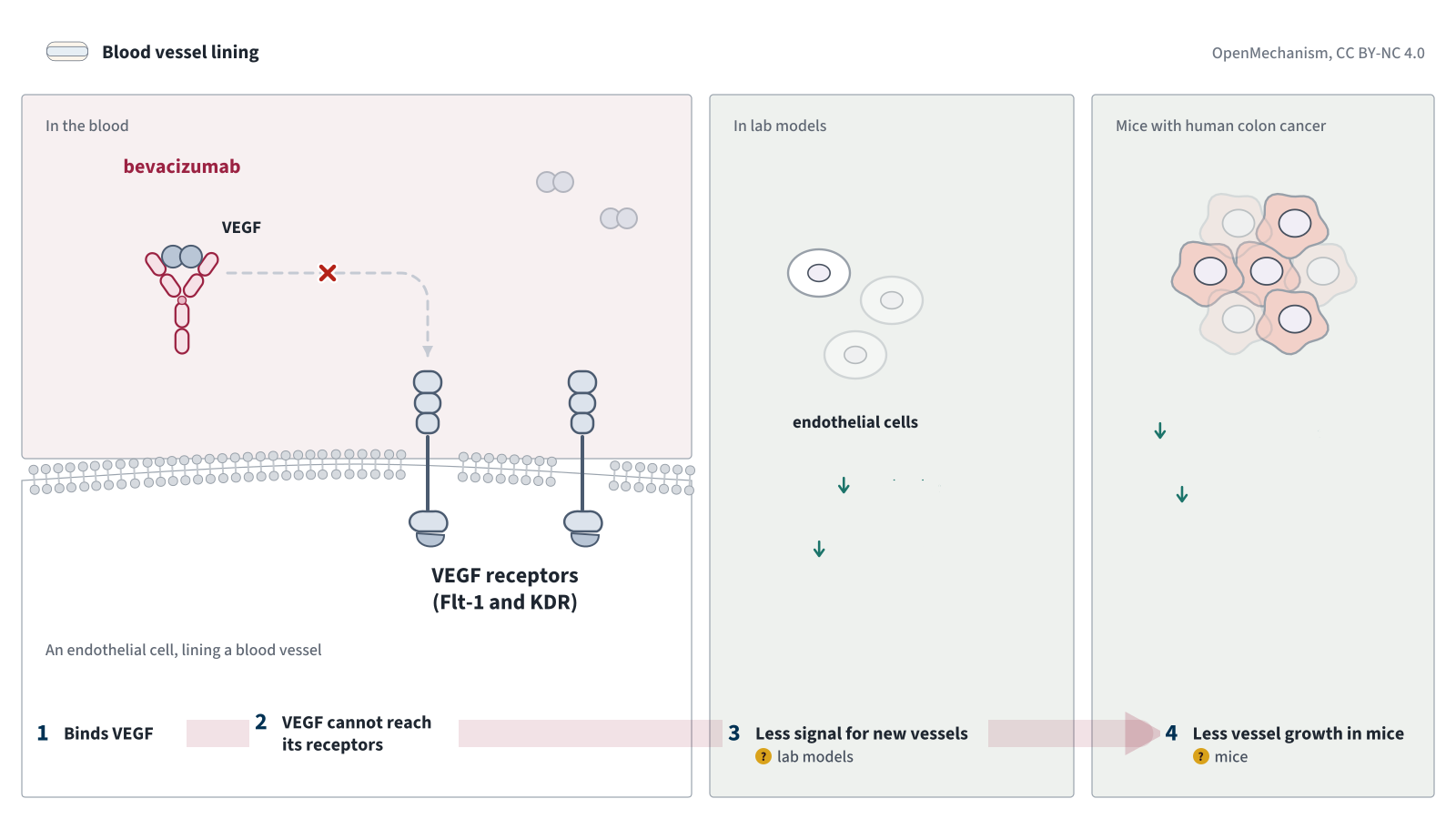
Step 3: lab models
The Avastin label says: The interaction of VEGF with its receptors leads to endothelial cell proliferation and new blood vessel formation in in vitro models of angiogenesis.
Source 1: Avastin (bevacizumab): FDA label, 11 Description; 12.1 Mechanism of Action
Clinical study: In a study in people with rectal cancer, the blood vessels in their tumors were measured after a single infusion: Here we show here that a single infusion of the VEGF-specific antibody bevacizumab decreases tumor perfusion, vascular volume, microvascular density, interstitial fluid pressure and the number of viable, circulating endothelial and progenitor cells, and increases the fraction of vessels with pericyte coverage in rectal carcinoma patients.
Willett CG et al., Nat Med 2004 (PMID 14745444)
This study was picked with a literature search and is not yet checked by our reviewer.
Step 4: mice
The Avastin label says: Administration of bevacizumab to xenotransplant models of colon cancer in nude (athymic) mice caused reduction of microvascular growth and inhibition of metastatic disease progression.
Source 1: Avastin (bevacizumab): FDA label, 11 Description; 12.1 Mechanism of Action
Clinical study: In a study in people with rectal cancer, which measured the blood vessels in their tumors after a single infusion: These data indicate that VEGF blockade has a direct and rapid antivascular effect in human tumors.
Willett CG et al., Nat Med 2004 (PMID 14745444)
This study was picked with a literature search and is not yet checked by our reviewer.
Key terms in this drawing
- VEGF
- Vascular endothelial growth factor. A growth factor for blood vessels; medicines that block it or its receptor are used in advanced kidney cancer.
How it works
Binds VEGF. Bevacizumab, a humanized antibody (), binds VEGF, the vascular endothelial growth factor.1
VEGF cannot reach its receptors. Bound this way, VEGF cannot reach its receptors (Flt-1 and KDR) on the surface of endothelial cells, the cells that line blood vessels.1
Less signal for new vessels. VEGF on its receptors makes endothelial cells multiply and form new blood vessels in lab models of blood vessel growth (angiogenesis); bevacizumab keeps VEGF off them.1
Less vessel growth in mice. In mice carrying human colon cancer (xenograft models), bevacizumab reduced the growth of small blood vessels and slowed the spread of the cancer.1
For teachers: download this drawing.
See also
Condition pages: cervical cancer, colorectal cancer, kidney cancer, non-small cell lung cancer and ovarian cancer.
Body system: cancer.
Sources
- 1Avastin (bevacizumab): FDA label11 Description; 12.1 Mechanism of Action
- 2ChEMBL CHEMBL1201583Target and action classification: Vascular endothelial growth factor A inhibitor
- 3Direct evidence that the VEGF-specific antibody bevacizumab has antivascular effects in human rectal cancerWillett CG et al. Nat Med 2004 (abstract)
Spotted a mistake? Report an error (hello@openmechanism.com). Since launch, every published error we fix is listed on the corrections page.
Notes and limits
- A schematic teaching drawing: not to scale, not exact structures, binding poses or a complete pathway, and not a guide to dosing, treatment or how a person will respond.
- The label's evidence for less blood vessel growth comes from lab and mouse models (12.1).
- Seen in lab (in vitro) models (the label, 12.1).
- Seen in mice (the label, 12.1).
All recorded limits are on the evidence page, and notes that apply to every page are on How to read a page. Version 1.0.0, not yet medically reviewed.
Cite this page
Tran D. Bevacizumab [Internet]. OpenMechanism; 2026 [updated 2026 Oct 18; cited 2026 Oct 18]. Available from: https://openmechanism.com/medicines/bevacizumab