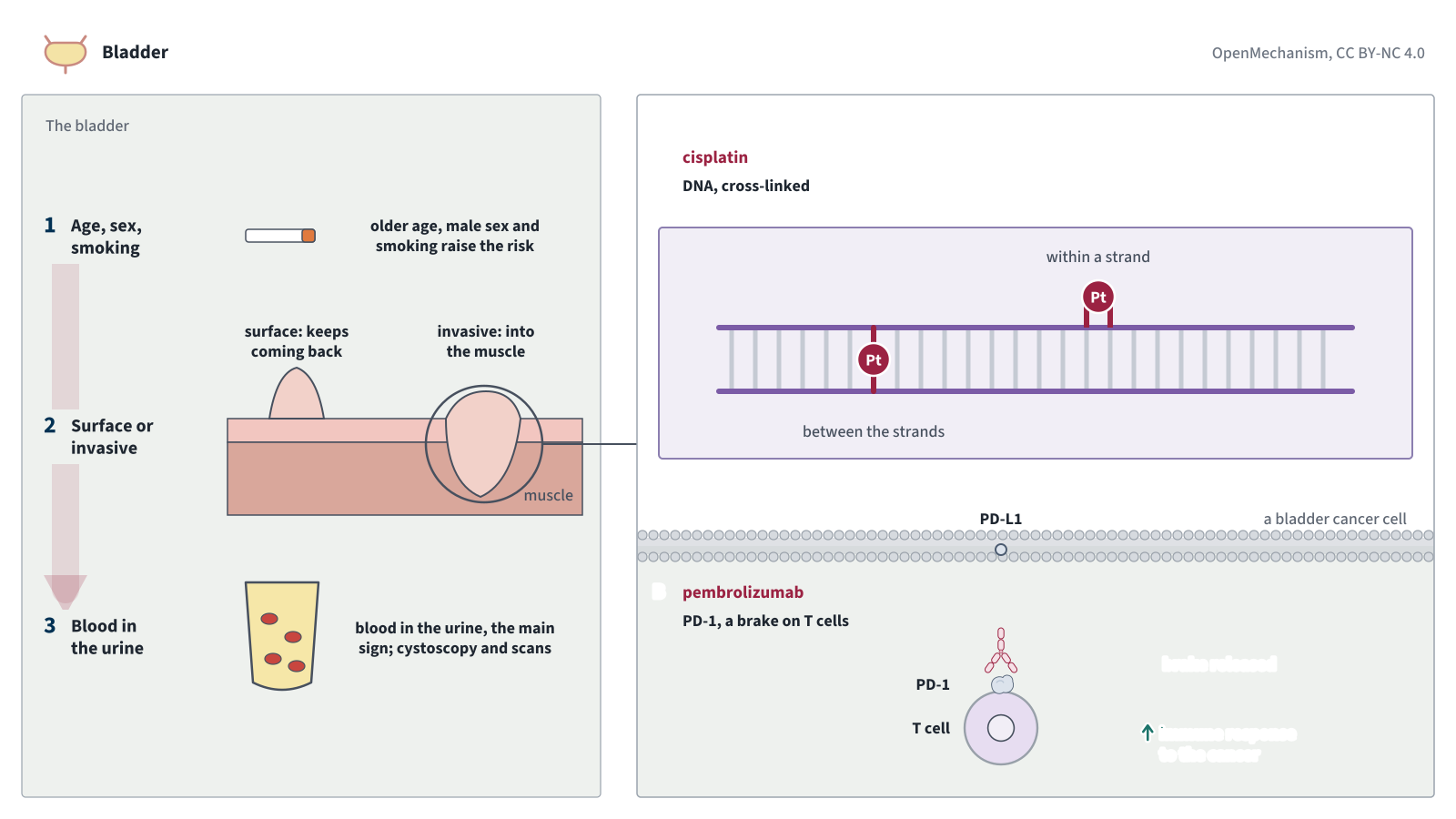
In a 2020 review, bladder cancer was the fourth most common cancer in men; older age, male sex and cigarette smoking raise the risk, and blood in the urine is the main sign. It ranges from tumors, usually on the surface, that keep coming back to aggressive tumors that grow into the bladder muscle. Cisplatin cross-links DNA; pembrolizumab releases a brake on T cells.
Deoxyribonucleic acid. The molecule that stores genes.
PD-1
Programmed cell death protein 1. A receptor on T cells that acts as a brake when PD-L1 or PD-L2 binds it.
PD-L1
Programmed death-ligand 1. One of the two PD-1 ligands (PD-L1 and PD-L2): it binds PD-1 on T cells and holds them back, and some tumors make more of it.
T cell
T lymphocyte. A white blood cell of the immune system.
What goes wrong
Age, sex, smoking. Older age, male sex and cigarette smoking raise the risk.1
What the source says
“Advanced age, male sex, and cigarette smoking contribute to the development of bladder cancer.”
Surface or invasive. It ranges from mild tumors, usually on the surface, that keep coming back, needing long-term invasive checks, to aggressive tumors that invade and often kill.1
What the source says
“Bladder cancer ranges from unaggressive and usually noninvasive tumors that recur and commit patients to long-term invasive surveillance, to aggressive and invasive tumors with high disease-specific mortality.”
Blood in the urine. Blood in the urine, seen or found on testing, is the main sign; depending on how much blood there is and the risk of cancer, it is checked with cystoscopy and scans.1,2
What the source says
“Bladder tumors can present with gross or microscopic hematuria, which is evaluated with cystoscopy and upper tract imaging depending on the degree of hematuria and risk of malignancy.”
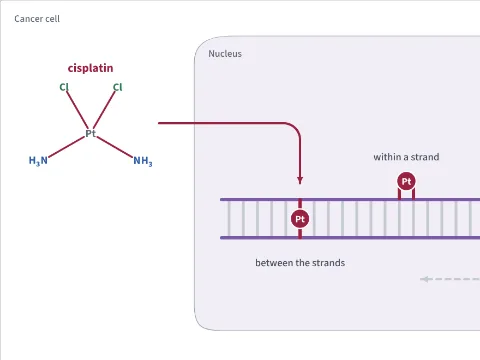
Cisplatin kills cells mainly by binding in the nucleus and forming cross-links within and between its strands. It treats advanced bladder cancer.3
What the source says
“The main mechanism of the cytotoxic action involves the binding of cisplatin to genomic DNA in the cell nucleus to form interstrand and intrastrand cross-links.”
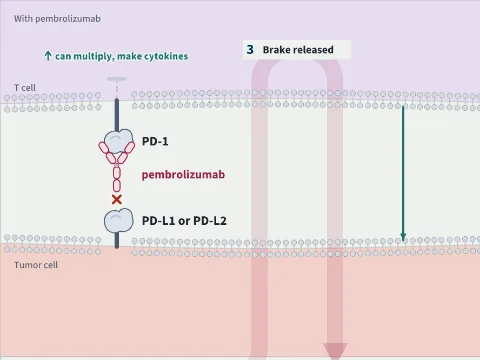
Pembrolizumab blocks , a brake on , and so releases the immune response, including the response against the cancer. It treats advanced urothelial cancer (with enfortumab vedotin in adults, or alone when platinum chemotherapy is not possible or has failed); muscle-invasive bladder cancer in adults, with enfortumab vedotin, before and after removal of the bladder; and, alone, high-risk surface cancer with carcinoma in situ that no longer responds to BCG, in people who cannot have or choose not to have the bladder removed.4
What the source says
“Binding of the PD-1 ligands, PD-L1 and PD-L2, to the PD-1 receptor found on T cells, inhibits T cell proliferation and cytokine production.”
“Pembrolizumab is a monoclonal antibody that binds to the PD-1 receptor and blocks its interaction with PD-L1 and PD-L2, releasing PD-1 pathway-mediated inhibition of the immune response, including the anti-tumor immune response.”
“KEYTRUDA, in combination with enfortumab vedotin-ejfv, is indicated for the treatment of adult patients with locally advanced or metastatic urothelial cancer.”
“KEYTRUDA, as a single agent, is indicated for the treatment of patients with locally advanced or metastatic urothelial carcinoma: who are not eligible for any platinum-containing chemotherapy, or who have disease progression during or following platinum-containing chemotherapy or within 12 months of neoadjuvant or adjuvant treatment with platinum-containing chemotherapy.”
“KEYTRUDA, in combination with enfortumab vedotin-ejfv, as neoadjuvant treatment and then continued after cystectomy as adjuvant treatment, is indicated for the treatment of adult patients with muscle invasive bladder cancer (MIBC).”
“KEYTRUDA, as a single agent, is indicated for the treatment of patients with Bacillus Calmette-Guerin (BCG)-unresponsive, high-risk, non-muscle invasive bladder cancer (NMIBC) with carcinoma in situ (CIS) with or without papillary tumors who are ineligible for or have elected not to undergo cystectomy.”
The National Cancer Institute's treatment summary for bladder cancer (updated 2 May 2025) describes these combinations. For the lettered medicines above, the page gives only the uses their own labels list. The quotes may name medicines, combinations or groups of patients that a medicine's own label does not list, and may leave out its label's limits.
Muscle-invasive bladder cancer: “Standard treatment for patients with muscle-invasive bladder cancers whose goal is cure is either neoadjuvant multiagent cisplatin–based chemotherapy followed by radical cystectomy and urinary diversion or radiation therapy with concomitant chemotherapy.”6
Stage IV bladder cancer: “While results cannot be extrapolated across trials, enfortumab vedotin plus pembrolizumab is a first-line therapy option for patients without a contraindication. … In a phase III trial (EV-302 [NCT04223856]), 886 patients were randomly assigned to receive either enfortumab vedotin plus pembrolizumab (n = 442) or gemcitabine plus either cisplatin or carboplatin (n = 444). The median follow-up was 17.2 months. Overall survival (OS) and progression-free survival (PFS) were longer for patients in the enfortumab vedotin-plus-pembrolizumab arm than in the chemotherapy arm. … Grade 3 or higher adverse events occurred in 55.9% of patients who received enfortumab vedotin plus pembrolizumab and 69.5% of patients who received chemotherapy. In the experimental arm, the most common high-grade adverse events were skin reactions, peripheral neuropathy, hyperglycemia, and neutropenia.”6
Stage IV bladder cancer (T4b, N0, M0 disease), chemotherapy alone: “The only chemotherapy regimens that have been shown to result in longer survival in randomized controlled trials are methotrexate, vinblastine, doxorubicin, and cisplatin (MVAC); high-dose MVAC; and cisplatin, methotrexate, and vinblastine (CMV). Gemcitabine plus cisplatin (GC) was compared with MVAC in a randomized controlled trial that reported no difference in response rate or survival. … A multicenter, randomized, phase III trial compared GC with MVAC in 405 patients with advanced or metastatic bladder cancer. GC yielded response rates, time-to-progression, and OS (HR, 1.04; 95% CI, 0.82–1.32; P = .75) similar to MVAC, but GC had a better safety profile and was better tolerated than MVAC. Although this study was not designed to show the equivalence of the two regimens, the similar efficacy and reduced toxic effects of GC make it a reasonable alternative in patients who may not tolerate the MVAC regimen.”6
Also used for it: doxorubicin (“Doxorubicin Hydrochloride Injection is indicated for the treatment of … metastatic transitional cell bladder carcinoma”5).
Bladder cancer is common: in a 2020 review, the fourth most common cancer in men, and common in women too.1
The reviews this page cites describe treatment. Surface tumors are removed, and then, depending on their risk, the bladder is treated with BCG or chemotherapy. For cancer in the bladder muscle, the 2016 review says removing the bladder after chemotherapy offers the best chance for cure, and that selected patients can be offered treatment that keeps the bladder: removal of the tumor through the urethra, with chemotherapy and radiation. In the 2016 review advanced cancer was best treated with cisplatin-based chemotherapy; by the 2020 review, immunotherapy and other newer medicines had become options for certain patients.1,2
In a 2020 review, high-risk surface tumors that did not respond to BCG were hard to treat, and many alternatives were being studied.1
Genetic subtypes of bladder cancer may respond differently to treatments.2
The combinations quoted from the National Cancer Institute are examples of how these medicines are given together. They are not a full list of regimens, and nothing here is advice on choosing a treatment. The words are from the summary's version of 2 May 2025, and the summary may have changed since. The summary says: “It is intended as a resource to inform and assist clinicians in the care of their patients. It does not provide formal guidelines or recommendations for making health care decisions.”6
Claude Opus 5.5 (AI source check), 14 November 2026: 36 statements compared with their sources, 6 flagged for the reviewer. An automated check, not a medical review.
Conflict of interest
Doxorubicin: Pfizer, the reviewer's former employer, makes or markets this medicine. Details
Next review due
16 May 2028
Cite this page
Tran D. Bladder cancer [Internet]. OpenMechanism; 2026 [updated 2026 Nov 15; cited 2026 Nov 15]. Available from: https://openmechanism.com/conditions/bladder-cancer