Endometrial cancer
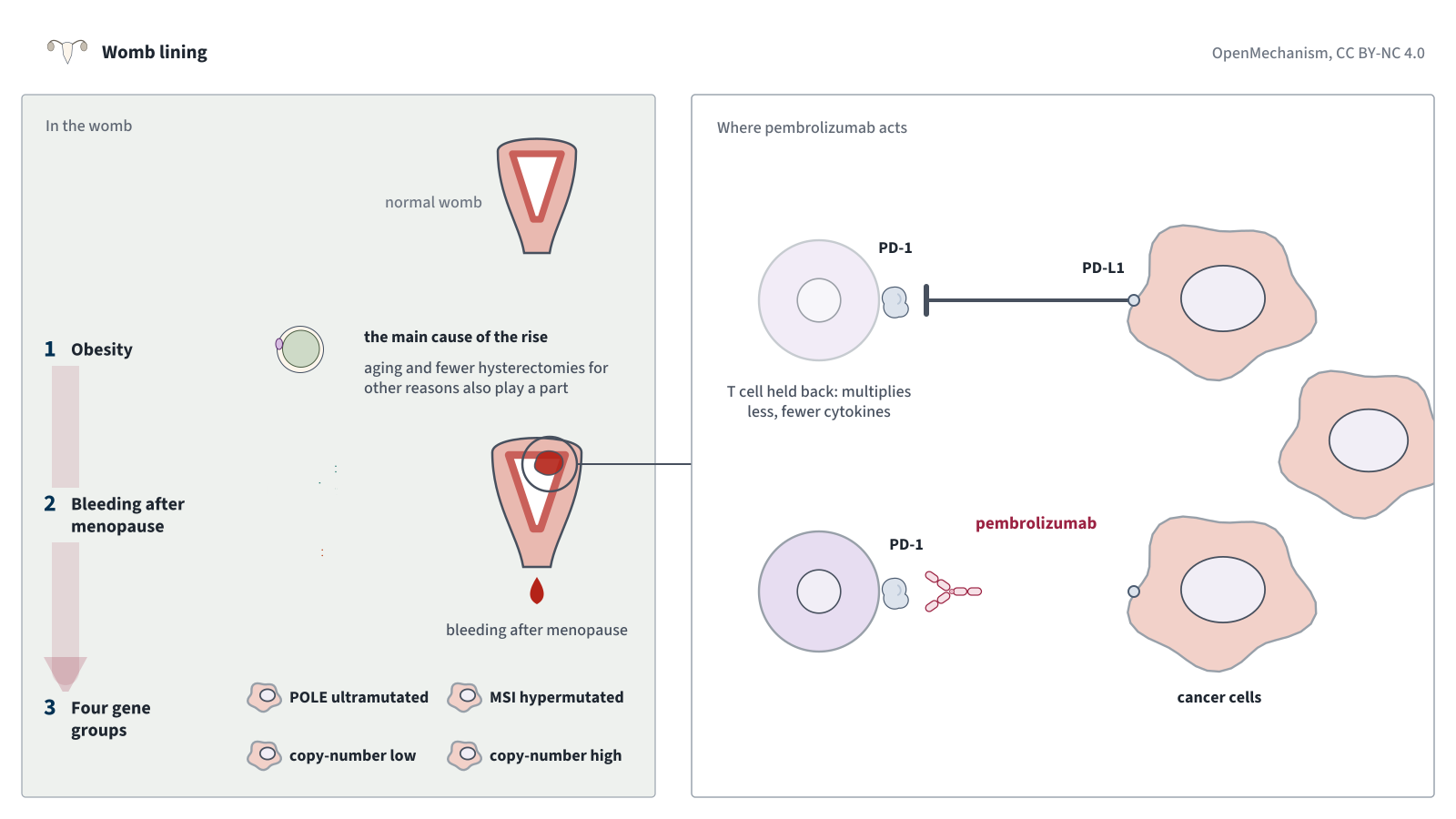
Endometrial cancer, in the womb's lining, is the most common gynecological cancer in high-income countries and rising worldwide, mainly because obesity is more common. It usually shows early, as bleeding after menopause, so most are cured by hysterectomy; advanced disease has a poor outlook. Gene studies sort it into four groups, one with microsatellite instability. Pembrolizumab releases a T-cell brake.
- Where
- Womb lining
- Body systems
- Cancer, Bladder & reproductive organs
- Medicines
- 1 medicine
For teachers: download this drawing.
Key terms in this drawing (6)
- cytokines
- Cytokines. Signal molecules involved in inflammation, such as interleukin-2, interferon-γ, interleukin-4 and TNF-α, which T cells make.
- MSI
- Microsatellite instability. A tumor that mutates very easily because it has lost DNA mismatch repair.
- PD-1
- Programmed cell death protein 1. A receptor on T cells that acts as a brake when PD-L1 or PD-L2 binds it.
- PD-L1
- Programmed death-ligand 1. One of the two PD-1 ligands (PD-L1 and PD-L2): it binds PD-1 on T cells and holds them back, and some tumors make more of it.
- POLE
- POLE gene. A gene whose mutations mark the 'POLE ultramutated' group, one of four groups of endometrial cancer.
- T cell
- T lymphocyte. A white blood cell of the immune system.
What goes wrong
Obesity. An aging population and fewer hysterectomies for other reasons play a part, but the main cause of the rise is that more people have obesity.1
What the source says
“Although an ageing population and fewer benign hysterectomies have contributed to this trend, the growing prevalence of obesity is the major underlying cause.”
Source 1Bleeding after menopause. It usually shows early, as bleeding after menopause, so most are cured by removing the womb; advanced disease has a poor outlook.1
What the source says
“Early presentation with postmenopausal bleeding ensures most endometrial cancers are cured by hysterectomy but those with advanced disease have a poor prognosis.”
Source 1Four gene groups. Gene studies sort it into four groups: ultramutated, microsatellite instability () hypermutated, copy-number low and copy-number high.2
What the source says
“Our results classified endometrial cancers into four categories: POLE ultramutated, microsatellite instability hypermutated, copy-number low, and copy-number high.”
Source 2
Where medicines act
- A
Pembrolizumab: the PD-1 brake released
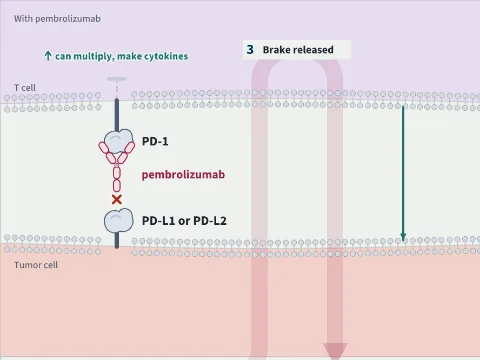
Pembrolizumab blocks , a brake on , and so releases the immune response against the cancer. With carboplatin and paclitaxel it treats advanced or recurrent endometrial cancer. Alone, it treats advanced MSI-H or mismatch-repair-deficient cancer after earlier treatment; with lenvatinib, advanced cancer that is not.3
What the source says
“Binding of the PD-1 ligands, PD-L1 and PD-L2, to the PD-1 receptor found on T cells, inhibits T cell proliferation and cytokine production.”
Source 3“Pembrolizumab is a monoclonal antibody that binds to the PD-1 receptor and blocks its interaction with PD-L1 and PD-L2, releasing PD-1 pathway-mediated inhibition of the immune response, including the anti-tumor immune response.”
Source 3“in combination with carboplatin and paclitaxel, followed by KEYTRUDA as a single agent, for the treatment of adult patients with primary advanced or recurrent endometrial carcinoma.”
Source 3“KEYTRUDA, as a single agent, is indicated for the treatment of adult patients with advanced endometrial carcinoma that is MSI-H or dMMR, as determined by an FDA-authorized test, who have disease progression following prior systemic therapy in any setting and are not candidates for curative surgery or radiation”
Source 3“KEYTRUDA, in combination with lenvatinib, is indicated for the treatment of adult patients with advanced endometrial carcinoma that is mismatch repair proficient (pMMR) or not MSI-H as determined by an FDA-authorized test, who have disease progression following prior systemic therapy in any setting and are not candidates for curative surgery or radiation”
Source 3
See also
Body systems: cancer and bladder & reproductive organs.
Other conditions: absent periods (secondary amenorrhea), bladder cancer, cervical cancer, ovarian cancer, B-cell lymphomas and breast cancer.
Sources
- 1Endometrial cancerCrosbie EJ et al. Lancet 2022 (abstract). Saved copy
- 2Integrated genomic characterization of endometrial carcinomaCancer Genome Atlas Research Network. Nature 2013 (abstract). Saved copy
- 3Keytruda (pembrolizumab): FDA label1 Indications and Usage; 12.1 Mechanism of Action. Saved copy
Notes and limits
- Obesity makes diagnosis and treatment harder; more research is needed on prevention for women at high risk and on life after treatment.1
- Trials are still testing the benefit of treatments chosen by the cancer's molecular type.1
Notes that apply to every page are on How to read a page.
Spotted a mistake? Report an error (hello@openmechanism.com). Since launch, every published error we fix is listed on the corrections page.
Cite this page
Tran D. Endometrial cancer [Internet]. OpenMechanism; 2026 [updated 2026 Oct 20; cited 2026 Oct 20]. Available from: https://openmechanism.com/conditions/endometrial-cancer