Chronic lymphocytic leukemia
Chronic lymphocytic leukemia (CLL) is a cancer of B cells: small, mature-looking lymphocytes build up in the blood, bone marrow and lymph tissue. B cell receptor signals, gene changes and neighboring cells drive it. Some people need treatment soon, others not for many years, if at all. Venetoclax blocks BCL-2, which keeps CLL cells alive; rituximab removes CD20-carrying B cells.
- Where
- Blood, marrow and lymph nodes
- Body systems
- Cancer, Blood & clotting, Immune system
- Medicines
- 2 medicines
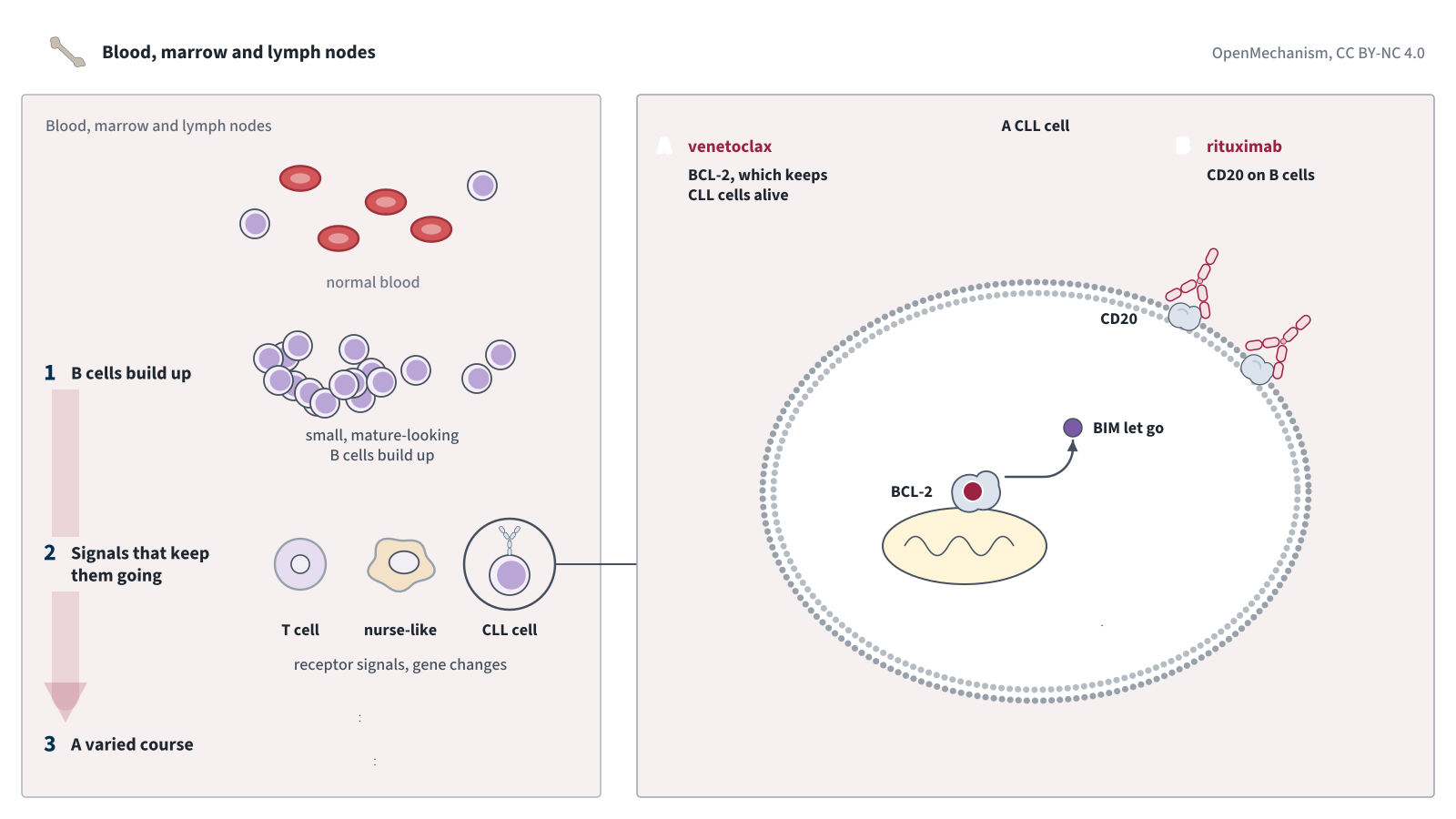
For teachers: download this drawing.
Key terms in this drawing (5)
- BCL2
- BCL-2 protein. A protein that helps cells avoid programmed cell death.
- BIM
- BCL2-interacting mediator of cell death. A protein that triggers programmed cell death when it is set free.
- CD20
- CD20 antigen. A molecule on the surface of B cells that rituximab targets.
- CLL
- Chronic lymphocytic leukemia. A blood cancer in which small, mature-looking lymphocytes build up in the blood, bone marrow and lymph tissues.
- T cell
- T lymphocyte. A white blood cell of the immune system.
What goes wrong
B cells build up. is a cancer of B cells: small, mature-looking lymphocytes build up in the blood, bone marrow and lymph tissue.1
What the source says
“is characterized by the accumulation of small, mature-appearing lymphocytes in the blood, marrow and lymphoid tissues.”
Source 1Signals that keep them going. Signals through the B cell receptor, gene changes and support from other cells in the lymph nodes, such as and nurse-like cells, drive it.1
What the source says
“Signalling via surface immunoglobulin, which constitutes the major part of the B cell receptor, and several genetic alterations play a part in CLL pathogenesis, in addition to interactions between CLL cells and other cell types, such as stromal cells, T cells and nurse-like cells in the lymph nodes.”
Source 1A varied course. Its course varies: some people need treatment soon after diagnosis, others not for many years, if at all.1
What the source says
“The clinical progression of CLL is heterogeneous and ranges from patients who require treatment soon after diagnosis to others who do not require therapy for many years, if at all.”
Source 1
Where medicines act
- A
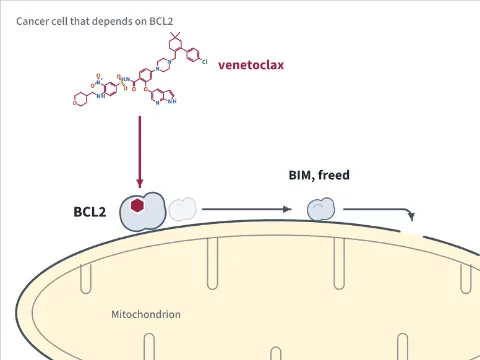
Venetoclax: BCL-2 blocked, the cell can die
CLL cells make too much , a protein that keeps them alive. Venetoclax binds BCL-2 and frees proteins such as , which set off the cell's self-destruction (apoptosis). It treats CLL.2
What the source says
“Venetoclax is a selective and orally bioavailable small-molecule inhibitor of BCL-2, an anti-apoptotic protein.”
Source 2“Overexpression of BCL-2 has been demonstrated in CLL and AML cells where it mediates tumor cell survival and has been associated with resistance to chemotherapeutics.”
Source 2“Venetoclax helps restore the process of apoptosis by binding directly to the BCL-2 protein, displacing pro-apoptotic proteins like BIM, triggering mitochondrial outer membrane permeabilization and the activation of caspases.”
Source 2“For the treatment of adult patients with chronic lymphocytic leukemia (CLL) or small lymphocytic lymphoma (SLL).”
Source 2 - B
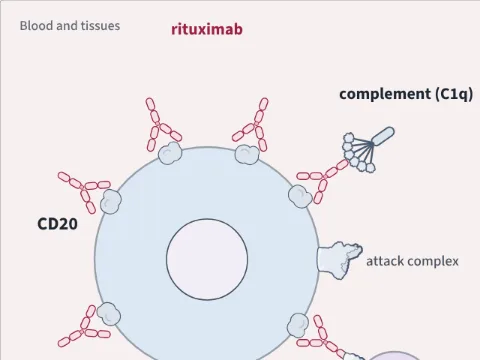
Rituximab: B cells removed
Rituximab binds on B cells and destroys them. With fludarabine and cyclophosphamide, it treats CD20-positive CLL, untreated or previously treated.3
What the source says
“Rituximab is a monoclonal antibody that targets the CD20 antigen expressed on the surface of pre-B and mature B-lymphocytes. Upon binding to CD20, rituximab mediates B-cell lysis.”
Source 3“Previously untreated and previously treated CD20-positive CLL in combination with fludarabine and cyclophosphamide (FC).”
Source 3
See also
Body systems: cancer, blood & clotting and immune system.
Also used for it: cyclophosphamide (“Cyclophosphamide Tablets is indicated for the treatment of: … leukemias: chronic lymphocytic leukemia”4).
Related medicines: prednisone.
Other conditions: B-cell lymphomas, acute lymphoblastic leukemia, Hodgkin lymphoma, acute myeloid leukemia, lupus nephritis and pemphigus.
Side effects: why rituximab can bring hepatitis B back.
Sources
- 1Chronic lymphocytic leukaemiaKipps TJ et al. Nat Rev Dis Primers 2017 (abstract). Saved copy
- 2Venclexta (venetoclax): FDA label1 Indications and Usage; 12.1 Mechanism of Action. Saved copy
- 3Rituxan (rituximab): FDA label1 Indications and Usage; 12.1 Mechanism of Action. Saved copy
- 4Cyclophosphamide tablets (Baxter): FDA label1 Indications and Usage. Saved copy
Notes and limits
Notes that apply to every page are on How to read a page.
Spotted a mistake? Report an error (hello@openmechanism.com). Since launch, every published error we fix is listed on the corrections page.
Cite this page
Tran D. Chronic lymphocytic leukemia [Internet]. OpenMechanism; 2026 [updated 2026 Oct 21; cited 2026 Oct 21]. Available from: https://openmechanism.com/conditions/chronic-lymphocytic-leukemia