Cervical cancer
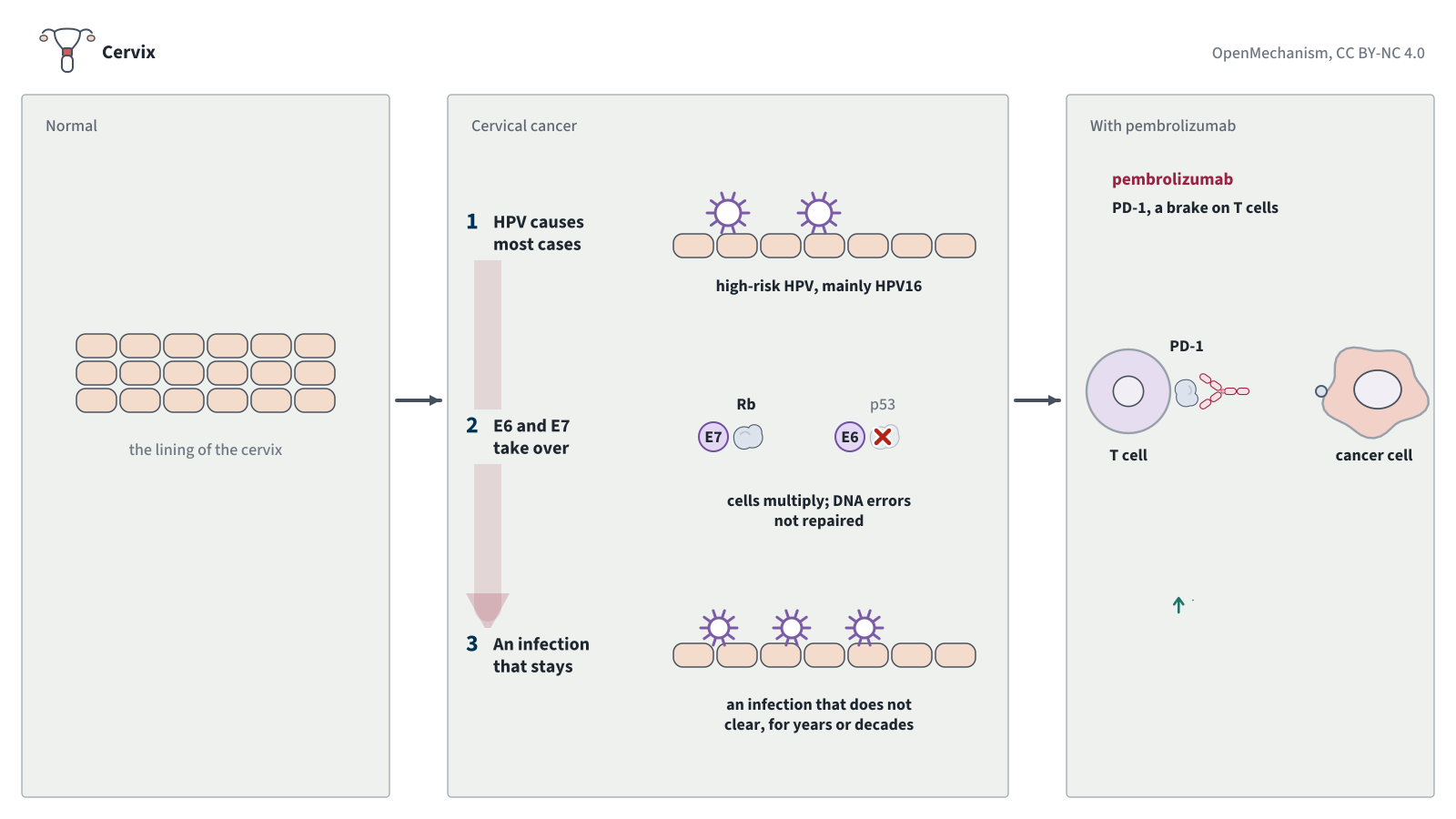
Cervical cancer is diagnosed in more than half a million women a year and causes over 300,000 deaths; it is largely preventable through screening and HPV vaccination. High-risk human papillomavirus (HPV) causes most cases: its E6 and E7 proteins push cells to multiply, and E6 destroys p53, stopping normal DNA repair. Pembrolizumab releases a brake on T cells.
- Where
- Cervix
- Body systems
- Cancer, Bladder & reproductive organs
- Medicines
- 1 medicine
For teachers: download this drawing.
Key terms in this drawing
- DNA
- Deoxyribonucleic acid. The molecule that stores genes.
- HPV
- Human papillomavirus. The virus whose L1 proteins Gardasil 9 contains, assembled into noninfectious particles.
- PD-1
- Programmed cell death protein 1. A receptor on T cells that acts as a brake when PD-L1 or PD-L2 binds it.
- T cell
- T lymphocyte. A white blood cell of the immune system.
What goes wrong
HPV causes most cases. High-risk types of human papillomavirus () cause most cases; high-risk HPV is found in almost all, HPV16 most often.1,2
E6 and E7 take over. The virus's E6 and E7 proteins push cells to multiply by binding Rb and other proteins. E6 also destroys p53, so chance mutations in the cell's DNA are not repaired.2
What the source says
“The high-risk E6 and E7 proteins drive cell proliferation through their association with PDZ domain proteins and Rb (retinoblastoma), and contribute to neoplastic progression, whereas E6-mediated p53 degradation prevents the normal repair of chance mutations in the cellular genome.”
Source 2An infection that stays. Most people's immune systems clear the virus or keep it quiet. Cancer usually arises in those whose infection does not clear and whose cells keep making the viral cancer proteins for years or decades.2
What the source says
“Cancers usually arise in individuals who fail to resolve their infection and who retain oncogene expression for years or decades.”
Source 2“In most individuals, immune regression eventually leads to clearance of the virus, or to its maintenance in a latent or asymptomatic state in the basal cells.”
Source 2
Where medicines act
- A
Pembrolizumab: the PD-1 brake released
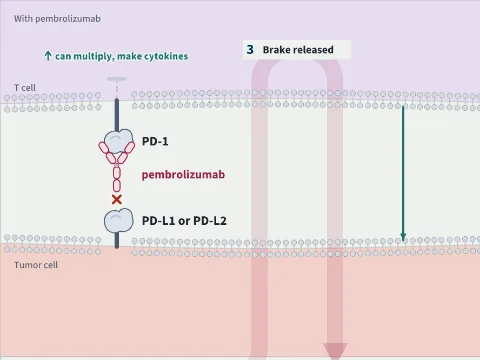
Pembrolizumab blocks , a brake on , and so releases the immune response against the cancer. With chemoradiotherapy it treats locally advanced cervical cancer (stage III to IVA). With chemotherapy, or alone after chemotherapy, it treats cancer that persists, comes back or spreads when the tumor carries .3
What the source says
“Binding of the PD-1 ligands, PD-L1 and PD-L2, to the PD-1 receptor found on T cells, inhibits T cell proliferation and cytokine production.”
Source 3“Pembrolizumab is a monoclonal antibody that binds to the PD-1 receptor and blocks its interaction with PD-L1 and PD-L2, releasing PD-1 pathway-mediated inhibition of the immune response, including the anti-tumor immune response.”
Source 3“in combination with chemoradiotherapy, for the treatment of patients with locally advanced cervical cancer involving the lower third of the vagina, with or without extension to pelvic sidewall, or hydronephrosis/non-functioning kidney, or spread to adjacent pelvic organs (FIGO 2014 Stage III-IVA).”
Source 3“KEYTRUDA, in combination with chemotherapy, with or without bevacizumab, is indicated for the treatment of patients with persistent, recurrent, or metastatic cervical cancer whose tumors express PD-L1 (CPS ≥1) as determined by an FDA-authorized test”
Source 3“KEYTRUDA, as a single agent, is indicated for the treatment of patients with recurrent or metastatic cervical cancer with disease progression on or after chemotherapy whose tumors express PD-L1 (CPS ≥1) as determined by an FDA-authorized test”
Source 3
See also
Body systems: cancer and bladder & reproductive organs.
Also used for it: bevacizumab (for persistent, recurrent or metastatic cervical cancer, with chemotherapy: “Persistent, recurrent, or metastatic cervical cancer, in combination with paclitaxel and cisplatin, or paclitaxel and topotecan.”4); and bleomycin (for squamous cell carcinoma: “It has been shown to be useful in the management of the following neoplasms either as a single agent or in proven combinations with other approved chemotherapeutic agents: … penis, cervix, and vulva.”5).
Other conditions: ovarian cancer; colorectal cancer; head and neck cancer; Hodgkin lymphoma; kidney cancer; and non-small cell lung cancer.
Side effects: why bleomycin can scar the lungs.
Sources
- 1Cervical cancerCohen PA, Jhingran A, Oaknin A, Denny L. Lancet 2019 (abstract). Saved copy
- 2Molecular biology of human papillomavirus infection and cervical cancerDoorbar J. Clin Sci 2006 (abstract). Saved copy
- 3Keytruda (pembrolizumab): FDA label1 Indications and Usage; 12.1 Mechanism of Action. Saved copy
- 4Avastin (bevacizumab): FDA label1 Indications and Usage. Saved copy
- 5Bleomycin for injection (Meitheal): FDA labelIndications and Usage. Saved copy
Notes and limits
- Each year more than half a million women are diagnosed with cervical cancer and over 300,000 die. It is largely preventable: about 90% of cases occur in low- and middle-income countries without organized screening and HPV vaccination, and in high-income countries cases and deaths have more than halved in the 30 years since screening programs began.1
- For cancer that has spread or come back, the outlook remains poor.1
Notes that apply to every page are on How to read a page.
Spotted a mistake? Report an error (hello@openmechanism.com). Since launch, every published error we fix is listed on the corrections page.
Cite this page
Tran D. Cervical cancer [Internet]. OpenMechanism; 2026 [updated 2026 Oct 21; cited 2026 Oct 21]. Available from: https://openmechanism.com/conditions/cervical-cancer