Ipilimumab
CTLA-4 holds back . Ipilimumab is an antibody that binds CTLA-4 and stops it binding its partners and CD86, so T cells, including the effector T cells inside a tumor, are activated and multiply more. Blocking CTLA-4 can also lower the function of regulatory T cells, which may add to a general increase in T-cell responsiveness.
- Acts on
- CTLA-4
- Where
- T cells
- Medicine type
- Antibody
- Used for
- Cancer
- Drug class
- Immune checkpoint inhibitors
Also called Yervoy.
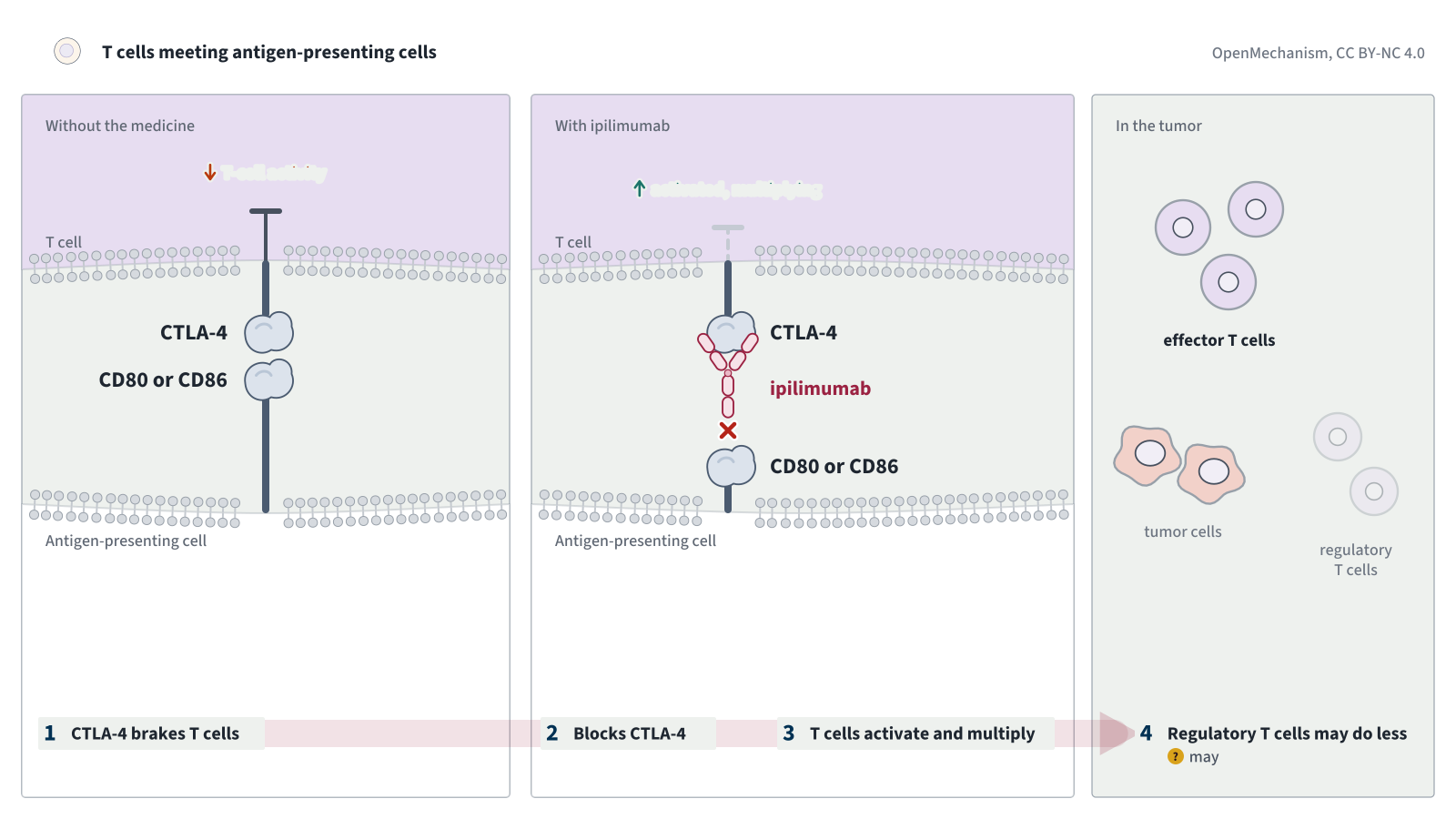
Step 4: may
The Yervoy label says: Inhibition of CTLA-4 signaling can also reduce T-regulatory cell function, which may contribute to a general increase in T-cell responsiveness, including the anti-tumor immune response.
Source 1: Yervoy (ipilimumab): FDA label, 11 Description; 12.1 Mechanism of Action
Clinical study: In a randomized trial in 676 patients with previously treated metastatic melanoma; the trial measured survival, not how it works: The median overall survival was 10.0 months among patients receiving ipilimumab plus gp100, as compared with 6.4 months among patients receiving gp100 alone
Hodi FS et al., N Engl J Med 2010 (PMID 20525992)
This study was picked with a literature search and is not yet checked by our reviewer.
Key terms in this drawing
- CD80/CD86
- CD80 and CD86 proteins. Proteins on antigen-presenting cells that bind CD28 on T cells.
- T cell
- T lymphocyte. A white blood cell of the immune system.
How it works
CTLA-4 brakes T cells. CTLA-4 is a negative regulator of T cells: it holds back their activity.1
Blocks CTLA-4. Ipilimumab, an antibody, binds CTLA-4 and stops it binding its partners CD80 and CD86, which sit on antigen-presenting cells.1,2
T cells activate and multiply. Blocking CTLA-4 increases T-cell activation and multiplication, including that of the effector T cells inside the tumor.1
Regulatory T cells may do less. Blocking CTLA-4 signaling can also lower the function of regulatory T cells, which may add to a general increase in T-cell responsiveness, including against the tumor.1
For teachers: download this drawing.
See also
Condition pages: colorectal cancer, kidney cancer, melanoma and non-small cell lung cancer.
Other immune checkpoint inhibitors: pembrolizumab.
Explained: why checkpoint inhibitors can inflame healthy organs.
Related drawings: pembrolizumab (releases another brake on T cells, PD-1).
Body system: cancer.
Sources
- 1Yervoy (ipilimumab): FDA label11 Description; 12.1 Mechanism of Action
- 2Nulojix (belatacept): FDA label12.1 Mechanism of Action
- 3ChEMBL CHEMBL1789844Target and action classification: Cytotoxic T-lymphocyte protein 4 inhibitor
- 4Improved survival with ipilimumab in patients with metastatic melanomaHodi FS et al. N Engl J Med 2010 (abstract)
Spotted a mistake? Report an error (hello@openmechanism.com). Since launch, every published error we fix is listed on the corrections page.
Notes and limits
- A schematic teaching drawing: not to scale, not exact structures, binding poses or a complete pathway, and not a guide to dosing, treatment or how a person will respond.
- The label says this may contribute (12.1).
All recorded limits are on the evidence page, and notes that apply to every page are on How to read a page. Version 1.0.0, not yet medically reviewed.
Cite this page
Tran D. Ipilimumab [Internet]. OpenMechanism; 2026 [updated 2026 Oct 18; cited 2026 Oct 18]. Available from: https://openmechanism.com/medicines/ipilimumab