Doxorubicin
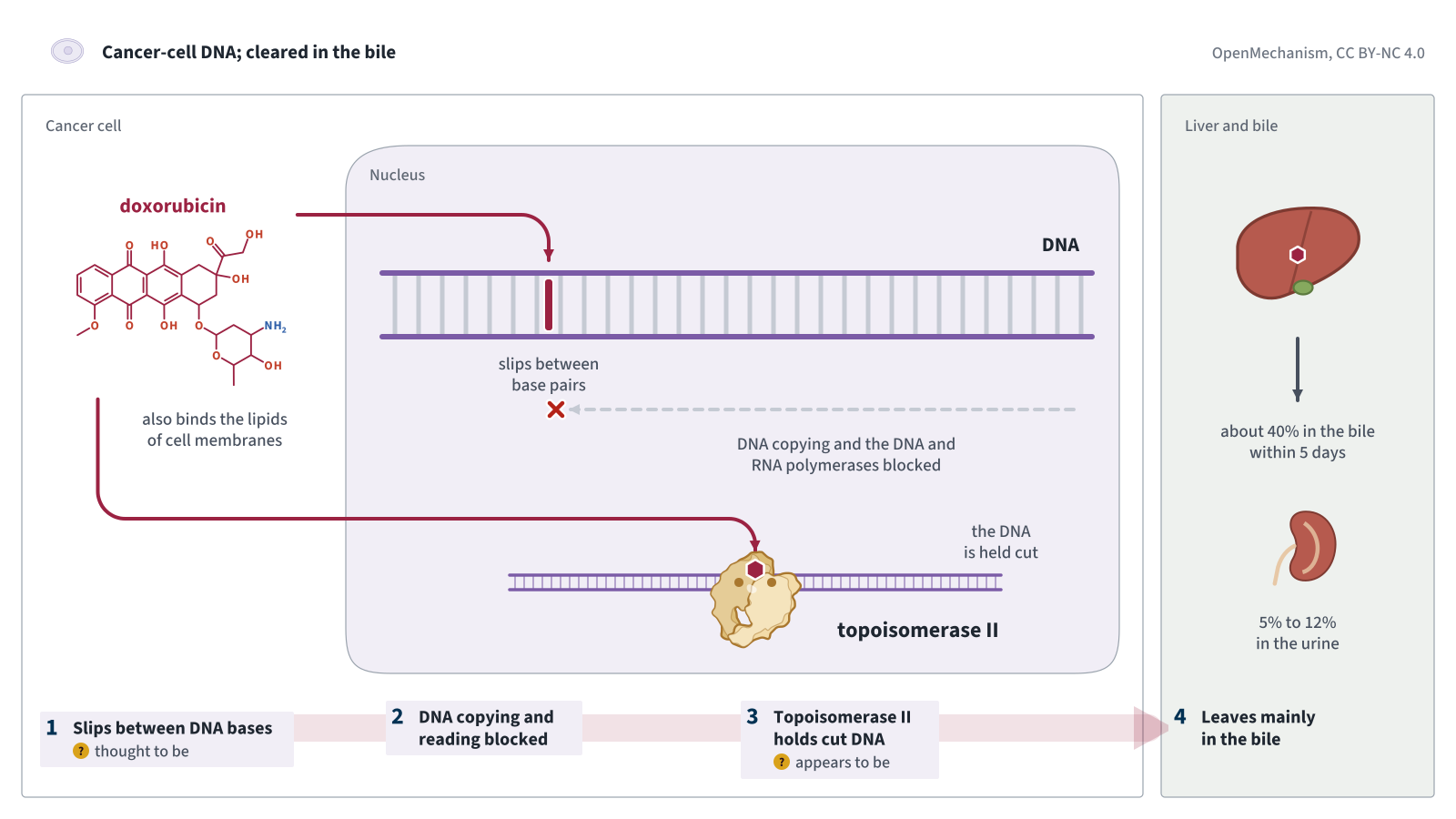
Doxorubicin is an anthracycline. Its effect on cancer cells, and its toxic effects on organs, are thought to come from slipping between the bases of and binding the lipids of cell membranes. Slipped into DNA, it blocks DNA copying and the DNA and polymerases. With the enzyme topoisomerase II it forms complexes in which the DNA is cut, which appears to be an important way it kills cells. It is cleared mainly in the bile; little reaches the urine, and it does not cross the blood-brain barrier.
- Acts on
- DNA (it slips between the bases) and topoisomerase II
- Where
- Cancer cells; cleared mainly in the bile
- Medicine type
- Small molecule
- Used for
- Cancer
- Drug class
- Topoisomerase inhibitors, Anthracyclines
Step 1: thought to be
The doxorubicin label says: The cytotoxic effect of doxorubicin hydrochloride on malignant cells and its toxic effects on various organs are thought to be related to nucleotide base intercalation and cell membrane lipid binding activities of doxorubicin.
Clinical study: In individual-patient-data meta-analyses of randomised trials of chemotherapy after surgery for early breast cancer, comparing regimens with and without anthracyclines such as doxorubicin (the A in 4AC and CAF); the trials measured breast cancer mortality, not how doxorubicin works: Trials with CMF-treated controls showed that standard 4AC and standard CMF were equivalent (RR 0·98, SE 0·05, 2p=0·67), but that anthracycline-based regimens with substantially higher cumulative dosage than standard 4AC (eg, CAF or CEF) were superior to standard CMF (RR 0·78, SE 0·06, 2p=0·0004).
Early Breast Cancer Trialists' Collaborative Group (EBCTCG) et al., Lancet 2012 (PMID 22152853)
This study was picked with a literature search and is not yet checked by our reviewer.
Step 3: appears to be
The doxorubicin label says: The interaction of doxorubicin with topoisomerase II to form DNA-cleavable complexes appears to be an important mechanism of doxorubicin hydrochloride cytocidal activity.
Clinical study: In a study of tumors from nearly 5,000 women with breast cancer treated in clinical trials, testing whether extra copies of the gene for topoisomerase II alpha (TOP2A) go with a better response to anthracyclines such as doxorubicin; it tested a link between the enzyme's gene and the response, not how doxorubicin acts on the enzyme: In a study involving nearly 5,000 breast malignancies, both test set and validation set demonstrate that TOP2A coamplification, not HER2 amplification, is the clinically useful predictive marker of an incremental response to anthracycline-based chemotherapy.
Press MF et al., J Clin Oncol 2011 (PMID 21189395)
This study was picked with a literature search and is not yet checked by our reviewer.
Key terms in this drawing
- DNA
- Deoxyribonucleic acid. The molecule that stores genes.
- RNA
- Ribonucleic acid. A molecule copied from DNA; messenger RNA carries a gene's instructions.
How it works
Slips between DNA bases. Doxorubicin is an anthracycline. Its effect on cancer cells, and its toxic effects on organs, are thought to come from its slipping between the bases of DNA (intercalation) and from its binding to the lipids of cell membranes.1
DNA copying and reading blocked. Intercalation inhibits the copying of DNA (replication) and the action of DNA and RNA polymerases.1
Topoisomerase II holds cut DNA. With topoisomerase II, doxorubicin forms complexes in which the DNA is cut (DNA-cleavable complexes); this appears to be an important way it kills cells.1
Leaves mainly in the bile. Doxorubicin is cleared mainly by metabolism and in the bile: about 40% of a dose appears in the bile within 5 days, and only 5% to 12% in the urine. It does not cross the blood-brain barrier.1
For teachers: download this drawing.
See also
Condition pages: acute lymphoblastic leukemia, acute myeloid leukemia, B-cell lymphomas, bladder cancer, breast cancer, Hodgkin lymphoma, Kaposi sarcoma, neuroblastoma, osteosarcoma, ovarian cancer and stomach cancer.
Other topoisomerase inhibitors: etoposide, irinotecan and trastuzumab deruxtecan.
Explained: why doxorubicin can damage the heart.
Related drawings: etoposide (also breaks DNA through topoisomerase II).
Body system: cancer.
Sources
- 1Doxorubicin hydrochloride injection (Pfizer): FDA label11 Description; 12.1 Mechanism of Action; 12.3 Pharmacokinetics
- 2ChEMBL CHEMBL53463Target and action classification: DNA inhibitor; DNA topoisomerase II alpha inhibitor
- 3Comparisons between different polychemotherapy regimens for early breast cancer: meta-analyses of long-term outcome among 100,000 women in 123 randomised trialsEarly Breast Cancer Trialists' Collaborative Group (EBCTCG) et al. Lancet 2012 (abstract)
- 4Alteration of topoisomerase II-alpha gene in human breast cancer: association with responsiveness to anthracycline-based chemotherapyPress MF et al. J Clin Oncol 2011 (abstract)
Also used for the drawing
The topoisomerase II outline is traced from the crystal structure below.
- 5Human topoisomerase II alpha with DNA and etoposidePDB 5GWK; Wang, Y.R. et al. Nucleic Acids Res. 2017; 45:10861-10871
Spotted a mistake? Report an error (hello@openmechanism.com). Since launch, every published error we fix is listed on the corrections page.
Notes and limits
- A schematic teaching drawing: not to scale, not exact structures, binding poses or a complete pathway, and not a guide to dosing, treatment or how a person will respond.
- The label says the cytotoxic effect on malignant cells and the toxic effects on various organs are thought to be related to nucleotide base intercalation and cell membrane lipid binding.
- The label says the interaction of doxorubicin with topoisomerase II to form DNA-cleavable complexes appears to be an important mechanism of its cell-killing (cytocidal) activity.
All recorded limits are on the evidence page, and notes that apply to every page are on How to read a page. Version 1.0.1, not yet medically reviewed.
Cite this page
Tran D. Doxorubicin [Internet]. OpenMechanism; 2026 [updated 2026 Nov 13; cited 2026 Nov 13]. Available from: https://openmechanism.com/medicines/doxorubicin