Kaposi sarcoma
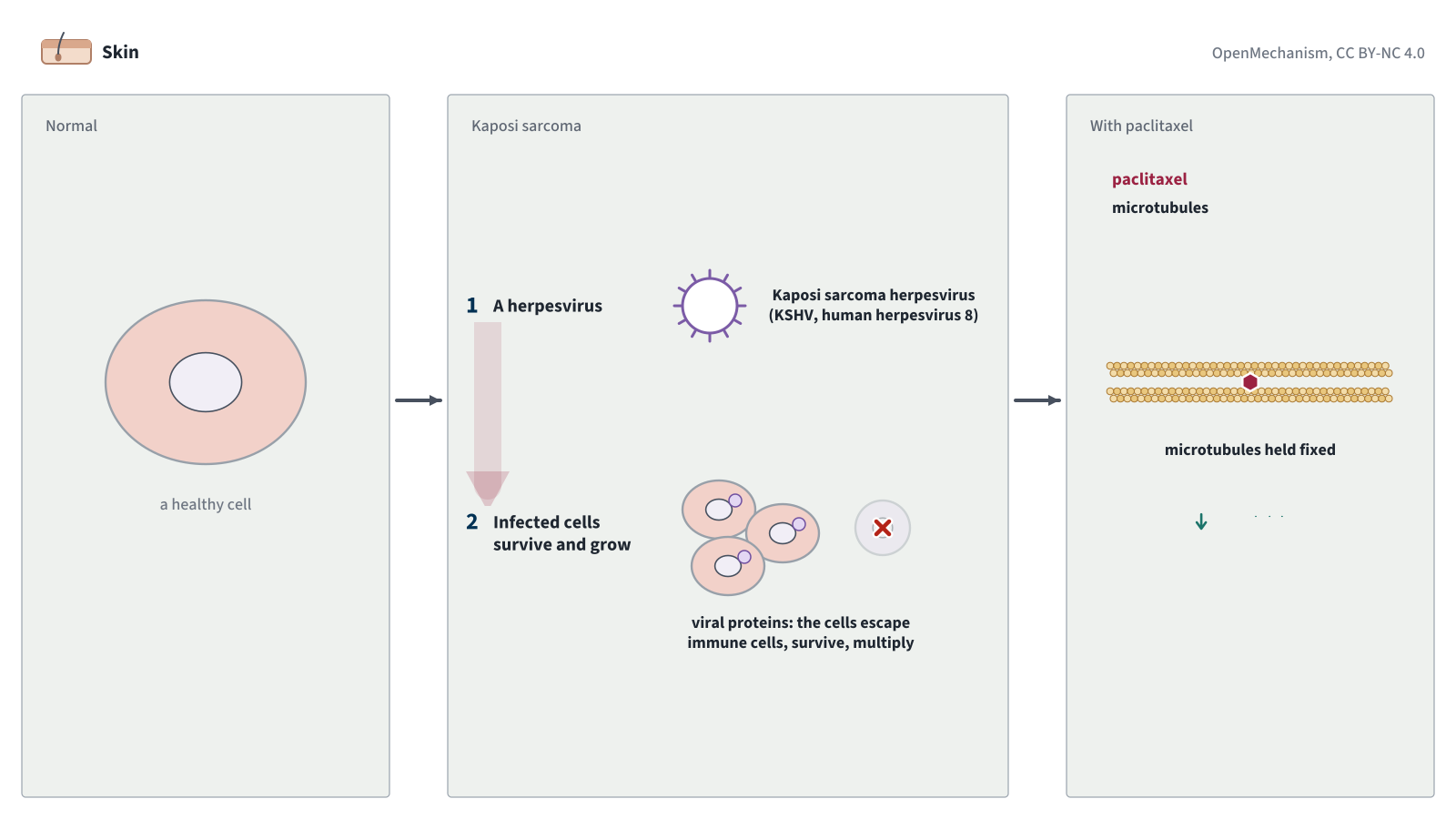
Kaposi sarcoma is caused by Kaposi sarcoma herpesvirus (KSHV, also called human herpesvirus 8): its proteins change infected cells so the virus escapes the immune system and the cells survive and multiply. Known as an cancer, it also occurs without : in older men, in transplant recipients and in sub-Saharan Africa, where most cases now are. Paclitaxel stabilizes microtubules.
- Where
- Skin
- Body systems
- Cancer; Skin, hair & nails
- Medicines
- 1 medicine
For teachers: download this drawing.
Key terms in this drawing
- KSHV
- Kaposi sarcoma herpesvirus (human herpesvirus 8). The virus that causes Kaposi sarcoma; also called human herpesvirus 8.
- microtubule
- Microtubule. A structure inside the cell, built from the protein tubulin, that the cell needs for dividing and for other vital work.
What goes wrong
A herpesvirus. Kaposi sarcoma is caused by a herpesvirus: Kaposi sarcoma herpesvirus (), also called human herpesvirus 8.1
What the source says
“The aetiologic agent of KS is KS herpesvirus (KSHV; also known as human herpesvirus-8)”
Source 1Infected cells survive and grow. Viral proteins change the infected cells so the virus escapes the immune system and the cells survive and multiply.1
What the source says
“viral proteins can induce KS-associated cellular changes that enable the virus to evade the host immune system and allow the infected cell to survive and proliferate despite viral infection.”
Source 1
Where medicines act
- A
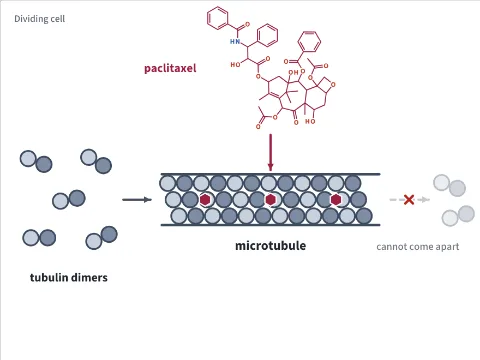
Paclitaxel: microtubules frozen
Paclitaxel builds and stabilizes so the cell cannot reorganize them, which it needs to divide. Its label lists it for the second-line treatment of AIDS-related Kaposi sarcoma. A 2019 review says chemotherapy with paclitaxel or pegylated liposomal doxorubicin is the most common treatment for advanced , though it seldom cures it.1,2
What the source says
“Paclitaxel is a novel antimicrotubule agent that promotes the assembly of microtubules from tubulin dimers and stabilizes microtubules by preventing depolymerization.”
Source 2“This stability results in the inhibition of the normal dynamic reorganization of the microtubule network that is essential for vital interphase and mitotic cellular functions.”
Source 2“Paclitaxel Injection USP is indicated for the second-line treatment of AIDS-related Kaposi’s sarcoma.”
Source 2“In advanced-stage KS, chemotherapy with pegylated liposomal doxorubicin or paclitaxel is the most common treatment, although it is seldom curative.”
Source 1
See also
Body systems: cancer; and skin, hair & nails.
Also used for it: doxorubicin (for advanced Kaposi sarcoma, in its pegylated liposomal form: “In advanced-stage KS, chemotherapy with pegylated liposomal doxorubicin or paclitaxel is the most common treatment, although it is seldom curative.”1).
Other conditions: breast cancer, ovarian cancer, acute lymphoblastic leukemia, acute myeloid leukemia, B-cell lymphomas and bladder cancer.
Sources
- 1Kaposi sarcomaCesarman E et al. Nat Rev Dis Primers 2019 (abstract). Saved copy
- 2Paclitaxel injection: FDA labelIndications and Usage; Clinical Pharmacology. Saved copy
Notes and limits
- Kaposi sarcoma became known as an AIDS-defining cancer, but it also occurs without HIV: in older men, in sub-Saharan Africa and in transplant recipients. Most cases now occur in sub-Saharan Africa.1
- Controlling HIV with antiretroviral medicines often makes early AIDS-related KS shrink.1
- KS still occurs in people whose HIV is well controlled, and in sub-Saharan Africa the outlook remains poor; newer treatments are being explored.1
Notes that apply to every page are on How to read a page.
Spotted a mistake? Report an error (hello@openmechanism.com). Since launch, every published error we fix is listed on the corrections page.
Cite this page
Tran D. Kaposi sarcoma [Internet]. OpenMechanism; 2026 [updated 2026 Nov 18; cited 2026 Nov 18]. Available from: https://openmechanism.com/conditions/kaposi-sarcoma