Kidney cancer
Renal cell carcinoma, cancer of the kidney's lining cells, makes up more than 90% of kidney cancers; its clear cell type is the most common and causes most deaths. Mutations in VHL are known in it; without working VHL protein, HIF-2α builds up and switches on growth and blood-vessel genes. Belzutifan blocks HIF-2α; pembrolizumab releases a brake on T cells.
- Where
- Kidney
- Medicines
- 2 medicines
For teachers: download this drawing.
Key terms in this drawing (6)
- DNA
- Deoxyribonucleic acid. The molecule that stores genes.
- HIF-1β
- Hypoxia-inducible factor 1-beta. The partner protein HIF-2α pairs with to switch on genes.
- HIF-2α
- Hypoxia-inducible factor 2-alpha. A protein that switches on genes when oxygen is low.
- PD-1
- Programmed cell death protein 1. A receptor on T cells that acts as a brake when PD-L1 or PD-L2 binds it.
- T cell
- T lymphocyte. A white blood cell of the immune system.
- VHL
- Von Hippel-Lindau protein. A protein that normally marks HIF-2α for breakdown when oxygen is normal.
What goes wrong
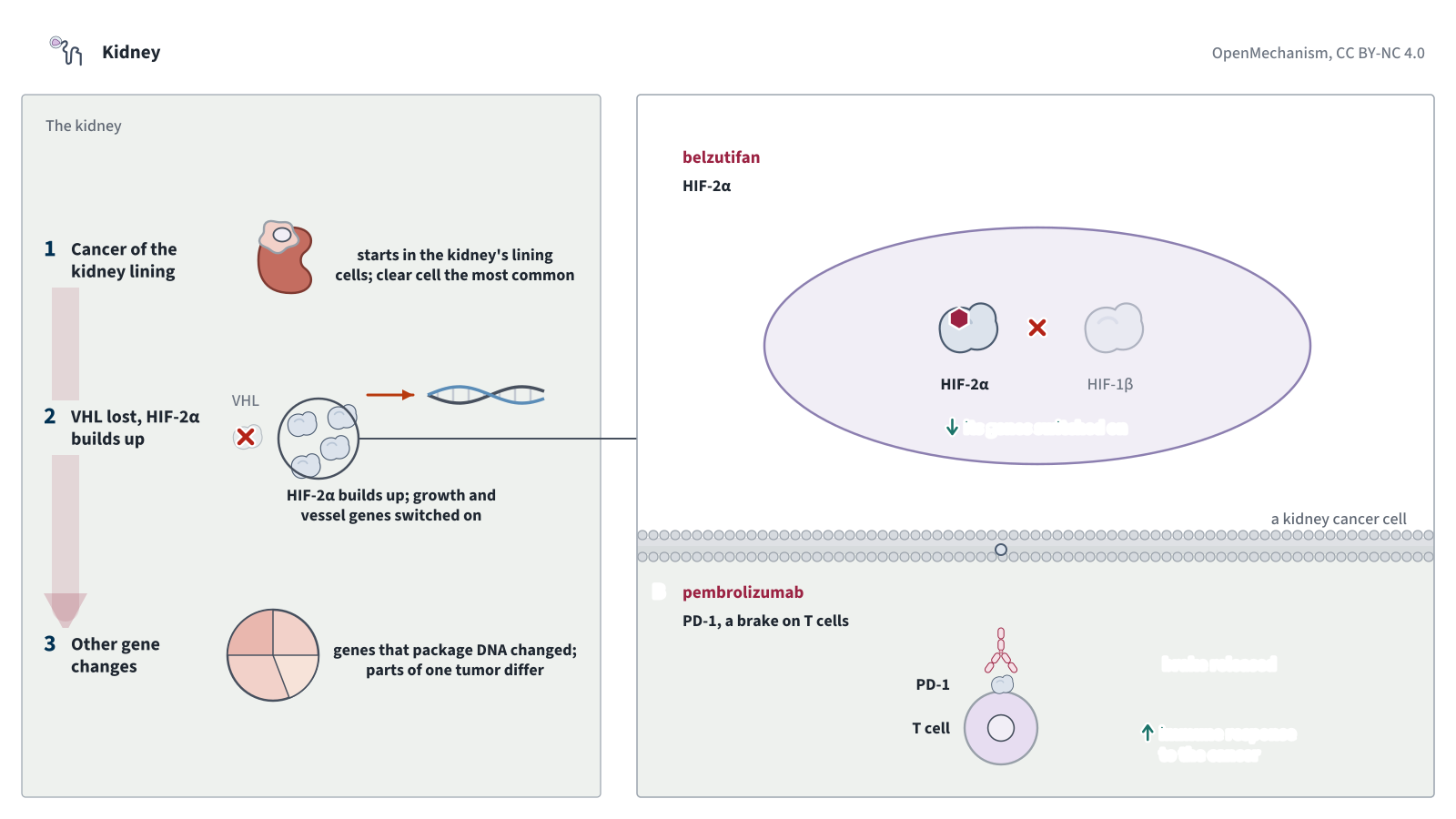
Cancer of the kidney lining. Renal cell carcinoma (RCC) starts in the kidney's lining cells and makes up more than 90% of kidney cancers. Of its more than 10 types, clear cell RCC is the most common and causes most deaths.1
What the source says
“Renal cell carcinoma (RCC) denotes cancer originated from the renal epithelium and accounts for >90% of cancers in the kidney.”
Source 1“The disease encompasses >10 histological and molecular subtypes, of which clear cell RCC (ccRCC) is most common and accounts for most cancer-related deaths.”
Source 1VHL lost, HIF-2α builds up. Mutations in the gene are known in RCC. VHL protein normally clears the signal ; without it, HIF-2α builds up and switches on genes for cell growth, new blood vessels and tumor growth.1,2
What the source says
“Although somatic VHL mutations have been described for some time”
Source 1“Under normal oxygen levels, HIF-2α is targeted for ubiquitin-proteasomal degradation by VHL protein.”
Source 2“Lack of functional VHL protein results in stabilization and accumulation of HIF-2α.”
Source 2“Upon stabilization, HIF-2α translocates into the nucleus and interacts with hypoxia-inducible factor 1 beta (HIF-1β) to form a transcriptional complex that induces expression of downstream genes, including genes associated with cellular proliferation, angiogenesis, and tumor growth.”
Source 2Other gene changes. Gene studies also found mutations in genes that control how is packaged and read (epigenetic regulators), and marked differences between parts of the same tumor.1
What the source says
“more-recent cancer genomic studies have identified mutations in epigenetic regulatory genes and demonstrated marked intra-tumour heterogeneity”
Source 1
Where medicines act
- A
Belzutifan: HIF-2α blocked
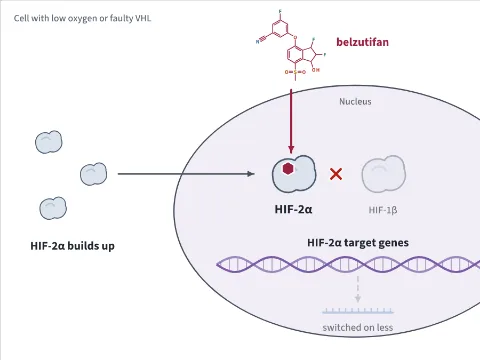
Belzutifan stops HIF-2α pairing with , so its target genes are switched down. It treats advanced clear cell RCC after a or blocker: together with lenvatinib, or on its own once a kinase blocker has also been used. With pembrolizumab, it is given after surgery when the risk of return is high.2
What the source says
“Belzutifan is an inhibitor of hypoxia-inducible factor 2 alpha (HIF-2α).”
Source 2“belzutifan blocks the HIF-2α-HIF-1β interaction, leading to reduced transcription and expression of HIF-2α target genes.”
Source 2“WELIREG, in combination with lenvatinib, is indicated for the treatment of adult patients with advanced ccRCC following a programmed death receptor-1 (PD-1) or programmed death-ligand 1 (PD-L1) inhibitor.”
Source 2“WELIREG, as monotherapy, is indicated for the treatment of adult patients with advanced ccRCC following a PD-1 or PD-L1 inhibitor and a vascular endothelial growth factor tyrosine kinase inhibitor (VEGF-TKI).”
Source 2“WELIREG, in combination with pembrolizumab or pembrolizumab and berahyaluronidase alfa-pmph, is indicated for the adjuvant treatment of adult patients with renal cell carcinoma with a clear cell component (ccRCC) at intermediate-high or high risk of recurrence following nephrectomy, or following nephrectomy and resection of metastatic lesions.”
Source 2 - B
Pembrolizumab: the PD-1 brake released
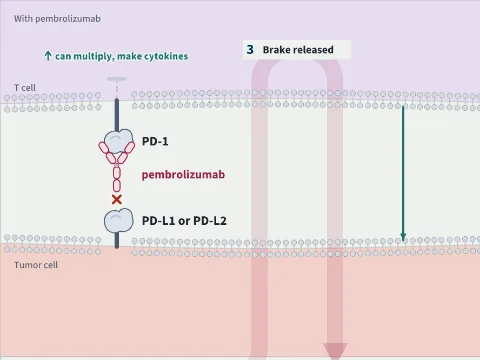
Pembrolizumab blocks PD-1, a brake on , and so releases the immune response against the cancer. With axitinib or lenvatinib it is a first treatment for advanced RCC, and it is given after surgery when the risk of return is high.3
What the source says
“Binding of the PD-1 ligands, PD-L1 and PD-L2, to the PD-1 receptor found on T cells, inhibits T cell proliferation and cytokine production.”
Source 3“Pembrolizumab is a monoclonal antibody that binds to the PD-1 receptor and blocks its interaction with PD-L1 and PD-L2, releasing PD-1 pathway-mediated inhibition of the immune response, including the anti-tumor immune response.”
Source 3“in combination with axitinib, for the first-line treatment of adult patients with advanced RCC.”
Source 3“KEYTRUDA, in combination with lenvatinib, is indicated for the first-line treatment of adult patients with advanced RCC.”
Source 3“KEYTRUDA is indicated for the adjuvant treatment of patients with RCC at intermediate-high or high risk of recurrence following nephrectomy, or following nephrectomy and resection of metastatic lesions”
Source 3
See also
Body systems: cancer and kidney.
Also used for it: bevacizumab (for metastatic renal cell carcinoma, with interferon alfa: “Metastatic renal cell carcinoma in combination with interferon alfa.”4); and ipilimumab (for intermediate- or poor-risk advanced renal cell carcinoma, with nivolumab: “Treatment of adult patients with intermediate or poor risk advanced renal cell carcinoma, as first-line treatment in combination with nivolumab.”5).
Other conditions: colorectal cancer, non-small cell lung cancer, cervical cancer, melanoma, ovarian cancer and von Hippel-Lindau disease.
Side effects: why checkpoint inhibitors can inflame healthy organs.
Sources
- 1Renal cell carcinomaHsieh JJ et al. Nat Rev Dis Primers 2017 (abstract). Saved copy
- 2Welireg (belzutifan): FDA label1.2 Renal Cell Carcinoma with a Clear Cell Component; 12.1 Mechanism of Action. Saved copy
- 3Keytruda (pembrolizumab): FDA label1 Indications and Usage; 12.1 Mechanism of Action. Saved copy
- 4Avastin (bevacizumab): FDA label1 Indications and Usage. Saved copy
- 5Yervoy (ipilimumab): FDA label1 Indications and Usage. Saved copy
Notes and limits
- Cancer that has not spread can be treated with surgery, but spread cancer resists standard chemotherapy. Medicines that block VEGF or its receptor, or mTORC1, and immune treatments are used instead.1
- The differences within one tumor may matter for outlook and treatment, and most of what is known is about clear cell RCC.1
Notes that apply to every page are on How to read a page.
Spotted a mistake? Report an error (hello@openmechanism.com). Since launch, every published error we fix is listed on the corrections page.
Cite this page
Tran D. Kidney cancer [Internet]. OpenMechanism; 2026 [updated 2026 Oct 21; cited 2026 Oct 21]. Available from: https://openmechanism.com/conditions/kidney-cancer