Bladder bleeding from chemotherapy (hemorrhagic cystitis)
Ifosfamide and cyclophosphamide, cancer medicines, are activated in the liver. Acrolein, formed in the urine from their breakdown products, enters the cells lining the bladder and damages them, so the bladder can bleed. Mesna reaches the urine and binds acrolein and the other harmful metabolites; it reduces how often ifosfamide causes this hemorrhagic cystitis.
- Where
- Liver, urine and the bladder lining
- Body systems
- Cancer, Bladder & reproductive organs
- Medicines
- 1 medicine
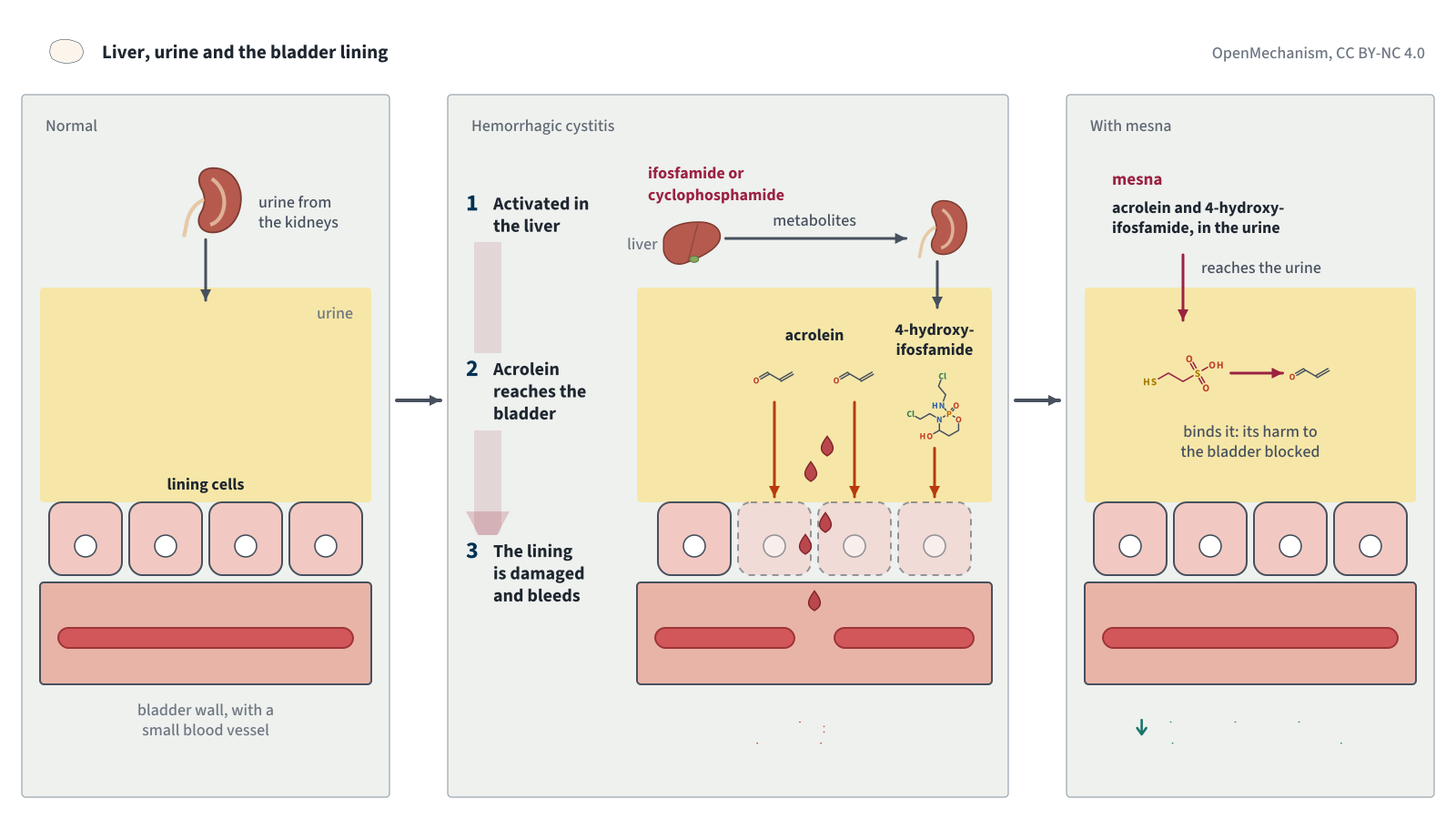
For teachers: download this drawing.
What goes wrong
Activated in the liver. Ifosfamide and cyclophosphamide are widely used cancer medicines. Ifosfamide is a prodrug: liver enzymes (cytochrome P450) activate it, and its unstable product breaks down into acrolein, toxic to cells and to the bladder, and an alkylating mustard. Both medicines are thought to act on cancer cells mainly by cross-linking their .1,2,3
What the source says
“Cyclophosphamide (CP) and ifosfamide (IF) are widely used antineoplastic agents, but their side-effect of hemorrhagic cystitis (HC) is still encountered as an important problem.”
Source 1“Ifosfamide is a prodrug that requires metabolic activation by hepatic cytochrome P450 isoenzymes to exert its cytotoxic activity.”
Source 2“Activation occurs by hydroxylation at the ring carbon atom forming the unstable intermediate 4-hydroxyifosfamide and its ring-opened aldo tautomer, which decomposes to yield the cytotoxic and urotoxic compound acrolein and an alkylating isophosphoramide mustard as well as multiple other nontoxic products.”
Source 2“The exact mechanism of action of ifosfamide has not been determined, but its cytotoxic action is primarily through DNA crosslinks caused by alkylation by the isophosphoramide mustard at guanine N-7 positions.”
Source 2“The mechanism of action is thought to involve cross-linking of tumor cell DNA.”
Source 3Acrolein reaches the bladder. The kidneys pass the medicines' metabolites into the urine, where acrolein forms. Acrolein is the main cause of the bladder damage: it quickly enters the cells lining the bladder. 4-hydroxy-ifosfamide, another metabolite, also harms the bladder.1,4,5
What the source says
“The urotoxicity of oxazaphosphorine cytostatics is not based on their alkylating activity but on the presence of acrolein, which is spontaneously formed in the urine from the primary metabolites eliminated via the kidneys.”
Source 4“Acrolein is the main molecule responsible of this side-effect and mesna (2-mercaptoethane sulfonate) is the commonly used preventive agent.”
Source 1“(1) acrolein rapidly enters into the uroepithelial cells; (2) it then activates intracellular reactive oxygen species and nitric oxide production (directly or through NF-kappaB and AP-1) leading to peroxynitrite production; (3) finally, the increased peroxynitrite level damages lipids (lipid peroxidation), proteins (protein oxidation) and DNA (strand breaks) leading to activation of PARP, a DNA repair enzyme.”
Source 1“Mesna reacts chemically with the urotoxic ifosfamide metabolites, acrolein and 4-hydroxy-ifosfamide, resulting in their detoxification.”
Source 5The lining is damaged and bleeds. Inside the cells acrolein sets off reactive oxygen and nitrogen species that damage fats, proteins and DNA, and the cells die; the process is inflammatory. The bladder can bleed, at times enough to need a blood transfusion. With ifosfamide it is very common, and the risk rises with dose and with single high doses.1,2
What the source says
“(2) it then activates intracellular reactive oxygen species and nitric oxide production (directly or through NF-kappaB and AP-1) leading to peroxynitrite production; (3) finally, the increased peroxynitrite level damages lipids (lipid peroxidation), proteins (protein oxidation) and DNA (strand breaks) leading to activation of PARP, a DNA repair enzyme.”
Source 1“DNA damage causes PARP overactivation, resulting in the depletion of oxidized nicotinamide-adenine dinucleotide and adenosine triphosphate, and consequently in necrotic cell death.”
Source 1“There is no doubt that HC is an inflammatory process, including when caused by CP.”
Source 1“Urotoxic side effects, especially hemorrhagic cystitis, have been very commonly associated with the use of Ifosfamide for Injection.”
Source 2“Hemorrhagic cystitis requiring blood transfusion has been reported with ifosfamide.”
Source 2“The risk of hemorrhagic cystitis is dose-dependent and increased with administration of single high doses compared to fractionated administration.”
Source 2
Where medicines act
In the urine
- A
Mesna targets Acrolein and 4-hydroxy-ifosfamide
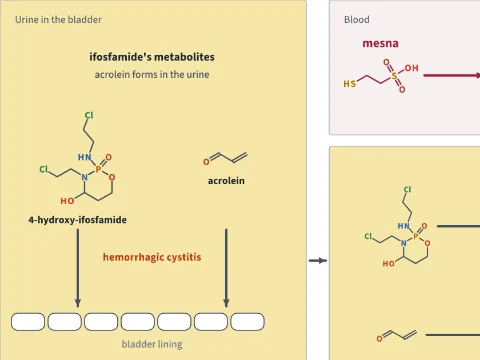
Reaches the urine and binds acrolein and 4-hydroxy-ifosfamide there, so they harm the bladder less.2,5,6,7
Used forPreventing hemorrhagic cystitis from ifosfamide: given with ifosfamide
What the label says
“MESNEX is indicated as a prophylactic agent in reducing the incidence of ifosfamide-induced hemorrhagic cystitis.”
Source 5“It should be used in combination with mesna for prophylaxis of hemorrhagic cystitis.”
Source 2“MESNEX is not indicated to reduce the risk of hematuria due to other pathological conditions such as thrombocytopenia.”
Source 5“In the body, mesna is rapidly transformed into its biologically inert disulfide.”
Source 6“Analogous to the physiological cysteine-cystine system, mesna is rapidly oxidized to its major metabolite, mesna disulfide (dimesna).”
Source 5“After glomerular filtration mesna disulfide is rapidly reduced by reacting with the glutathion system and elimination in the urine as a free thiol compound, further detoxifying the aggressive oxazaphosphorine metabolites.”
Source 6“The first step in the detoxification process is the binding of mesna to 4-hydroxy-ifosfamide forming a non-urotoxic 4-sulfoethylthioifosfamide.”
Source 5“Mesna also binds to the double bonds of acrolein and to other urotoxic metabolites and inhibits their effects on the bladder.”
Source 5“A randomized study in 20 patients with cancer was carried out to test the clinical efficacy of sodium-2-mercaptoethane sulfonate (ASTA D-7093; mesnum) as an agent to prevent urotoxic side effects (in particular, hemorrhagic cystitis) during cytostatic therapy with the oxazaphosphorines cyclophosphamide and ifosfamide.”
Source 7“The frequency of microhematuria was significantly lower in the patients receiving mesnum.”
Source 7
See also
Body systems: cancer and bladder & reproductive organs.
Can raise or cause it: cyclophosphamide (“Hemorrhagic cystitis, pyelitis, ureteritis, and hematuria have been reported with cyclophosphamide.”8).
Other conditions: testicular cancer; bladder cancer; urinary tract infections; chemotherapy nausea and vomiting; anemia from cancer treatment; and ovarian cancer.
Side effects: why cyclophosphamide can make the bladder bleed.
Sources
- 1Pathophysiological aspects of cyclophosphamide and ifosfamide induced hemorrhagic cystitisKorkmaz A et al. Cell Biol Toxicol 2007 (abstract). Saved copy
- 2Ifosfamide for injection (Fresenius Kabi): FDA labelBoxed Warning; 1 Indications and Usage; 5.3 Renal and Urothelial Toxicity and Effects; 12.1 Mechanism of Action. Saved copy
- 3Cyclophosphamide: FDA label12.1 Mechanism of Action. Saved copy
- 4Acrolein, the causative factor of urotoxic side-effects of cyclophosphamide, ifosfamide, trofosfamide and sufosfamideBrock N et al. Arzneimittelforschung 1979 (abstract). Saved copy
- 5Mesnex (mesna): FDA label1 Indications and Usage; 12.1 Mechanism of Action; 12.3 Pharmacokinetics. Saved copy
- 6Detoxification of urotoxic oxazaphosphorines by sulfhydryl compoundsBrock N et al. J Cancer Res Clin Oncol 1981 (abstract). Saved copy
- 7Controlled clinical studies with an antidote against the urotoxicity of oxazaphosphorines: preliminary resultsScheef W et al. Cancer Treat Rep 1979 (abstract). Saved copy
- 8Cyclophosphamide: FDA label5.2 Urinary Tract and Renal Toxicity. Saved copy
- 9Chemical- and radiation-induced haemorrhagic cystitis: current treatments and challengesPayne H et al. BJU Int 2013 (abstract). Saved copy
- 10Hemorrhagic cystitis: a challenge to the urologistManikandan R et al. Indian J Urol 2010 (abstract). Saved copy
Notes and limits
- Mesna is one part of prevention: the labels also describe plenty of fluids and frequent emptying of the bladder, and a review found that mesna, extra fluids and bladder washing do not always work.2,8,9
- The damage can be severe: cyclophosphamide's label lists ulcers, dead tissue, scarring, a shrunken bladder and later cancer, some needing the bladder removed, and says the damage can be fatal.8
- Radiation to the bladder, now or before, and busulfan may add to the risk. Bladder bleeding has other causes too: radiation for pelvic cancers and, in people with weak immune systems, infections.2,10
- The mesna study was small, 20 people; all nine on the usual prevention alone had blood in the urine.7
Notes that apply to every page are on How to read a page.
Spotted a mistake? Report an error (hello@openmechanism.com). Since launch, every published error we fix is listed on the corrections page.
Cite this page
Tran D. Bladder bleeding from chemotherapy (hemorrhagic cystitis) [Internet]. OpenMechanism; 2026 [updated 2026 Nov 18; cited 2026 Nov 18]. Available from: https://openmechanism.com/conditions/hemorrhagic-cystitis