Pheochromocytoma and paraganglioma
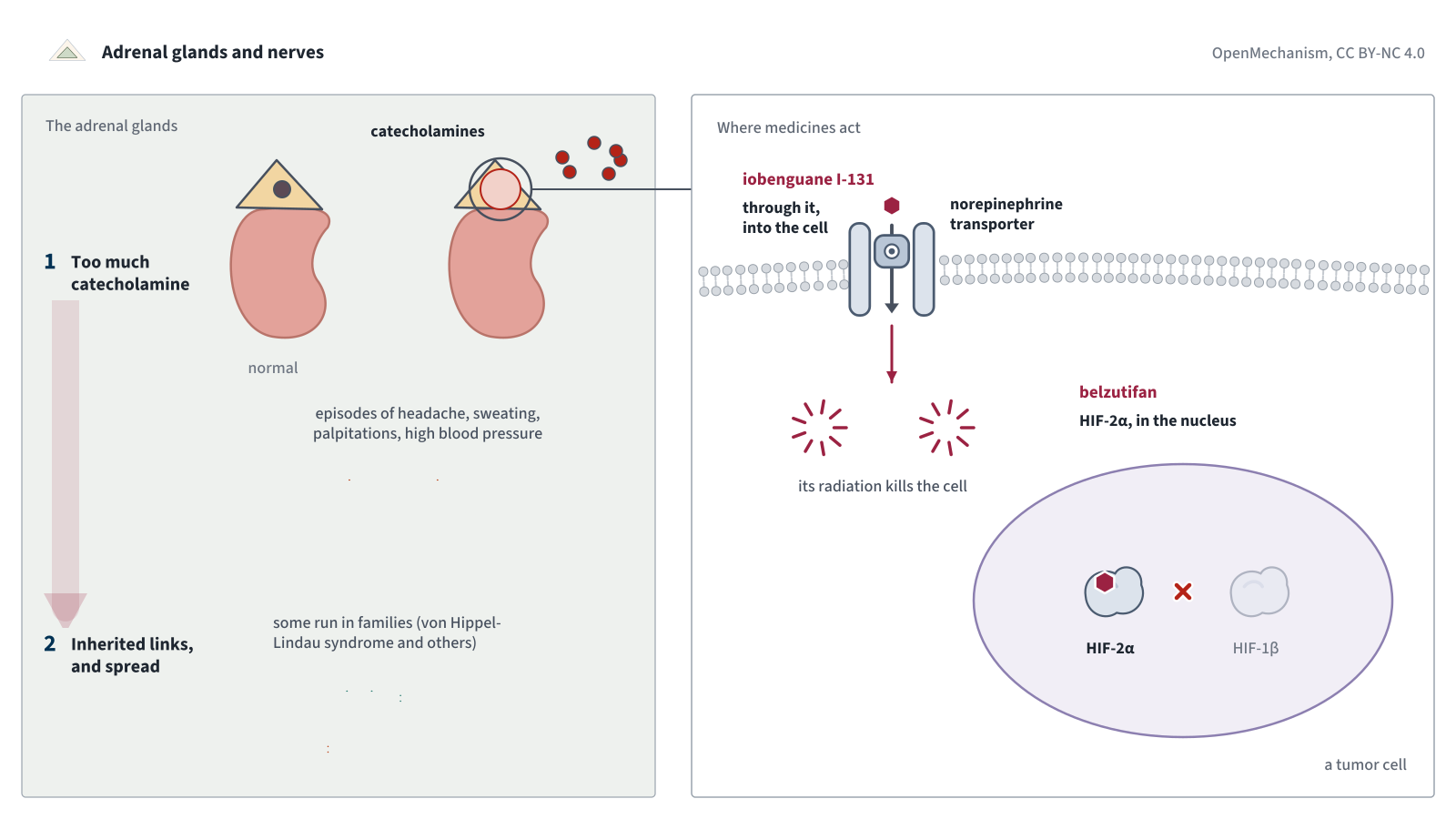
Pheochromocytomas are rare neuroendocrine tumors that most often cause episodes of headache, sweating, palpitations and high blood pressure; their serious, sometimes deadly, heart and vessel effects come from the catecholamines they release. Removed in time, the outlook is excellent; once spread, it is poor. Iobenguane I-131 is taken up like norepinephrine and irradiates the tumor from inside; belzutifan blocks HIF-2α.
- Where
- Adrenal glands and nerves
- Body systems
- Hormones & metabolism; Heart, vessels & cholesterol; Cancer
- Medicines
- 2 medicines
For teachers: download this drawing.
Key terms in this drawing
- HIF-1β
- Hypoxia-inducible factor 1-beta. The partner protein HIF-2α pairs with to switch on genes.
- HIF-2α
- Hypoxia-inducible factor 2-alpha. A protein that switches on genes when oxygen is low.
- I-131
- Iodine-131. A radioactive form of iodine that gives off radiation as it decays.
What goes wrong
Too much catecholamine. They most often cause episodes of headache, sweating, palpitations and high blood pressure; their serious, sometimes deadly, effects on the heart and blood vessels come from the catecholamines they release.1
What the source says
“Phaeochromocytomas are rare neuroendocrine tumours with a highly variable clinical presentation but most commonly presenting with episodes of headaches, sweating, palpitations, and hypertension.”
Source 1“The serious and potentially lethal cardiovascular complications of these tumours are due to the potent effects of secreted catecholamines.”
Source 1Inherited links, and spread. Some run in families, for example with von Hippel-Lindau syndrome. Removed in time, the outlook is excellent; once spread, it is poor.1
What the source says
“identified genetic predispositions (eg, multiple endocrine neoplasia type 2, von Hippel-Lindau syndrome, neurofibromatosis type 1, and mutations of the succinate dehydrogenase genes)”
Source 1“If removal of phaeochromocytoma is timely, prognosis is excellent. However, prognosis is poor in patients with metastases, which especially occur in patients with large, extra-adrenal tumours.”
Source 1
Where medicines act
- A
Iobenguane I-131: radiation delivered from inside
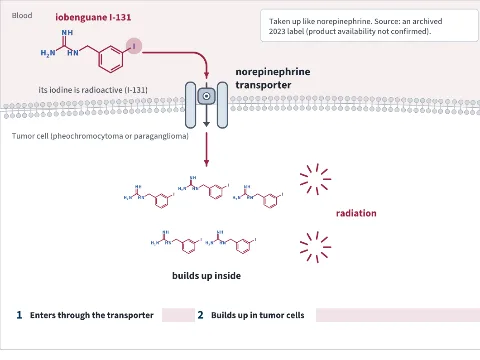
Iobenguane looks like norepinephrine and is taken up by the norepinephrine transporter, which these tumors carry in large amounts; the radioactive it carries then kills the tumor cells. It treats scan-positive tumors that cannot be removed and need systemic therapy.2
What the source says
“Iobenguane is similar in structure to the neurotransmitter norepinephrine (NE) and is subject to the same uptake and accumulation pathways as NE.”
Source 2“Pheochromocytoma and paraganglioma (PPGL) are tumors of neural crest origin that express high levels of the NE transporter on their cell surfaces.”
Source 2“radiation resulting from radioactive decay of I 131 causes cell death and tumor necrosis.”
Source 2“iobenguane scan positive, unresectable, locally advanced or metastatic pheochromocytoma or paraganglioma who require systemic anticancer therapy.”
Source 2 - B
Belzutifan: HIF-2α switched off
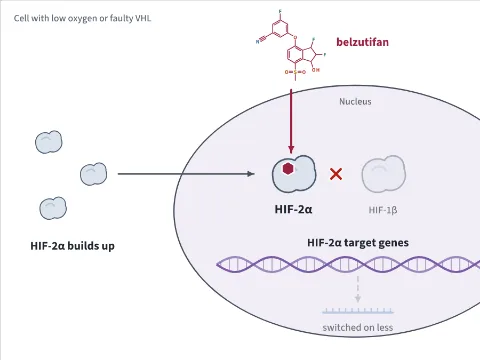
Belzutifan binds and blocks its pairing with , so fewer of its target genes are switched on. It treats advanced or spread pheochromocytoma or paraganglioma that cannot be removed.3
What the source says
“belzutifan blocks the HIF-2α-HIF-1β interaction, leading to reduced transcription and expression of HIF-2α target genes.”
Source 3“for treatment of adult and pediatric patients 12 years and older with locally advanced, unresectable, or metastatic pheochromocytoma or paraganglioma (PPGL).”
Source 3
See also
Body systems: hormones & metabolism; heart, vessels & cholesterol; and cancer.
Other conditions: kidney cancer and von Hippel-Lindau disease.
Sources
- 1PhaeochromocytomaLenders JW et al. Lancet 2005 (abstract). Saved copy
- 2Azedra (iobenguane I 131): FDA labelHighlights: Indications and Usage; 12.1 Mechanism of Action. Saved copy
- 3Welireg (belzutifan): FDA label1 Indications and Usage; 12.1 Mechanism of Action. Saved copy
Notes and limits
Notes that apply to every page are on How to read a page.
Spotted a mistake? Report an error (hello@openmechanism.com). Since launch, every published error we fix is listed on the corrections page.
Cite this page
Tran D. Pheochromocytoma and paraganglioma [Internet]. OpenMechanism; 2026 [updated 2026 Oct 19; cited 2026 Oct 19]. Available from: https://openmechanism.com/conditions/pheochromocytoma-and-paraganglioma