Cytarabine
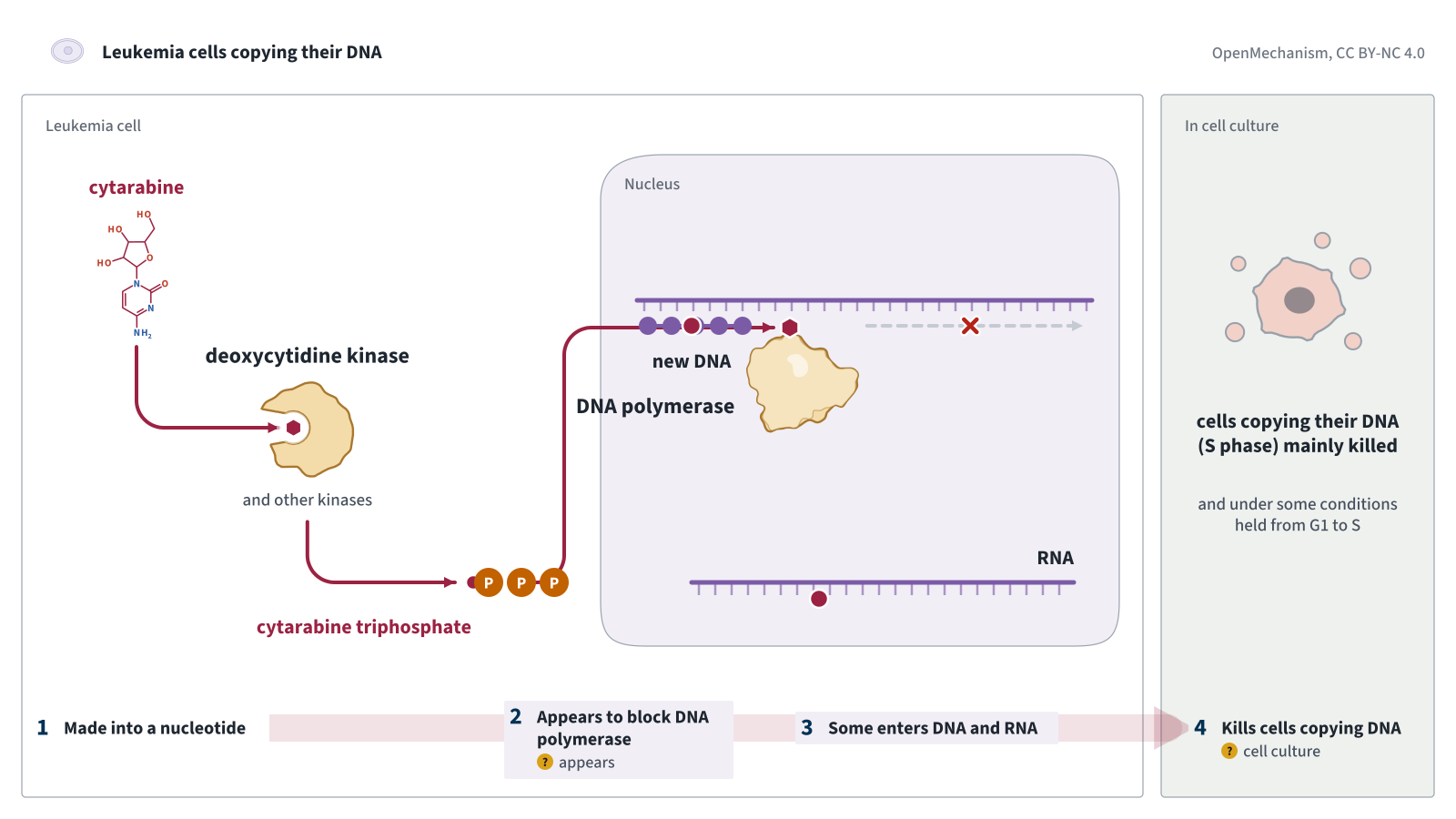
Deoxycytidine kinase and other kinases turn cytarabine into its triphosphate. Its mechanism is not completely understood, but it appears to act by blocking polymerase, and a limited amount is built into DNA and . In cell culture it mainly kills cells that are copying their DNA.
- Acts on
- DNA polymerase
- Where
- Cells copying their DNA, including leukemia cells
- Medicine type
- Small molecule
- Used for
- Cancer
- Drug class
- Antimetabolites
Step 2: appears
The cytarabine label says: Although the mechanism of action is not completely understood, it appears that cytarabine acts through the inhibition of DNA polymerase.
Clinical study: In a randomized trial of three cytarabine doses after remission in adults with acute myeloid leukemia; the trial measured how long remissions lasted, not how it works: The probability of remaining in continuous complete remission after four years for patients 60 years of age or younger was 24 percent in the 100-mg group, 29 percent in the 400-mg group, and 44 percent in the 3-g group
Mayer RJ et al., N Engl J Med 1994 (PMID 8078551)
This study was picked with a literature search and is not yet checked by our reviewer.
Step 4: cell culture
The cytarabine label says: It exhibits cell phase specificity, primarily killing cells undergoing DNA synthesis (S-phase) and under certain conditions blocking the progression of cells from the G 1 phase to the S-phase.
Clinical study: In a randomized trial of three cytarabine doses after remission in adults with acute myeloid leukemia; the trial measured disease-free survival, not how it works: After a median follow-up of 52 months, the disease-free survival rates in the three treatment groups were significantly different (P = 0.003).
Mayer RJ et al., N Engl J Med 1994 (PMID 8078551)
This study was picked with a literature search and is not yet checked by our reviewer.
Key terms in this drawing
- DNA
- Deoxyribonucleic acid. The molecule that stores genes.
- RNA
- Ribonucleic acid. A molecule copied from DNA; messenger RNA carries a gene's instructions.
How it works
Made into a nucleotide. Deoxycytidine kinase and other nucleotide kinases turn cytarabine into its triphosphate, an effective blocker of DNA polymerase.1
Appears to block DNA polymerase. Its mechanism is not completely understood, but cytarabine appears to act by blocking DNA polymerase.1
Some enters DNA and RNA. A limited but significant amount of cytarabine has also been reported to be built into both DNA and RNA.1
Kills cells copying DNA. In cell culture, it mainly kills cells that are copying their DNA (S phase), and under certain conditions it stops cells moving from the G1 phase to S phase.1
For teachers: download this drawing.
See also
Condition pages: acute lymphoblastic leukemia, acute myeloid leukemia and chronic myeloid leukemia.
Also named on: B-cell lymphomas, in combinations quoted from the National Cancer Institute.
Other antimetabolites: fluorouracil, gemcitabine, hydroxyurea, mercaptopurine and methotrexate.
Related drawings: gemcitabine (also turned into nucleotides that are built into new DNA).
Body system: cancer.
Sources
- 1Cytarabine injection (Meitheal): FDA labelClinical Pharmacology: Cell Culture Studies; Cellular Resistance and Sensitivity
- 2ChEMBL CHEMBL803Target and action classification: DNA inhibitor; DNA polymerase (alpha/delta/epsilon) inhibitor; RNA inhibitor
- 3Intensive postremission chemotherapy in adults with acute myeloid leukemia. Cancer and Leukemia Group BMayer RJ et al. N Engl J Med 1994 (abstract)
Also used for the drawing
The deoxycytidine kinase and DNA polymerase outlines are traced from the crystal structures below.
- 4Human deoxycytidine kinase with cytarabine and ADPPDB 1P5Z; Sabini, E. et al. Nat.Struct.Biol. 2003; 10:513-519
- 5The catalytic core of human DNA polymerase alpha on an RNA-primed DNA template, with dCTPPDB 4QCL; Baranovskiy, A.G. et al. J.Biol.Chem. 2018
Spotted a mistake? Report an error (hello@openmechanism.com). Since launch, every published error we fix is listed on the corrections page.
Notes and limits
- A schematic teaching drawing: not to scale, not exact structures, binding poses or a complete pathway, and not a guide to dosing, treatment or how a person will respond.
- A pyrimidine nucleoside deaminase inactivates it, making the non-toxic uracil derivative; the balance of kinase and deaminase may help decide how sensitive a cell is (the label).
- The label: the mechanism of action is not completely understood (Clinical Pharmacology).
- Seen in cell culture (the label, Clinical Pharmacology).
All recorded limits are on the evidence page, and notes that apply to every page are on How to read a page. Version 1.0.0, not yet medically reviewed.
Cite this page
Tran D. Cytarabine [Internet]. OpenMechanism; 2026 [updated 2026 Oct 18; cited 2026 Oct 18]. Available from: https://openmechanism.com/medicines/cytarabine