Osimertinib
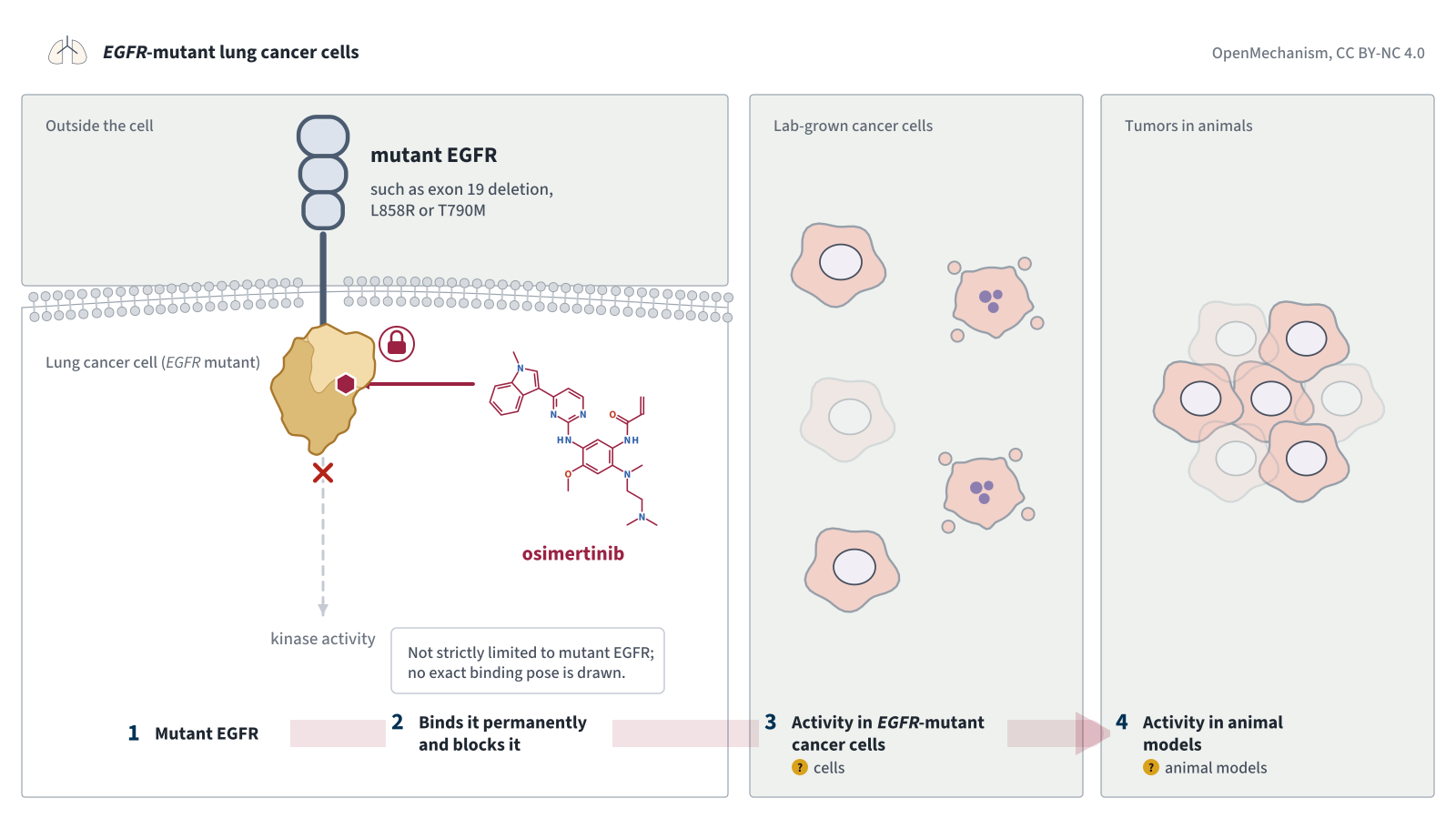
Osimertinib binds permanently to certain mutated forms of , such as exon 19 deletion, and , and blocks their kinase activity. The label describes anti-tumor activity in EGFR-mutant lung cancer cells and animal models. Benefits and escape mechanisms depend on the lung-cancer setting.
- Acts on
- EGFR mutant kinase
- Where
- EGFR-mutant lung cancer cells
- Medicine type
- Small molecule
- Used for
- Cancer
- Drug class
- Kinase inhibitors
Also called Tagrisso.
Step 3: cells
The osimertinib label says: In cultured cells and animal tumor implantation models, osimertinib exhibited anti-tumor activity against NSCLC lines harboring EGFR-mutations (T790M/L858R, L858R, T790M/exon 19 deletion, and exon 19 deletion) and, to a lesser extent, wild-type EGFR amplifications.
Source 1: Tagrisso (osimertinib): FDA label, 12.1 Mechanism of Action
Clinical study: In FLAURA, a double-blind, phase 3 trial of osimertinib or an older EGFR medicine (gefitinib or erlotinib) in 556 people with untreated, EGFR-mutated advanced non-small-cell lung cancer; the trial measured progression-free survival in people, not activity in cancer cells grown in the lab: Osimertinib showed efficacy superior to that of standard EGFR-TKIs in the first-line treatment of EGFR mutation-positive advanced NSCLC, with a similar safety profile and lower rates of serious adverse events.
Soria JC et al., N Engl J Med 2018 (PMID 29151359)
This study was picked with a literature search and is not yet checked by our reviewer.
Step 4: animal models
The osimertinib label says: In cultured cells and animal tumor implantation models, osimertinib exhibited anti-tumor activity against NSCLC lines harboring EGFR-mutations (T790M/L858R, L858R, T790M/exon 19 deletion, and exon 19 deletion) and, to a lesser extent, wild-type EGFR amplifications.
Source 1: Tagrisso (osimertinib): FDA label, 12.1 Mechanism of Action
Clinical study: In the same trial (FLAURA), which measured progression-free survival in people, not activity in animal tumor models: The median progression-free survival was significantly longer with osimertinib than with standard EGFR-TKIs (18.9 months vs. 10.2 months; hazard ratio for disease progression or death, 0.46; 95% confidence interval [CI], 0.37 to 0.57; P<0.001).
Soria JC et al., N Engl J Med 2018 (PMID 29151359)
This study was picked with a literature search and is not yet checked by our reviewer.
Key terms in this drawing
- EGFR
- Epidermal growth factor receptor. A receptor with a kinase part, in the same receptor family as HER2; changes in its gene are one of the driver mutations in non-small cell lung cancer.
- L858R
- EGFR L858R mutation. A change in EGFR found in lung cancer; osimertinib binds EGFR carrying it, or T790M, or an exon 19 deletion, at lower concentrations than normal EGFR.
- T790M
- EGFR T790M mutation. A second change in EGFR that often drives the resistance of lung cancer to first-generation EGFR blockers.
How it works
Mutant EGFR. The selected target is an EGFR mutant such as exon 19 deletion, L858R or T790M.1
Binds it permanently and blocks it. Osimertinib binds these mutant forms irreversibly and inhibits EGFR kinase activity.1
Activity in EGFR-mutant cancer cells. The label describes anti-tumor activity in cultured EGFR-mutant NSCLC cells.1
Activity in animal models. Animal tumor-implantation models also showed anti-tumor activity.1
For teachers: download this drawing or build a slide deck.
More detail
Binding mutant EGFR
Binds mutant EGFR more readily than normal EGFR. Osimertinib irreversibly binds sensitizing and T790M mutant EGFR at lower concentrations than wild-type EGFR.1
Bonds to EGFR at C797 (lab studies). Experimental AZD9291 engagement involves covalent modification of EGFR C797.2
Less EGFR signaling in lab cells. AZD9291 reduced phospho-EGFR and downstream phospho-AKT/phospho-ERK in tested mutant-EGFR cell models.2
Growth blocked in lung cancer models. AZD9291 inhibited growth in sensitizing/T790M mutant lung-cancer models.2
What the source says
“Osimertinib is a kinase inhibitor of the epidermal growth factor receptor (EGFR), which binds irreversibly to certain mutant forms of EGFR (T790M, L858R, and exon 19 deletions) at approximately 9-fold lower concentrations than wild-type.”
Source 1
“Preclinically, the drug potently inhibits signaling pathways and cellular growth in both EGFRm(+) and EGFRm(+)/T790M(+) mutant cell lines in vitro, with lower activity against wild-type EGFR lines”
Source 2
A trial against older EGFR medicines
Longer time without progression than gefitinib or erlotinib. FLAURA showed longer median progression-free survival with osimertinib than gefitinib/erlotinib in untreated exon 19-deletion/L858R advanced NSCLC.4
What the source says
“The median progression-free survival was significantly longer with osimertinib than with standard EGFR-TKIs”
Source 4
How resistance can arise (C797S)
C797S caused resistance in lab cells. Expressing acquired EGFR C797S conferred AZD9291 resistance in a cell-line experiment.3
Found in 6 of 15 relapses studied. Six of 15 selected T790M-positive AZD9291 relapse cases acquired C797S; other cases retained or lost T790M without C797S.3
What the source says
“expression of this mutant EGFR construct in a cell line rendered it resistant to AZD9291”
Source 3
“six cases acquired the C797S mutation, five cases maintained the T790M mutation but did not acquire the C797S mutation and four cases lost the T790M mutation despite the presence of the underlying EGFR activating mutation”
Source 3
Active breakdown products
Broken down mainly by CYP3A; two active products. Oxidation is predominantly CYP3A-mediated; dealkylation and active metabolites AZ7550/AZ5104 are also described.1
What the source says
“Two pharmacologically-active metabolites (AZ7550 and AZ5104 circulating at approximately 10% of the parent) with similar inhibitory profiles to osimertinib have been identified in the plasma after oral administration of osimertinib.”
Source 1
Heart rhythm (QTc)
Higher levels may lengthen the QTc interval. AURA2 pharmacokinetic/pharmacodynamic analysis suggested concentration-dependent QTc prolongation.1
See also
Condition pages: non-small cell lung cancer.
Other kinase inhibitors: imatinib, sirolimus and tofacitinib.
Body system: cancer.
Sources
- 1Tagrisso (osimertinib): FDA label12.1 Mechanism of Action; §12.1 mechanism, §12.2 cardiac electrophysiology, §12.3 metabolism; 12.2 Pharmacodynamics; 12.3 Pharmacokinetics
- 2AZD9291, an irreversible EGFR TKI, overcomes T790M-mediated resistance to EGFR inhibitors in lung cancerCross DA et al., Cancer Discov 2014 (abstract)
- 3Acquired EGFR C797S mutation mediates resistance to AZD9291 in non-small cell lung cancer harboring EGFR T790MThress KS et al., Nat Med 2015 (abstract)
- 4Osimertinib in Untreated EGFR-Mutated Advanced Non-Small-Cell Lung CancerSoria JC et al., N Engl J Med 2018 (abstract)
- 5ChEMBL CHEMBL3353410Target and action classification: Epidermal growth factor receptor erbB1 inhibitor
Also used on this page
The EGFR outline is traced from the crystal structure below.
- 6EGFR (residues 696 to 1022) with the T790M change, in complex with AZD9291PDB 6JX0; Yan, X.E. et al. J.Med.Chem. 2020; 63:8502-8511
Spotted a mistake? Report an error (hello@openmechanism.com). Since launch, every published error we fix is listed on the corrections page.
Notes and limits
- A schematic teaching drawing: not to scale, not exact structures, binding poses or a complete pathway, and not a guide to dosing, treatment or how a person will respond.
- The steps are in the order that explains them; one step is said to cause the next only where the source says so.
- Mutant-selective does not mean zero wild-type activity.
- C797S evidence is selected T790M-positive acquired resistance, not universal first-line prevalence.
- No atomic binding pose or universal downstream response is inferred.
- DailyMed index reports update 2026-09-14/version37, but accessed HTML/PDF is revised 9/2024; inspected section facts are pinned with that access limitation.
- Selectivity, metabolites and additional kinase targets are not reduced to an absolute mutant-only rule.
- No atom-level covalent pose, resistance prediction or tumor response simulation is claimed.
All recorded limits are on the evidence page, and notes that apply to every page are on How to read a page. Version 1.1.0, not yet medically reviewed.
Cite this page
Tran D. Osimertinib [Internet]. OpenMechanism; 2026 [updated 2026 Oct 15; cited 2026 Oct 15]. Available from: https://openmechanism.com/medicines/osimertinib