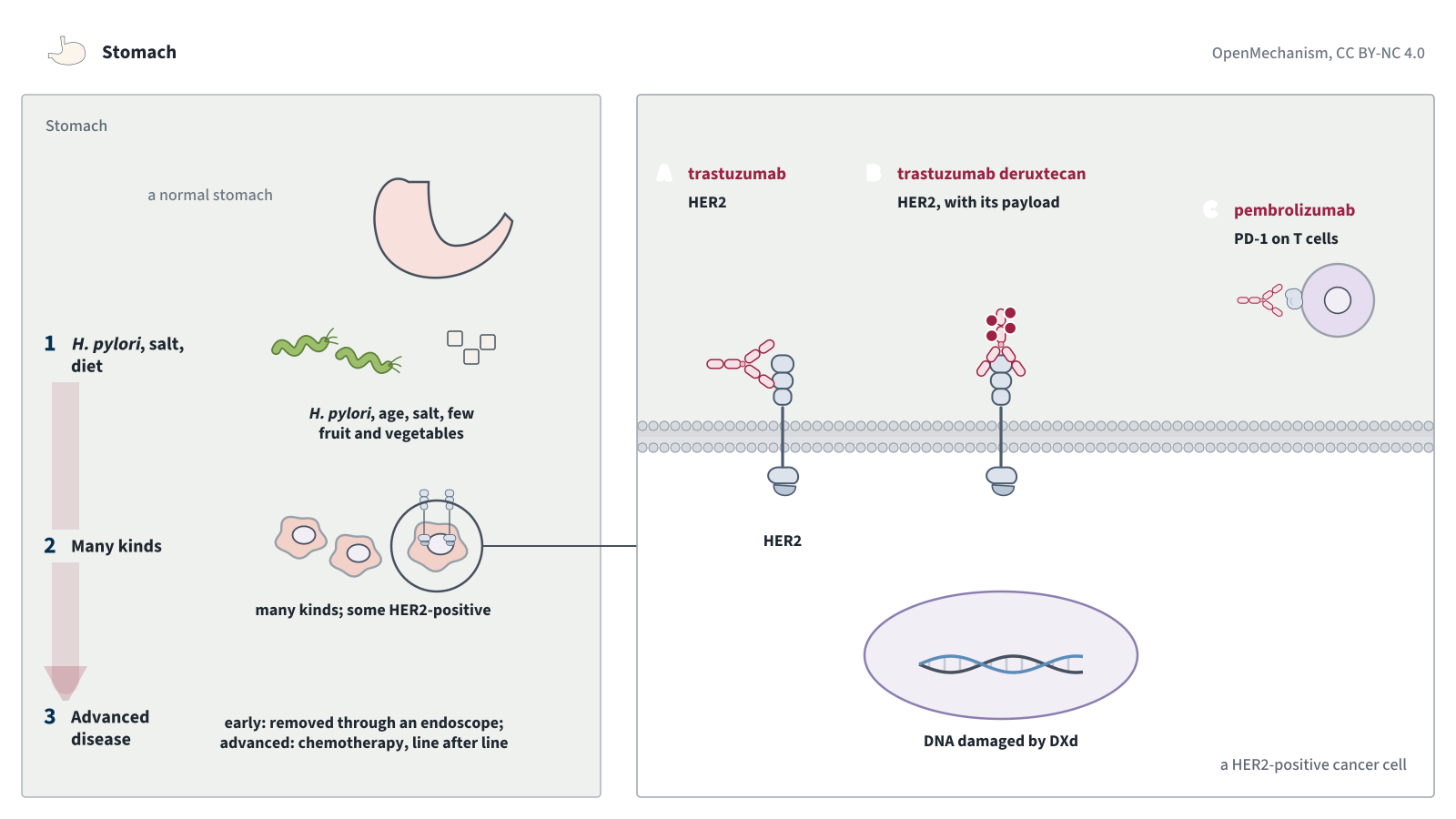
In a 2020 review, stomach (gastric) cancer was the fifth most common cancer and the third most common cause of cancer death worldwide. Helicobacter pylori infection, age, a salty diet and few fruits and vegetables raise the risk. In that review, advanced cancer had a median survival under a year. Trastuzumab and trastuzumab deruxtecan target HER2 on some tumors; pembrolizumab releases a brake on T cells.
Many kinds. It is a very varied disease, in its molecules and its appearance. Some tumors are ; the 2020 review lists trastuzumab as licensed for these patients as a first treatment.1
What the source says
“It is a molecularly and phenotypically highly heterogeneous disease.”
Advanced disease. Early cancer can be removed through an endoscope, and cancer that is not early but can be operated on is treated with surgery. In the 2020 review this page cites, advanced cancer was treated with chemotherapy, one line after another, and median survival was under a year.1
What the source says
“The main treatment for early gastric cancer is endoscopic resection.”
“Advanced gastric cancer is treated with sequential lines of chemotherapy, starting with a platinum and fluoropyrimidine doublet in the first line; median survival is less than 1 year.”
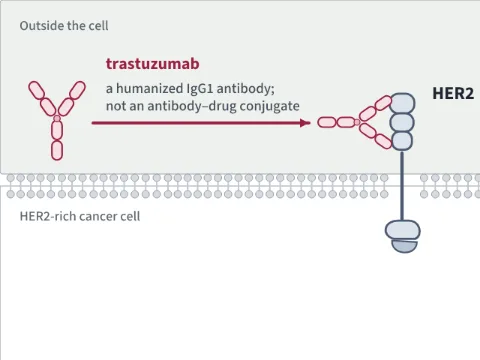
Trastuzumab binds HER2. In lab and animal studies it slowed the growth of tumor cells that overexpress HER2, and it marks them for killing (). With cisplatin and capecitabine or 5-fluorouracil, it treats adults with HER2-overexpressing stomach or gastroesophageal junction cancer that has spread, as their first treatment for the spread cancer.2
What the source says
“Trastuzumab is a humanized IgG1 kappa monoclonal antibody that selectively binds with high affinity to the extracellular domain of the human epidermal growth factor receptor 2 protein, HER2.”
“Herceptin has been shown, in both in vitro assays and in animals, to inhibit the proliferation of human tumor cells that overexpress HER2. Herceptin is a mediator of antibody-dependent cellular cytotoxicity (ADCC).”
“Herceptin is indicated in adults, in combination with cisplatin and capecitabine or 5-fluorouracil, for the treatment of patients with HER2-overexpressing metastatic gastric or gastroesophageal junction adenocarcinoma who have not received prior treatment for metastatic disease.”
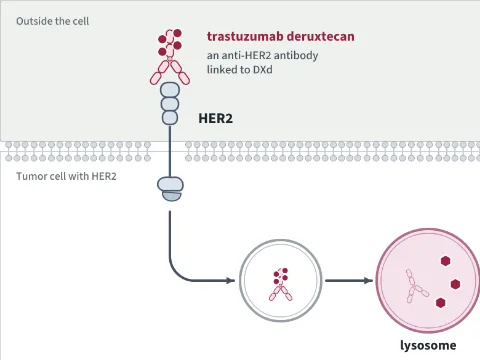
Trastuzumab deruxtecan is a HER2 antibody joined to a DNA-damaging compound, . After binding HER2 it is taken into the cell, where enzymes release DXd, which damages and kills the cell. On its own, it treats adults with HER2-positive stomach or gastroesophageal junction cancer that is locally advanced or has spread, after a trastuzumab-based treatment.3
What the source says
“Fam-trastuzumab deruxtecan-nxki is a HER2-directed antibody-drug conjugate.”
“Following binding to HER2 on tumor cells, fam-trastuzumab deruxtecan-nxki undergoes internalization and intracellular linker cleavage by lysosomal enzymes. Upon release, the membrane-permeable DXd causes DNA damage and apoptotic cell death.”
“ENHERTU, as monotherapy, is indicated for the treatment of adult patients with locally advanced or metastatic HER2-positive (IHC 3+ or IHC 2+/ISH positive) gastric or gastroesophageal junction (GEJ) adenocarcinoma who have received a prior trastuzumab-based regimen.”
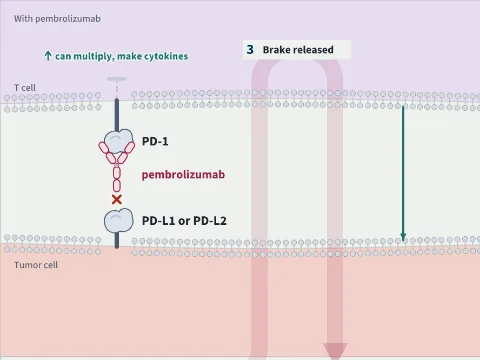
Pembrolizumab blocks , a brake on , and so releases the immune response, including the response against the cancer. With chemotherapy, and with trastuzumab when the cancer is HER2-positive, it is a first treatment for adults with stomach or gastroesophageal junction cancer that is locally advanced and cannot be removed by surgery, or has spread, when the tumor carries .4
What the source says
“Binding of the PD-1 ligands, PD-L1 and PD-L2, to the PD-1 receptor found on T cells, inhibits T cell proliferation and cytokine production.”
“Pembrolizumab is a monoclonal antibody that binds to the PD-1 receptor and blocks its interaction with PD-L1 and PD-L2, releasing PD-1 pathway-mediated inhibition of the immune response, including the anti-tumor immune response.”
“in combination with trastuzumab, fluoropyrimidine- and platinum-containing chemotherapy, for the first-line treatment of adults with locally advanced unresectable or metastatic HER2-positive gastric or gastroesophageal junction (GEJ) adenocarcinoma whose tumors express PD-L1 (CPS ≥1) as determined by an FDA-authorized test.”
“in combination with fluoropyrimidine- and platinum-containing chemotherapy, for the first-line treatment of adults with locally advanced unresectable or metastatic HER2-negative gastric or gastroesophageal junction (GEJ) adenocarcinoma whose tumors express PD-L1 (CPS ≥1) as determined by an FDA-authorized test.”
The National Cancer Institute's treatment summary for gastric cancer (updated 21 February 2025) describes these combinations. For the lettered medicines above, the page gives only the uses their own labels list. The quotes may name medicines, combinations or groups of patients that a medicine's own label does not list, and may leave out its label's limits.
Stages II and III gastric cancer, perioperative chemotherapy: “In the randomized phase III AIO-FLOT4 trial (NCT01216644), 716 patients with stage IB to stage III resectable gastric or gastroesophageal adenocarcinoma were randomly assigned to receive either perioperative chemotherapy with docetaxel, oxaliplatin, and fluorouracil (5-FU)/leucovorin (FLOT) or epirubicin, cisplatin, and 5-FU or capecitabine (ECF/ECX). Median overall survival (OS) was 50 months with FLOT and 35 months with ECF/ECX (hazard ratio [HR], 0.77; 95% confidence interval [CI], 0.63–0.94; P = .012). … Toxicity rates were similar between groups (26% required hospitalizations in the ECF/ECX group and 25% in the FLOT group). However, types of side effects differed, with increased nausea, thromboembolic events, and anemia in the ECF/ECX group versus higher rates of grade 3/4 infections, neutropenia, diarrhea, and neuropathy in the FLOT group.”7
Stage IV, inoperable, and recurrent gastric cancer, first-line palliative systemic therapy for patients with HER2-negative tumors: “Palliative chemotherapy with or without immunotherapy. Chemotherapy with immunotherapy: fluorouracil (5-FU) or capecitabine combined with oxaliplatin and nivolumab.”7
Stage IV, inoperable, and recurrent gastric cancer, first-line palliative systemic therapy for patients with HER2-positive tumors: “Trastuzumab may be combined with pembrolizumab and chemotherapy (either 5-FU and cisplatin or CAPOX) as treatment for patients with HER2-positive metastatic gastric adenocarcinoma. For patients who do not tolerate pembrolizumab, trastuzumab may be combined with cisplatin and 5-FU or capecitabine.”7
Also used for it: doxorubicin (“Doxorubicin Hydrochloride Injection is indicated for the treatment of … metastatic gastric carcinoma”5) and fluorouracil (for gastric adenocarcinoma: “Fluorouracil is a nucleoside metabolic inhibitor indicated for the treatment of patients with … Gastric Adenocarcinoma”6).
Related medicines: cisplatin (named in the Herceptin label: “Herceptin is indicated in adults, in combination with cisplatin and capecitabine or 5-fluorouracil, for the treatment of patients with HER2-overexpressing metastatic gastric or gastroesophageal junction adenocarcinoma who have not received prior treatment for metastatic disease.”2).
Pembrolizumab's stomach cancer uses depend on an FDA-authorized test showing PD-L1 on the tumor, with a combined positive score (CPS) of 1 or more. The steps are in the order that explains them; one step is said to cause the next only where a source says so.4
Stomach cancer is common: in a 2020 review, the fifth most common cancer and the third most common cause of cancer death worldwide.1
The combinations quoted from the National Cancer Institute are examples of how these medicines are given together. They are not a full list of regimens, and nothing here is advice on choosing a treatment. The words are from the summary's version of 21 February 2025, and the summary may have changed since. The summary says: “It is intended as a resource to inform and assist clinicians in the care of their patients. It does not provide formal guidelines or recommendations for making health care decisions.”7
Claude Opus 5.5 (AI source check), 14 November 2026: 42 statements compared with their sources, 4 flagged for the reviewer. An automated check, not a medical review.
Conflict of interest
Doxorubicin: Pfizer, the reviewer's former employer, makes or markets this medicine. Details
Key terms
Definitions reworded since this review: ADCC. Definitions are shared across pages, so a later rewording does not take the review line off (what a review covers).
Next review due
16 May 2028
Cite this page
Tran D. Stomach cancer [Internet]. OpenMechanism; 2026 [updated 2026 Nov 15; cited 2026 Nov 15]. Available from: https://openmechanism.com/conditions/stomach-cancer