Padeliporfin
Padeliporfin stays in the blood vessels. When a laser lights the tumor area, it makes oxygen radicals that damage and block the tumor's vessels, causing local tumor-cell death.
- Acts on
- Oxygen radicals, tumor vasculature
- Where
- Tumor blood vessels (prostate)
- Medicine type
- Small molecule
- Used for
- Cancer
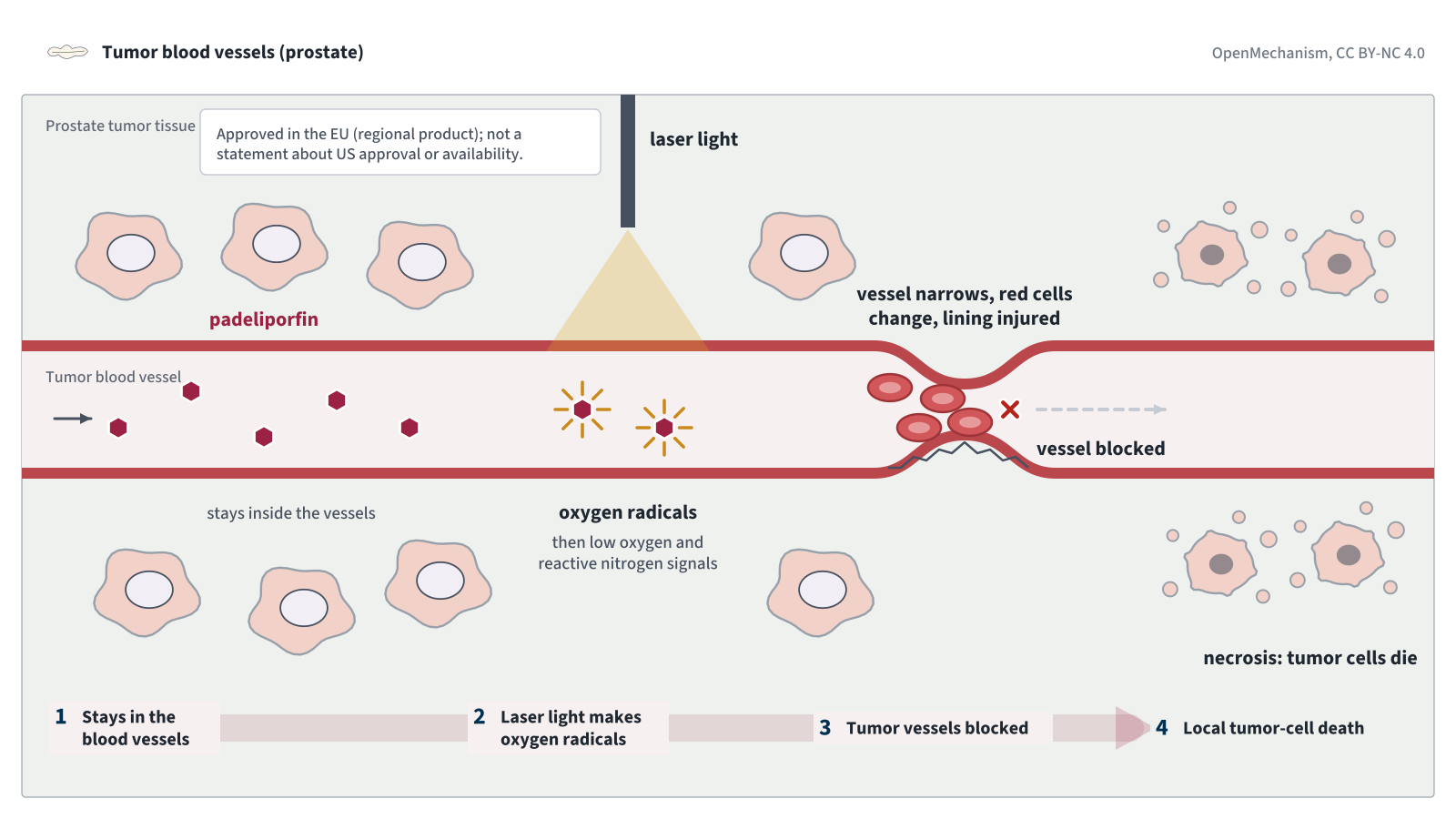
How it works
Stays in the blood vessels. The product is retained within the vasculature.1
Laser light makes oxygen radicals. Laser activation generates oxygen radicals and initiates local hypoxia and reactive-nitrogen signaling.1
Tumor vessels blocked. The source describes vascular constriction, altered erythrocyte behavior and endothelial injury contributing to vessel occlusion.1
Local tumor-cell death. Vascular disruption and membrane peroxidation lead to focal tumor-cell necrosis.1
For teachers: download this drawing or build a slide deck.
See also
Condition pages: prostate cancer.
More medicines for cancer: abiraterone acetate, anastrozole, belzutifan, bevacizumab, bleomycin, blinatumomab, bortezomib, brentuximab vedotin and 38 more.
Body system: cancer.
Sources
- 1EMA product information · Padeliporfin: activate vascular photochemistry5.1 Pharmacodynamic properties; EMA PDF page11
- 2ChEMBL CHEMBL4594284Target and action classification: Vascular targeted photodynamic therapy
Spotted a mistake? Report an error (hello@openmechanism.com). Since launch, every published error we fix is listed on the corrections page.
Notes and limits
- A schematic teaching drawing: not to scale, not exact structures, binding poses or a complete pathway, and not a guide to dosing, treatment or how a person will respond.
- Other medicines in the same family may not follow every step or share the same clinical endpoint.
- The steps are in the order that explains them; one step is said to cause the next only where the source says so.
- This is the EMA-approved regional product context, not US approval or current worldwide availability.
- The route summarizes a complex source model; erythrocyte aggregation is described as a thought contribution rather than a measured universal intermediate.
- The source product uses padeliporfin di-potassium; the catalog parent identity does not assert identical counterion chemistry.
All recorded limits are on the evidence page, and notes that apply to every page are on How to read a page. Version 1.0.0, not yet medically reviewed.
Cite this page
Tran D. Padeliporfin [Internet]. OpenMechanism; 2026 [updated 2026 Oct 15; cited 2026 Oct 15]. Available from: https://openmechanism.com/medicines/padeliporfin