Colorectal cancer
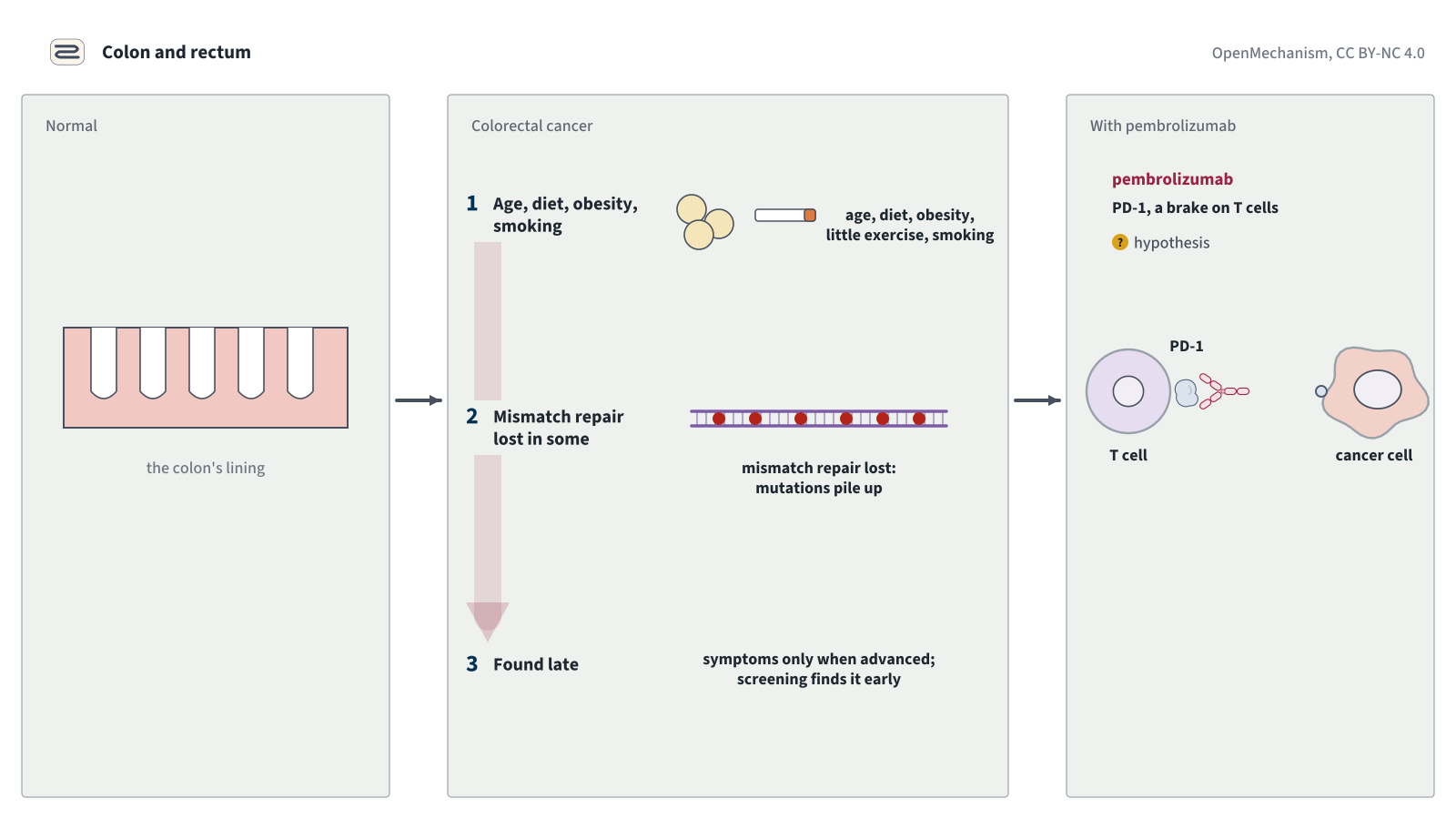
Colorectal cancer is the world's fourth most deadly cancer, with almost 900,000 deaths a year; age, diet, obesity, lack of exercise and smoking raise the risk. About 15% have microsatellite instability (MSI): DNA mismatch repair is lost. It causes symptoms only when advanced. Pembrolizumab, which releases a brake on T cells, treats tumors with mismatch-repair defects.
- Where
- Colon and rectum
- Body systems
- Cancer; Stomach, gut & liver
- Medicines
- 1 medicine
Hypothesis
Le and colleagues' 2015 study says: We hypothesized that tumors with a large number of somatic mutations due to mismatch-repair defects may be susceptible to immune checkpoint blockade.
Source 4: PD-1 blockade in tumors with mismatch-repair deficiency, Le DT et al. N Engl J Med 2015 (abstract)
Clinical study: In a randomized, open-label trial in 307 people with untreated metastatic colorectal cancer with mismatch-repair defects (MSI-H-dMMR), pembrolizumab was compared with chemotherapy; every tumor had the defect, so the trial measured how long the cancer was held back, not why such tumors respond: Pembrolizumab led to significantly longer progression-free survival than chemotherapy when received as first-line therapy for MSI-H-dMMR metastatic colorectal cancer, with fewer treatment-related adverse events.
André T et al., N Engl J Med 2020 (PMID 33264544)
This study was picked with a literature search and is not yet checked by our reviewer.
For teachers: download this drawing.
Key terms in this drawing
- PD-1
- Programmed cell death protein 1. A receptor on T cells that acts as a brake when PD-L1 or PD-L2 binds it.
- T cell
- T lymphocyte. A white blood cell of the immune system.
What goes wrong
Age, diet, obesity, smoking. An aging population and the diets of high-income countries add to the risk, as do obesity, lack of exercise and smoking.1
What the source says
“Besides an ageing population and dietary habits of high-income countries, unfavourable risk factors such as obesity, lack of physical exercise, and smoking increase the risk of colorectal cancer.”
Source 1Mismatch repair lost in some. About 15% have microsatellite instability (): mismatch repair is lost, so mutations pile up. A few come from Lynch syndrome; most come from silencing of the MLH1 gene.2
What the source says
“Microsatellite instability (MSI) is a hypermutable phenotype caused by the loss of DNA mismatch repair activity.”
Source 2“MSI is detected in about 15% of all colorectal cancers; 3% are of these are associated with Lynch syndrome and the other 12% are caused by sporadic, acquired hypermethylation of the promoter of the MLH1 gene”
Source 2Found late. It causes symptoms only when advanced, so screening programs aim to find it early. Newer treatments doubled survival in advanced disease to 3 years, but survival is best before it spreads.1
What the source says
“As the disease only becomes symptomatic at an advanced stage, worldwide organised screening programmes are being implemented, which aim to increase early detection and reduce morbidity and mortality from colorectal cancer.”
Source 1“Although these new treatment options have doubled overall survival for advanced disease to 3 years, survival is still best for those with non-metastasised disease.”
Source 1
Where medicines act
- A
Pembrolizumab: the PD-1 brake released
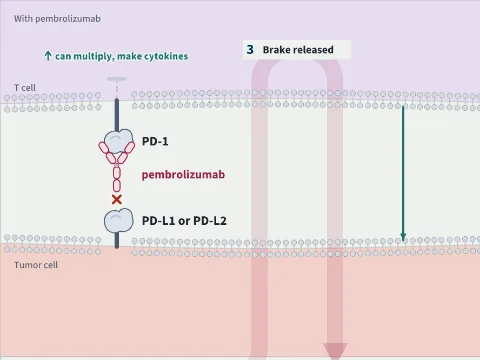
Pembrolizumab blocks , a brake on , and so releases the immune response against the cancer. Tumors with mismatch-repair defects carry many mutations, which may make them easier for the immune system to see; in a trial, mismatch-repair status predicted who benefited. It treats MSI-H or mismatch-repair-deficient colorectal cancer that cannot be removed or has spread.3,4
What the source says
“Binding of the PD-1 ligands, PD-L1 and PD-L2, to the PD-1 receptor found on T cells, inhibits T cell proliferation and cytokine production.”
Source 3“Pembrolizumab is a monoclonal antibody that binds to the PD-1 receptor and blocks its interaction with PD-L1 and PD-L2, releasing PD-1 pathway-mediated inhibition of the immune response, including the anti-tumor immune response.”
Source 3“We hypothesized that tumors with a large number of somatic mutations due to mismatch-repair defects may be susceptible to immune checkpoint blockade.”
Source 4“This study showed that mismatch-repair status predicted clinical benefit of immune checkpoint blockade with pembrolizumab.”
Source 4“for the treatment of patients with unresectable or metastatic MSI-H or dMMR colorectal cancer (CRC) as determined by an FDA-authorized test.”
Source 3
See also
Body systems: cancer; and stomach, gut & liver.
Also used for it: bevacizumab (for metastatic colorectal cancer, with fluorouracil-based chemotherapy: “Avastin, in combination with intravenous fluorouracil-based chemotherapy, is indicated for the first-or second-line treatment of patients with metastatic colorectal cancer (mCRC).”5); ipilimumab (for metastatic MSI-H or mismatch repair deficient colorectal cancer, with nivolumab: “Treatment of adults and pediatric patients 12 years and older with unresectable or metastatic microsatellite instability-high (MSI-H) or mismatch repair deficient (dMMR) colorectal cancer (CRC) as determined by an FDA-authorized test in combination with nivolumab.”6); fluorouracil (for adenocarcinoma of the colon and rectum: “Fluorouracil is a nucleoside metabolic inhibitor indicated for the treatment of patients with … Adenocarcinoma of the Colon and Rectum”7); irinotecan (for metastatic colorectal cancer, first with fluorouracil and leucovorin or after fluorouracil: “Irinotecan Hydrochloride Injection is indicated as a component of first-line therapy in combination with 5-fluorouracil (5-FU) and leucovorin (LV) for patients with metastatic carcinoma of the colon or rectum. … Irinotecan Hydrochloride Injection is indicated for patients with metastatic carcinoma of the colon or rectum whose disease has recurred or progressed following initial fluorouracil-based therapy.”8); and leucovorin (for advanced colorectal cancer, with fluorouracil: “Leucovorin is also indicated for use in combination with 5-fluorouracil to prolong survival in the palliative treatment of patients with advanced colorectal cancer.”9).
Other conditions: kidney cancer, non-small cell lung cancer, stomach cancer, breast cancer, cervical cancer and melanoma.
The medicine in the body: fluorouracil and the DPYD gene; and irinotecan and the UGT1A1 gene.
Interactions: leucovorin with methotrexate and with fluorouracil.
Sources
- 1Colorectal cancerDekker E et al. Lancet 2019 (abstract). Saved copy
- 2Microsatellite instability in colorectal cancerBoland CR, Goel A. Gastroenterology 2010 (abstract). Saved copy
- 3Keytruda (pembrolizumab): FDA label1 Indications and Usage; 12.1 Mechanism of Action. Saved copy
- 4PD-1 blockade in tumors with mismatch-repair deficiencyLe DT et al. N Engl J Med 2015 (abstract). Saved copy
- 5Avastin (bevacizumab): FDA label1 Indications and Usage. Saved copy
- 6Yervoy (ipilimumab): FDA label1 Indications and Usage. Saved copy
- 7Fluorouracil injection (Fresenius Kabi): FDA labelIndications and Usage. Saved copy
- 8Irinotecan hydrochloride injection (Sagent): FDA labelIndications and Usage. Saved copy
- 9Leucovorin calcium injection (Fresenius Kabi): FDA labelIndications and Usage. Saved copy
- 10Pembrolizumab in Microsatellite-Instability-High Advanced Colorectal CancerAndré T et al. N Engl J Med 2020 (abstract). Saved copy
Notes and limits
- Tumors with MSI have a slightly better outlook and respond differently to chemotherapy.2
Notes that apply to every page are on How to read a page.
Spotted a mistake? Report an error (hello@openmechanism.com). Since launch, every published error we fix is listed on the corrections page.
Cite this page
Tran D. Colorectal cancer [Internet]. OpenMechanism; 2026 [updated 2026 Oct 20; cited 2026 Oct 20]. Available from: https://openmechanism.com/conditions/colorectal-cancer