Methotrexate
Methotrexate blocks dihydrofolate reductase, so cells run short of the active folate they need to make building blocks. Methotrexate interferes with DNA synthesis, repair and cellular replication; actively dividing tissues are in general more sensitive to this effect. The Trexall label lists it for acute lymphoblastic leukemia in adults and children, as part of a combination chemotherapy maintenance regimen; in adults, for mycosis fungoides (cutaneous T-cell lymphoma), alone or as part of combination chemotherapy, for relapsed or refractory as part of a metronomic combination chemotherapy regimen, and for rheumatoid arthritis and severe psoriasis; and for polyarticular juvenile idiopathic arthritis in children. It says the mechanism in rheumatoid arthritis and in psoriasis is unknown.
- Acts on
- Dihydrofolate reductase
- Where
- Cells; actively dividing tissues are in general more sensitive
- Medicine type
- Small molecule
- Used for
- Cancer
- Drug class
- Antimetabolites
Also called Trexall.
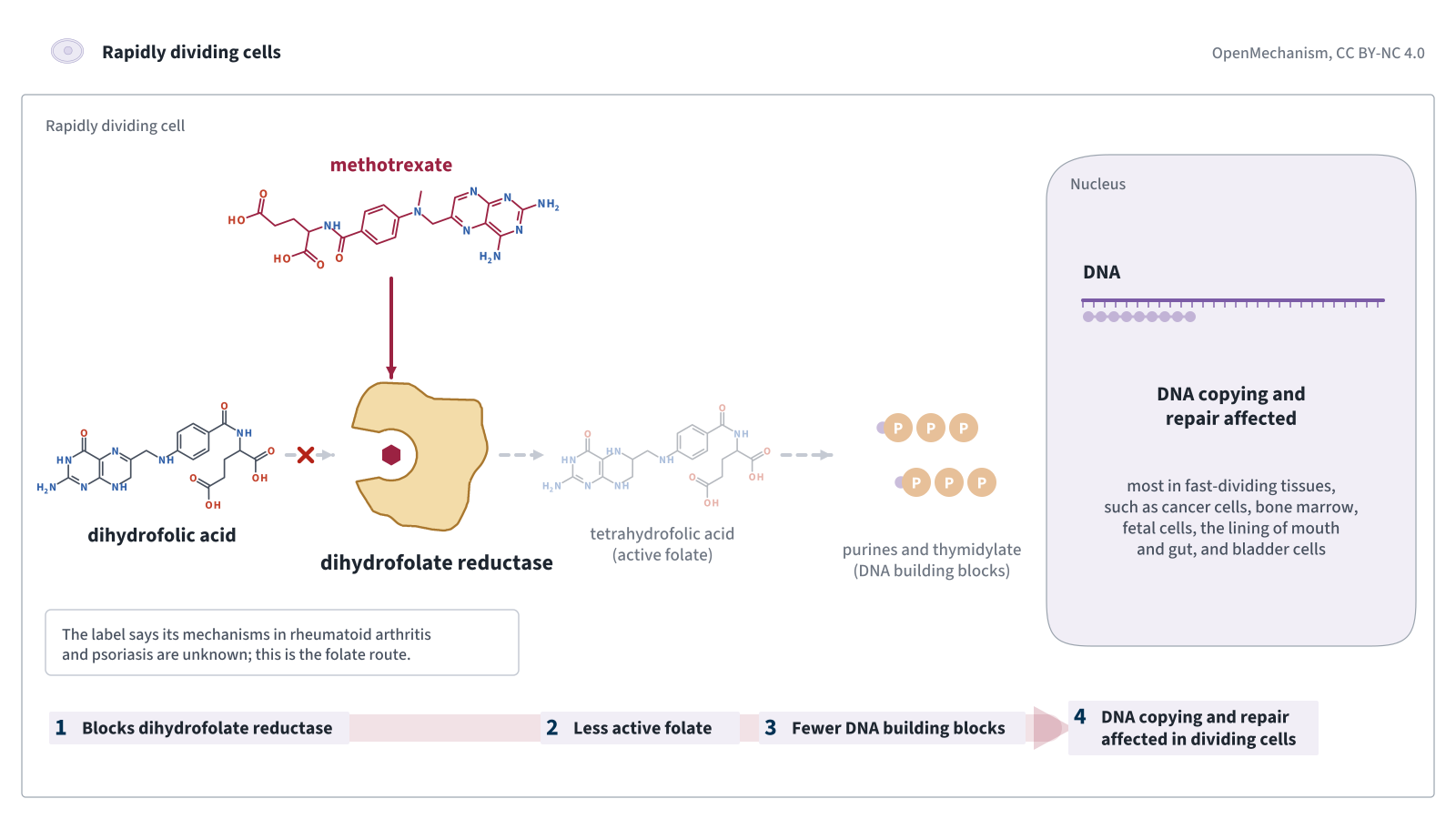
Key terms in this drawing
- DNA
- Deoxyribonucleic acid. The molecule that stores genes.
How it works
Blocks dihydrofolate reductase. Methotrexate inhibits dihydrofolate reductase.1
Less active folate. With the enzyme blocked, dihydrofolates cannot be efficiently reduced to tetrahydrofolates used for one-carbon transfer.1
Fewer DNA building blocks. With less tetrahydrofolate, purine and thymidylate synthesis is disrupted.1
DNA copying and repair affected in dividing cells. Methotrexate interferes with DNA synthesis, repair and cellular replication; actively dividing tissues are in general more sensitive to this effect.1
For teachers: download this drawing or build a slide deck.
See also
Condition pages: acute lymphoblastic leukemia, B-cell lymphomas, cutaneous T-cell lymphoma, juvenile idiopathic arthritis, psoriasis and rheumatoid arthritis.
Also named on: bladder cancer, in combinations quoted from the National Cancer Institute.
Side effects: methotrexate toxicity.
Other antimetabolites: cytarabine, fluorouracil, gemcitabine, hydroxyurea and mercaptopurine.
Explained: leucovorin with methotrexate and with fluorouracil; and methotrexate with NSAIDs or trimethoprim-sulfamethoxazole.
Related drawings: leucovorin (a reduced folate that can counteract methotrexate's effects).
Body system: cancer.
Sources
- 1Trexall (methotrexate): FDA label1 Indications and Usage; 12.1 Mechanism of Action
- 2ChEMBL CHEMBL34259Target and action classification: Dihydrofolate reductase inhibitor
Also used for the drawing
The DHFR outline is traced from the crystal structure below.
- 3Dihydrofolate reductase (DHFR) with methotrexate and NADPHPDB 1U72; Cody, V. et al. Acta Crystallogr.,Sect.D 2005; 61:147-155
Spotted a mistake? Report an error (hello@openmechanism.com). Since launch, every published error we fix is listed on the corrections page.
Notes and limits
- A schematic teaching drawing: not to scale, not exact structures, binding poses or a complete pathway, and not a guide to dosing, treatment or how a person will respond.
- The steps are in the order that explains them; one step is said to cause the next only where the source says so.
- The label states that mechanisms in rheumatoid arthritis and psoriasis are unknown; this folate story is not substituted for those indications.
All recorded limits are on the evidence page, and notes that apply to every page are on How to read a page. Version 1.0.1, medically reviewed by Daniel Tran, PharmD, on 15 November 2026.
Cite this page
Tran D. Methotrexate [Internet]. OpenMechanism; 2026 [updated 2026 Nov 15; cited 2026 Nov 15]. Available from: https://openmechanism.com/medicines/methotrexate