Chemotherapy nausea and vomiting
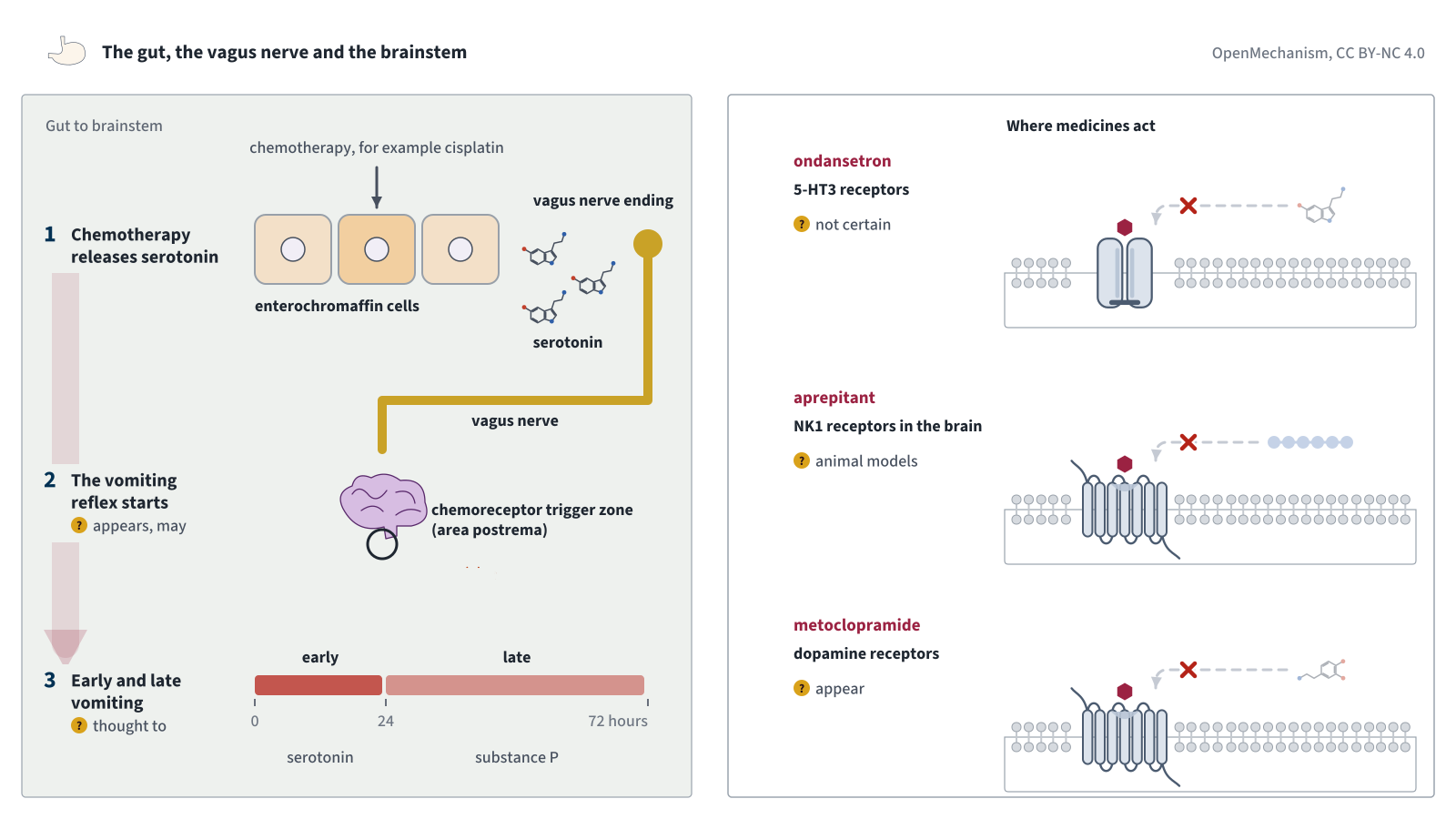
Cancer chemotherapy can cause nausea and vomiting, both in the first day and in the days after. Serotonin released in the gut appears to set off the early phase through 5-HT3 receptors, while the later phase has been linked mainly to substance P at NK1 receptors. Regimens often combine 5-HT3 and NK1 receptor blockers with a corticosteroid.
- Where
- The gut, the vagus nerve and the brainstem
- Body systems
- Stomach, gut & liver; Cancer
- Medicines
- 3 medicines
Step 2: appears, may
The ondansetron tablets label says: However, cytotoxic chemotherapy appears to be associated with release of serotonin from the enterochromaffin cells of the small intestine. … The released serotonin may stimulate the vagal afferents through the 5-HT 3 receptors and initiate the vomiting reflex.
Source 1: Ondansetron tablets: FDA label, 1 Indications and Usage; 12.1 Mechanism of Action
Clinical study: In a trial comparing ondansetron with placebo in 28 people with cancer given cisplatin: The urinary excretion of 5-hydroxyindoleacetic acid, the main metabolite of serotonin, was increased in all patients two to six hours after they received cisplatin chemotherapy, and the increases paralleled the episodes of emesis.
Cubeddu LX et al., N Engl J Med 1990 (PMID 1689807)
This study was picked with a literature search and is not yet checked by our reviewer.
Step 3: thought to
The Rojas 2012 review says: These findings led to the hypothesis that serotonin plays a central role in the mechanism of acute emesis but a lesser role in the pathogenesis of delayed emesis. … In contrast, delayed emesis has been largely associated with the activation of neurokinin 1 (NK(1)) receptors by substance P.
Clinical study: In a double-blind crossover trial of ondansetron and high-dose metoclopramide in people starting cisplatin (95 assessed in the early phase, 79 in the late phase); the trial measured responses, not what drives each phase: In the acute phase, a major or complete response was seen in 72% of the ondansetron-treated and 41% of the metoclopramide-treated patients (P less than 0.001). … In the delayed phase, no statistically significant difference was seen between ondansetron- and metoclopramide-treated patients.
De Mulder PH et al., Ann Intern Med 1990 (PMID 2146911)
This study was picked with a literature search and is not yet checked by our reviewer.
Not certain
The ondansetron tablets label says: While its mechanism of action has not been fully characterized, ondansetron is not a dopamine-receptor antagonist. … It is not certain whether ondansetron’s antiemetic action is mediated centrally, peripherally, or in both sites.
Source 1: Ondansetron tablets: FDA label, 1 Indications and Usage; 12.1 Mechanism of Action
Clinical study: In a double-blind crossover trial of ondansetron and metoclopramide in 97 people starting cisplatin chemotherapy; the trial measured vomiting and nausea, not where ondansetron acts: We conclude that ondansetron is more effective than metoclopramide in the control of cisplatin-induced nausea and vomiting, and that this suggests that serotonin is an important mediator of this side effect.
Marty M et al., N Engl J Med 1990 (PMID 2137902)
This study was picked with a literature search and is not yet checked by our reviewer.
Animal models
The Emend label says: Aprepitant has been shown in animal models to inhibit emesis induced by cytotoxic chemotherapeutic agents, such as cisplatin, via central actions.
Source 3: Emend (aprepitant): FDA label, 1 Indications and Usage; 12.1 Mechanism of Action
Clinical study: In a randomized, double-blind trial in patients given high-dose cisplatin for the first time, adding aprepitant to ondansetron and dexamethasone; the trial measured how many had no vomiting and no rescue treatment, not how aprepitant works: The percentage of patients with complete response on days 1 to 5 was significantly higher in the aprepitant group (72.7% [n = 260] v 52.3% in the standard therapy group [n = 260])
Hesketh PJ et al., J Clin Oncol 2003 (PMID 14559886)
This study was picked with a literature search and is not yet checked by our reviewer.
Appear
The metoclopramide injection label says: The antiemetic properties of metoclopramide appear to be a result of its antagonism of central and peripheral dopamine receptors.
Source 4: Metoclopramide injection: FDA label, Indications and Usage; Clinical Pharmacology
Clinical study: In two small double-blind trials in 41 people with advanced cancer given cisplatin; the trials measured vomiting, not how metoclopramide works: Patients given metoclopramide had significantly fewer episodes of emesis than patients given placebo (medians, 1.0 vs. 10.5; P = 0.001) or prochlorperazine (medians, 1.5 vs. 12.0; P = 0.005).
Gralla RJ et al., N Engl J Med 1981 (PMID 7024807)
This study was picked with a literature search and is not yet checked by our reviewer.
For teachers: download this drawing.
Key terms in this drawing
- 5-HT3 receptor
- Serotonin 3 receptor. A serotonin receptor on vagus nerve endings and in the brain's vomiting trigger zone; ondansetron blocks it.
- dopamine receptors
- Dopamine receptors. Receptors that dopamine acts on, among them D1, D2, D3 and D4; olanzapine binds these four strongly.
What goes wrong
Chemotherapy releases serotonin. Chemotherapy appears to make enterochromaffin cells in the small intestine release serotonin; after cisplatin, a breakdown product of serotonin in the urine rises in step with the vomiting.1
What the source says
“However, cytotoxic chemotherapy appears to be associated with release of serotonin from the enterochromaffin cells of the small intestine.”
Source 1“In humans, urinary 5-hydroxyindoleacetic acid (5-HIAA) excretion increases after cisplatin administration in parallel with the onset of emesis.”
Source 1The vomiting reflex starts. The serotonin may stimulate the endings of the vagus nerve through and set off the vomiting reflex. 5-HT3 receptors are also found in the chemoreceptor trigger zone of the brainstem's area postrema.1
What the source says
“The released serotonin may stimulate the vagal afferents through the 5-HT 3 receptors and initiate the vomiting reflex.”
Source 1“Serotonin receptors of the 5-HT 3 type are present both peripherally on vagal nerve terminals and centrally in the chemoreceptor trigger zone of the area postrema.”
Source 1Early and late vomiting. Vomiting can come early, within 24 hours, or late, from 24 to 72 hours. Serotonin is thought to play a central role in the early phase but a lesser one in the late phase, which has been largely linked to substance P acting on NK1 receptors.2
What the source says
“Nausea and vomiting can be acute (0-24h) or delayed (24-72 h) after chemotherapy administration.”
Source 2“These findings led to the hypothesis that serotonin plays a central role in the mechanism of acute emesis but a lesser role in the pathogenesis of delayed emesis.”
Source 2“In contrast, delayed emesis has been largely associated with the activation of neurokinin 1 (NK(1)) receptors by substance P.”
Source 2
Where medicines act
On the vagus nerve and in the brainstem
- A
Ondansetron targets 5-HT3 receptors
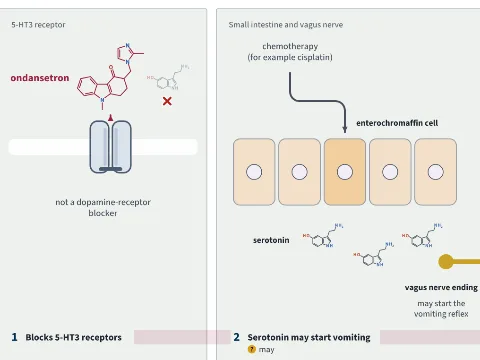
Blocks 5-HT3 receptors; whether on the vagus nerve, in the brain or both is not certain.1
Used forPrevention of chemotherapy nausea and vomiting: highly or moderately emetogenic chemotherapyPrevention of nausea and vomiting after radiotherapy or surgery
What the label says
“Ondansetron tablets are indicated for the prevention of nausea and vomiting associated with: highly emetogenic cancer chemotherapy, including cisplatin greater than or equal to 50 mg/m 2 . initial and repeat courses of moderately emetogenic cancer chemotherapy. radiotherapy in patients receiving either total body irradiation, single high-dose fraction to the abdomen, or daily fractions to the abdomen Ondansetron tablets are also indicated for the prevention of postoperative nausea and/or vomiting.”
Source 1“Ondansetron is a selective 5-HT 3 receptor antagonist.”
Source 1“While its mechanism of action has not been fully characterized, ondansetron is not a dopamine-receptor antagonist.”
Source 1“It is not certain whether ondansetron’s antiemetic action is mediated centrally, peripherally, or in both sites.”
Source 1
In the brainstem
- B
Aprepitant targets NK1 receptors in the brain
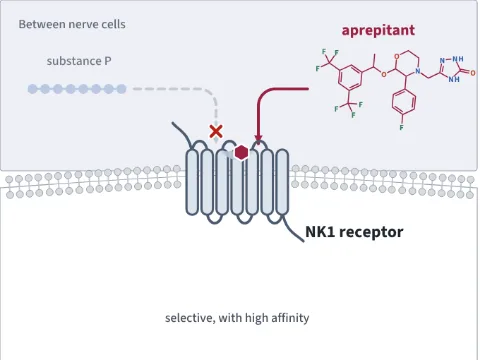
Blocks substance P's NK1 receptors in the brain, adding to other antiemetics against both phases.3
Used forPrevention of early and late nausea and vomiting: highly emetogenic chemotherapy, with other antiemeticsPrevention of nausea and vomiting: moderately emetogenic chemotherapy, with other antiemetics
What the label says
“EMEND ® capsules, in combination with other antiemetic agents, is indicated in patients 12 years of age and older for the prevention of: acute and delayed nausea and vomiting associated with initial and repeat courses of highly emetogenic cancer chemotherapy (HEC) including high-dose cisplatin. nausea and vomiting associated with initial and repeat courses of moderately emetogenic cancer chemotherapy (MEC).”
Source 3“Aprepitant is a selective high-affinity antagonist of human substance P/neurokinin 1 (NK 1 ) receptors.”
Source 3“Aprepitant has been shown in animal models to inhibit emesis induced by cytotoxic chemotherapeutic agents, such as cisplatin, via central actions.”
Source 3“Animal and human Positron Emission Tomography (PET) studies with aprepitant have shown that it crosses the blood brain barrier and occupies brain NK 1 receptors.”
Source 3“Animal and human studies show that aprepitant augments the antiemetic activity of the 5-HT 3 -receptor antagonist ondansetron and the corticosteroid dexamethasone and inhibits both the acute and delayed phases of cisplatin-induced emesis.”
Source 3 - C
Metoclopramide targets Dopamine receptors in the chemoreceptor trigger zone
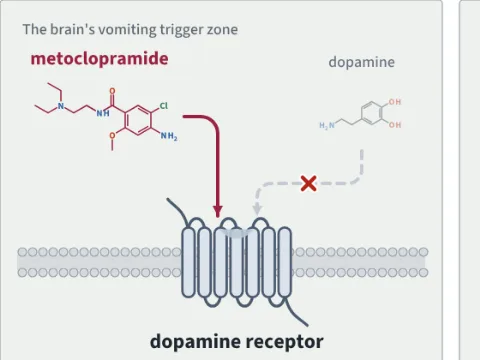
Blocks , so dopamine stimulates the chemoreceptor trigger zone less.4
Used forPrevention of vomiting from emetogenic cancer chemotherapy: the injection
What the label says
“Metoclopramide Injection, USP is indicated for the prophylaxis of vomiting associated with emetogenic cancer chemotherapy.”
Source 4“The antiemetic properties of metoclopramide appear to be a result of its antagonism of central and peripheral dopamine receptors.”
Source 4“Dopamine produces nausea and vomiting by stimulation of the medullary chemoreceptor trigger zone (CTZ), and metoclopramide blocks stimulation of the CTZ by agents like l‑dopa or apomorphine which are known to increase dopamine levels or to possess dopamine-like effects.”
Source 4
See also
Body systems: stomach, gut & liver; and cancer.
Other conditions: acid reflux (GERD); methemoglobinemia; tardive dyskinesia; colorectal cancer; gastrointestinal stromal tumors (GIST); and head and neck cancer.
Side effects: why some medicines lengthen the QT interval and why antipsychotics can cause movement problems.
Sources
- 1Ondansetron tablets: FDA label1 Indications and Usage; 12.1 Mechanism of Action. Saved copy
- 2Pharmacological mechanisms of 5-HT3 and tachykinin NK1 receptor antagonism to prevent chemotherapy-induced nausea and vomitingRojas C, Slusher BS. Eur J Pharmacol 2012 (abstract). Saved copy
- 3Emend (aprepitant): FDA label1 Indications and Usage; 12.1 Mechanism of Action. Saved copy
- 4Metoclopramide injection: FDA labelIndications and Usage; Clinical Pharmacology. Saved copy
- 5Chemotherapy-induced nausea and vomiting: pathogenesis, recommendations, and new trendsGupta K, Walton R, Kataria SP. Cancer Treat Res Commun 2021 (abstract). Saved copy
- 6Efficacy of ondansetron (GR 38032F) and the role of serotonin in cisplatin-induced nausea and vomitingCubeddu LX et al. N Engl J Med 1990 (abstract). Saved copy
- 7Ondansetron compared with high-dose metoclopramide in prophylaxis of acute and delayed cisplatin-induced nausea and vomiting. A multicenter, randomized, double-blind, crossover studyDe Mulder PH et al. Ann Intern Med 1990 (abstract). Saved copy
- 8Comparison of the 5-hydroxytryptamine3 (serotonin) antagonist ondansetron (GR 38032F) with high-dose metoclopramide in the control of cisplatin-induced emesisMarty M et al. N Engl J Med 1990 (abstract). Saved copy
- 9The oral neurokinin-1 antagonist aprepitant for the prevention of chemotherapy-induced nausea and vomiting: a multinational, randomized, double-blind, placebo-controlled trial in patients receiving high-dose cisplatin--the Aprepitant Protocol 052 Study GroupHesketh PJ et al. J Clin Oncol 2003 (abstract). Saved copy
- 10Antiemetic efficacy of high-dose metoclopramide: randomized trials with placebo and prochlorperazine in patients with chemotherapy-induced nausea and vomitingGralla RJ et al. N Engl J Med 1981 (abstract). Saved copy
Notes and limits
- Chemotherapy nausea and vomiting has five main forms (acute, delayed, anticipatory, breakthrough and refractory) that need different regimens, which often include 5-HT3 receptor blockers, NK1 receptor blockers and corticosteroids.5
- Aprepitant has not been studied for treating nausea and vomiting that has already started.3
Notes that apply to every page are on How to read a page.
Spotted a mistake? Report an error (hello@openmechanism.com). Since launch, every published error we fix is listed on the corrections page.
Cite this page
Tran D. Chemotherapy nausea and vomiting [Internet]. OpenMechanism; 2026 [updated 2026 Oct 20; cited 2026 Oct 20]. Available from: https://openmechanism.com/conditions/chemotherapy-nausea-and-vomiting