Vorinostat
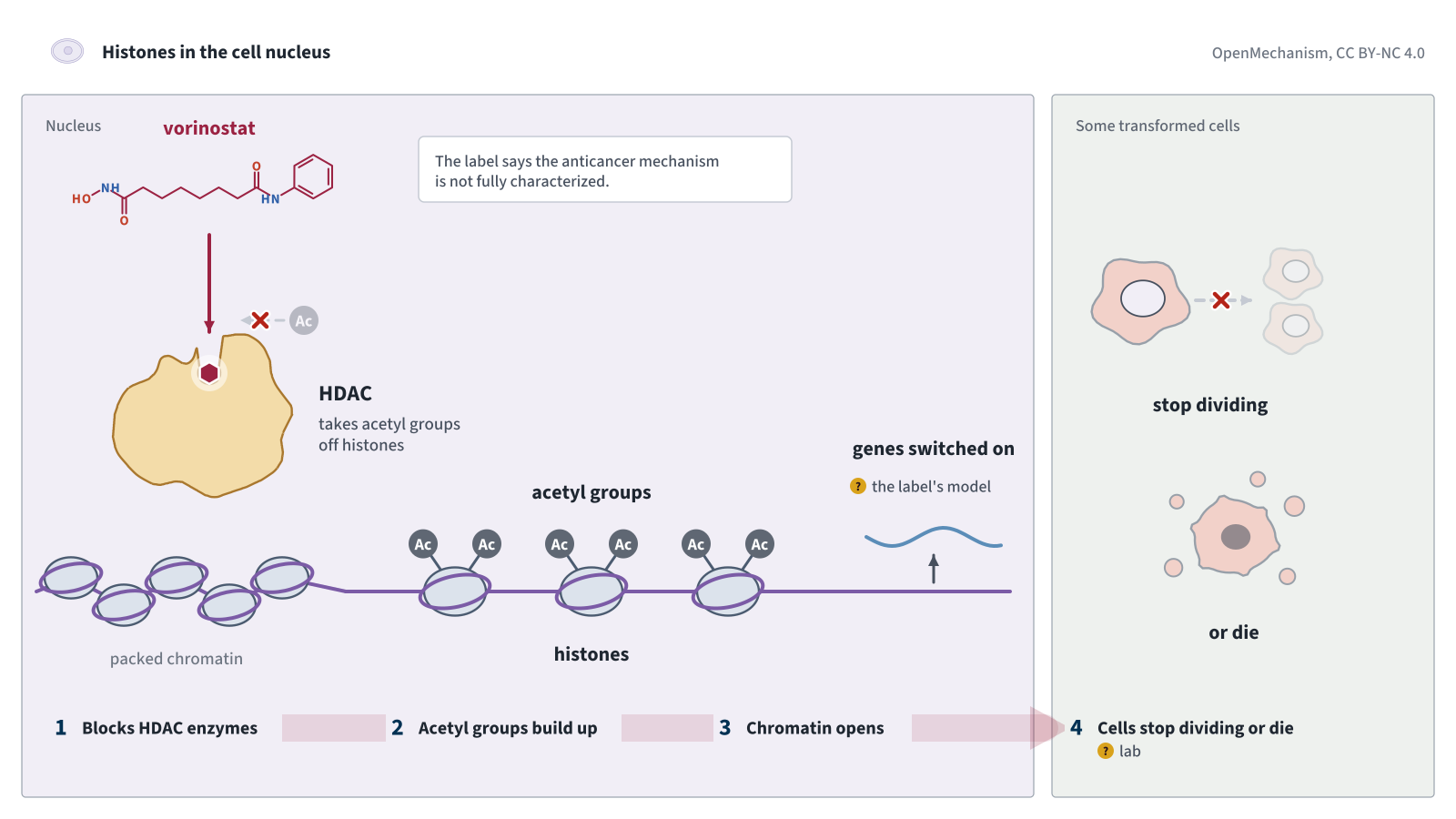
Vorinostat blocks histone deacetylases (), so acetyl groups build up on histones. In the label's model this opens chromatin and switches on genes; in laboratory studies some transformed cells stop dividing or die.
- Acts on
- HDAC1, HDAC2, HDAC3, HDAC6
- Where
- Histones in the cell nucleus
- Medicine type
- Small molecule
- Used for
- Cancer
Also called Zolinza.
The label's model
The Zolinza label says: Inhibition of HDAC activity allows for the accumulation of acetyl groups on the histone lysine residues resulting in an open chromatin structure and transcriptional activation.
Source 1: Zolinza (vorinostat): FDA label, 12.1 Mechanism of Action
Clinical study: In an open-label phase IIb trial, with no comparison group, in 74 people with mycosis fungoides or Sézary syndrome (forms of cutaneous T-cell lymphoma) that persisted or came back after at least two earlier treatments; the trial measured the objective response rate, not histone acetylation or which genes are switched on: Oral vorinostat was effective in treatment refractory MF/SS with an acceptable safety profile.
Olsen EA et al., J Clin Oncol 2007 (PMID 17577020)
This study was picked with a literature search and is not yet checked by our reviewer.
Step 4: lab
The Zolinza label says: In vitro , vorinostat causes the accumulation of acetylated histones and induces cell cycle arrest and/or apoptosis of some transformed cells.
Source 1: Zolinza (vorinostat): FDA label, 12.1 Mechanism of Action
Clinical study: In an open-label phase IIb trial, with no comparison group, in 74 people with mycosis fungoides or Sézary syndrome (forms of cutaneous T-cell lymphoma) that persisted or came back after at least two earlier treatments; the trial measured the objective response rate, not whether cancer cells stop dividing or die: The ORR was 29.7% overall; 29.5% in stage IIB or higher patients. … Oral vorinostat was effective in treatment refractory MF/SS with an acceptable safety profile.
Olsen EA et al., J Clin Oncol 2007 (PMID 17577020)
This study was picked with a literature search and is not yet checked by our reviewer.
Key terms in this drawing
- HDAC
- Histone deacetylase. An enzyme that removes acetyl groups from histones.
How it works
Blocks HDAC enzymes. Vorinostat inhibits selected histone-deacetylase enzymes.1
Acetyl groups build up. HDAC inhibition allows acetyl groups to accumulate on histone lysines.1
Chromatin opens. In the label model, greater histone acetylation favors open chromatin and transcriptional activation.1
Cells stop dividing or die. In-vitro studies show cell-cycle arrest or apoptosis in some transformed cells.1
For teachers: download this drawing or build a slide deck.
See also
Condition pages: cutaneous T-cell lymphoma.
More medicines for cancer: abiraterone acetate, anastrozole, belzutifan, bevacizumab, bleomycin, blinatumomab, bortezomib, brentuximab vedotin and 38 more.
Body system: cancer.
Sources
- 1Zolinza (vorinostat): FDA label12.1 Mechanism of Action
- 2ChEMBL CHEMBL98Target and action classification: Histone deacetylase 1 inhibitor; Histone deacetylase 2 inhibitor; Histone deacetylase 3 inhibitor; Histone deacetylase 6 inhibitor
- 3Phase IIb multicenter trial of vorinostat in patients with persistent, progressive, or treatment refractory cutaneous T-cell lymphomaOlsen EA et al. J Clin Oncol 2007 (abstract)
Also used for the drawing
The HDAC outline is traced from the crystal structure below.
- 4Human HDAC2 with vorinostatPDB 4LXZ; Lauffer, B.E. et al. J.Biol.Chem. 2013; 288:26926-26943
Spotted a mistake? Report an error (hello@openmechanism.com). Since launch, every published error we fix is listed on the corrections page.
Notes and limits
- A schematic teaching drawing: not to scale, not exact structures, binding poses or a complete pathway, and not a guide to dosing, treatment or how a person will respond.
- Other medicines in the same family may not follow every step or share the same clinical endpoint.
- The steps are in the order that explains them; one step is said to cause the next only where the source says so.
- The label says the antineoplastic mechanism is not fully characterized. Histones and other proteins are substrates.
- The scene does not claim universal transcriptional activation or one gene program in every cell.
All recorded limits are on the evidence page, and notes that apply to every page are on How to read a page. Version 1.0.0, not yet medically reviewed.
Cite this page
Tran D. Vorinostat [Internet]. OpenMechanism; 2026 [updated 2026 Oct 15; cited 2026 Oct 15]. Available from: https://openmechanism.com/medicines/vorinostat