Immune system
How the body recognizes and fights invaders, and what happens when it overreacts or turns on itself.
For teachers: download this drawing.
Key terms in this drawing
- IgE
- Immunoglobulin E. A type of antibody involved in allergic reactions.
- mast cell
- Mast cell. An immune cell in tissues such as the skin and the airways that releases histamine and other signals.
- T cell
- T lymphocyte. A white blood cell of the immune system.
- TNF
- Tumor necrosis factor (TNF-α). A signaling molecule (cytokine) that drives inflammation.
How it works
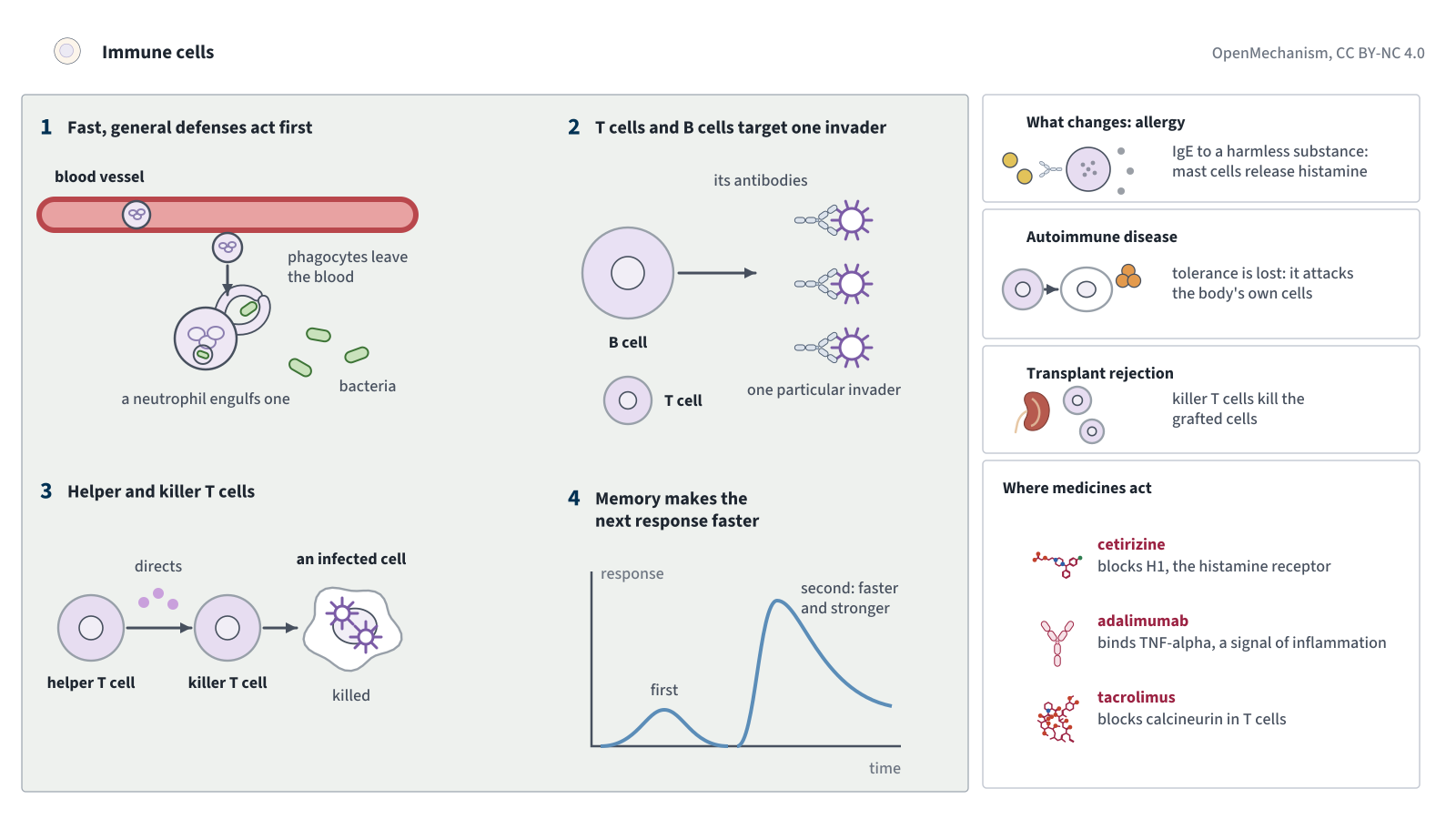
Fast, general defenses act first. Inflammation brings phagocytes to an injury or infection, and neutrophils destroy bacteria by engulfing them; inflammation also removes damaged cells and starts repair.1,2
What the source says
“Although inflammation is typically associated with negative consequences of injury or disease, it is a necessary process insofar as it allows for recruitment of the cellular defenses needed to eliminate pathogens, remove damaged and dead cells, and initiate repair mechanisms.”
Source 1“Vasodilation and increased vascular permeability are also associated with an influx of phagocytes at the site of injury and/or infection.”
Source 1“Neutrophils (PMNs) are frequently involved in the elimination and destruction of extracellular bacteria.”
Source 2“They are capable of migrating through the walls of blood vessels to areas of bacterial infection and tissue damage, where they seek out and kill infectious bacteria.”
Source 2“PMN granules contain a variety of defensins and hydrolytic enzymes that help them destroy bacteria through phagocytosis”
Source 2T cells and B cells target one invader. Adaptive immunity is specific: it targets one particular invader. It works through two kinds of cell, B cells, which make antibodies, and .3
What the source says
“Adaptive immunity is defined by two important characteristics: specificity and memory.”
Source 3“Specificity refers to the adaptive immune system’s ability to target specific pathogens, and memory refers to its ability to quickly respond to pathogens to which it has previously been exposed.”
Source 3“Adaptive specific immunity involves the actions of two distinct cell types: B lymphocytes (B cells) and T lymphocytes (T cells).”
Source 3“B cells mature in the bone marrow and are responsible for the production of glycoproteins called antibodies, or immunoglobulins.”
Source 3Helper and killer T cells. Helper T cells direct the rest of the response, and cytotoxic (killer) T cells recognize and kill cells infected by a pathogen.4,5
What the source says
“Helper T cells serve as the central orchestrators that help activate and direct functions of humoral and cellular immunity.”
Source 4“In contrast, cytotoxic T cells recognize antigens presented in association with MHC I, either by APCs or by nucleated cells infected with an intracellular pathogen.”
Source 4“Cytotoxic T cells then target and kill the grafted cells through the same mechanism they use to kill virus-infected cells”
Source 5Memory makes the next response faster. After a first exposure, a later exposure to the same invader brings a response that is faster and stronger. Normally, the immune system does not attack the body's own cells (tolerance).3,6
What changes in disease
Allergy. In an allergy, an antibody response to a harmless substance makes release histamine and other substances, which cause the inflammation and symptoms such as a runny nose and itching.7
What the source says
“Such a response is called an allergy and is classified as a type I hypersensitivity.”
Source 7“Allergens may be seemingly harmless substances such as animal dander, molds, or pollen.”
Source 7“Type I hypersensitivity reactions involve immunoglobulin E (IgE) antibody against soluble antigen, triggering mast cell degranulation.”
Source 7“Preformed components that are released from granules include histamine, serotonin, and bradykinin (Table 19.1).”
Source 7“The chemical mediators released by mast cells collectively cause the inflammation and signs and symptoms associated with type I hypersensitivity reactions.”
Source 7“Histamine stimulates mucus secretion in nasal passages and tear formation from lacrimal glands, promoting the runny nose and watery eyes of allergies.”
Source 7“Interaction of histamine with nerve endings causes itching and sneezing.”
Source 7Autoimmune disease. In autoimmune disease, tolerance is lost and the immune system attacks the body's own cells.6
What the source says
“Although the immune system protects the body by attacking invading “enemies” (pathogens), in some cases, the immune system can mistakenly identify the body’s own cells as the enemy, resulting in autoimmune disease.”
Source 6“However, with autoimmunity, there is a loss of immune tolerance”
Source 6Transplant rejection. A transplanted organ is rejected when the recipient's immune system recognizes it as foreign; killer T cells kill the grafted cells.5
Where medicines act
- d
Cetirizine
An antihistamine: it blocks H1 receptors, the receptors for histamine.
- e
Adalimumab
Binds TNF-alpha, a signal of inflammation, and blocks it from reaching its receptors.
- f
Tacrolimus
Blocks calcineurin inside T cells, which holds back their activation and multiplication.
See also
Zoom in: immune attack on a tumor, an allergic reaction to food and t cells and a transplanted kidney.
Body systems: cancer and infections.
Conditions
- Acute lymphoblastic leukemia
- ANCA vasculitis
- Ankylosing spondylitis
- Atypical hemolytic uremic syndrome (aHUS)
- B-cell lymphomas
- CAPS and DIRA
- Chronic hives (urticaria)
- Chronic lymphocytic leukemia
- Chronic sinusitis with nasal polyps
- Crohn disease
- Cutaneous T-cell lymphoma
- Eczema (atopic dermatitis)
- Food allergy
- HIV infection
- Hodgkin lymphoma
- Juvenile idiopathic arthritis
- Lupus nephritis
- Multiple myeloma
- Multiple sclerosis
- Myasthenia gravis
- Neuromyelitis optica (NMOSD)
- Paroxysmal nocturnal hemoglobinuria
- Pemphigus
- Psoriasis
- Psoriatic arthritis
- Rheumatoid arthritis
- Transplant rejection
- Ulcerative colitis
More medicines for this area
Sources
- 1Inflammation and feverOpenStax Microbiology, section 17.5 (CC BY-NC-SA 4.0). Saved copy
- 2Cellular defensesOpenStax Microbiology, section 17.3 (CC BY-NC-SA 4.0). Saved copy
- 3Overview of specific adaptive immunityOpenStax Microbiology, section 18.1 (CC BY-NC-SA 4.0). Saved copy
- 4T lymphocytes and cellular immunityOpenStax Microbiology, section 18.3 (CC BY-NC-SA 4.0). Saved copy
- 5Organ transplantation and rejectionOpenStax Microbiology, section 19.3 (CC BY-NC-SA 4.0). Saved copy
- 6Autoimmune disordersOpenStax Microbiology, section 19.2 (CC BY-NC-SA 4.0). Saved copy
- 7HypersensitivitiesOpenStax Microbiology, section 19.1 (CC BY-NC-SA 4.0). Saved copy
- 8Cetirizine tablets: FDA labelClinical Pharmacology: Mechanism of Actions. Saved copy
- 9Humira (adalimumab): FDA label12.1 Mechanism of Action. Saved copy
- 10Prograf (tacrolimus): FDA label12.1 Mechanism of Action. Saved copy
Notes and limits
- How most autoimmune diseases begin is not yet fully known.6
- The drawing is schematic and not to scale; it shows only what the statements above say.
Spotted a mistake? Report an error (hello@openmechanism.com). Since launch, every published error we fix is listed on the corrections page.
Cite this page
Tran D. Immune system [Internet]. OpenMechanism; 2026 [updated 2026 Nov 13; cited 2026 Nov 13]. Available from: https://openmechanism.com/body/immune