Gemcitabine
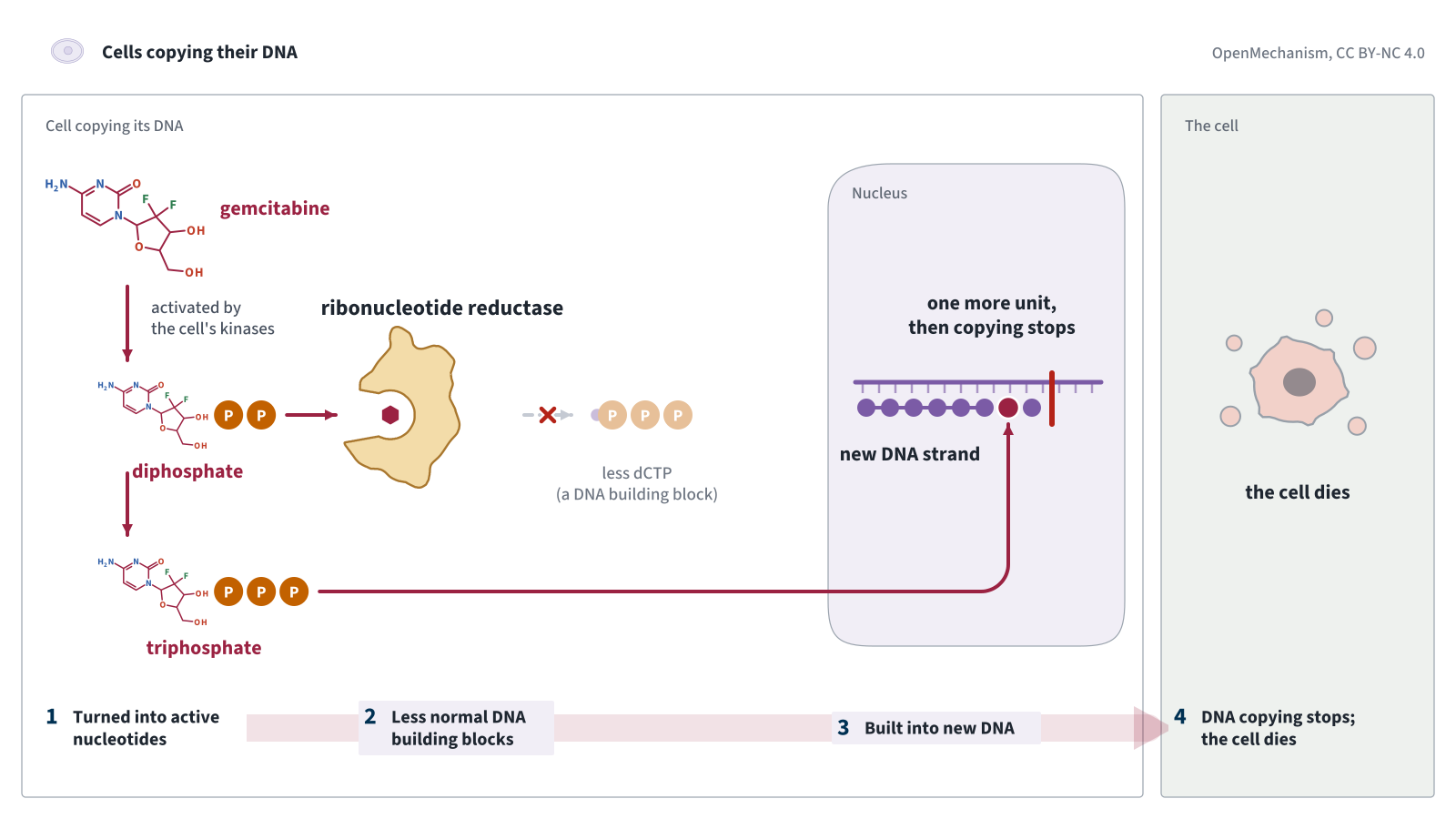
Inside cells, gemcitabine is turned into active nucleotides. One form lowers the supply of normal building blocks; the other is built into new DNA, after which only one more unit can be added. DNA copying stops, eventually triggering cell death.
- Acts on
- Ribonucleotide reductase, DNA
- Where
- Cells copying their DNA
- Medicine type
- Small molecule
- Used for
- Cancer
- Drug class
- Antimetabolites
Also called Avgemsi.
Key terms in this drawing
- dCTP
- Deoxycytidine triphosphate. One of the four building blocks used to make DNA.
- DNA
- Deoxyribonucleic acid. The molecule that stores genes.
How it works
Turned into active nucleotides. Nucleoside kinases convert gemcitabine into diphosphate and triphosphate metabolites.1
Less normal DNA building blocks. The diphosphate inhibits ribonucleotide reductase, lowering deoxynucleotide concentrations including .1
Built into new DNA. The triphosphate competes with dCTP for DNA incorporation; lower dCTP enhances its incorporation.1
DNA copying stops; the cell dies. Only one more nucleotide is added after incorporation, eventually initiating apoptotic cell death.1
For teachers: download this drawing or build a slide deck.
See also
Condition pages: breast cancer, non-small cell lung cancer, ovarian cancer and pancreatic cancer.
Also named on: bladder cancer, in combinations quoted from the National Cancer Institute.
Other antimetabolites: cytarabine, fluorouracil, hydroxyurea, mercaptopurine and methotrexate.
Related drawings: hydroxyurea (also thought to block ribonucleotide reductase); and cytarabine (also made into a triphosphate, which appears to block DNA polymerase).
Body system: cancer.
Sources
- 1Avgemsi (gemcitabine): FDA label12.1 Mechanism of Action
- 2ChEMBL CHEMBL888Target and action classification: DNA polymerase (alpha/delta/epsilon) inhibitor; Ribonucleoside-diphosphate reductase RR1 inhibitor
Also used for the drawing
The ribonucleotide reductase outline is traced from the crystal structure below.
- 3Yeast ribonucleotide reductase large subunit (Rnr1) with gemcitabine diphosphatePDB 2EUD; Xu, H. et al. Proc.Natl.Acad.Sci.Usa 2006; 103:4028-4033
Spotted a mistake? Report an error (hello@openmechanism.com). Since launch, every published error we fix is listed on the corrections page.
Notes and limits
- A schematic teaching drawing: not to scale, not exact structures, binding poses or a complete pathway, and not a guide to dosing, treatment or how a person will respond.
- Other medicines in the same family may not follow every step or share the same clinical endpoint.
- The steps are in the order that explains them; one step is said to cause the next only where the source says so.
- The parent drug, diphosphate and triphosphate have distinct actions; this label route must not be collapsed to parent-drug binding at one polymerase pocket.
All recorded limits are on the evidence page, and notes that apply to every page are on How to read a page. Version 1.0.0, not yet medically reviewed.
Cite this page
Tran D. Gemcitabine [Internet]. OpenMechanism; 2026 [updated 2026 Oct 15; cited 2026 Oct 15]. Available from: https://openmechanism.com/medicines/gemcitabine