Selinexor
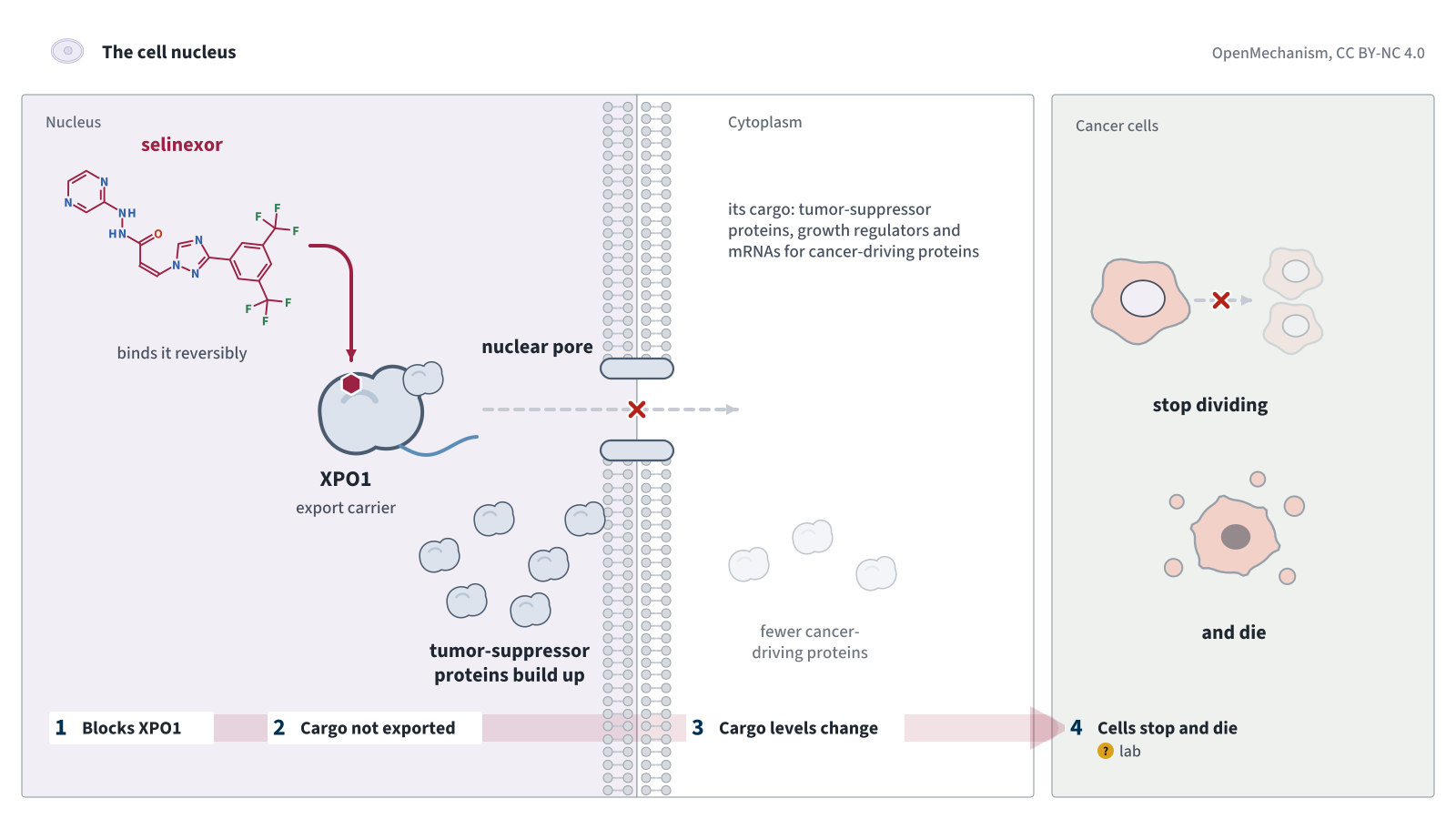
Selinexor blocks , a carrier that exports proteins and messenger RNAs out of the nucleus. Tumor-suppressor proteins build up in the nucleus and some cancer-driving proteins fall; in laboratory studies this stops cancer cells dividing and kills them.
- Acts on
- Exportin-1
- Where
- The cell nucleus
- Medicine type
- Small molecule
- Used for
- Cancer
Also called Xpovio.
Step 4: lab
The Xpovio label says: In nonclinical studies, selinexor reversibly inhibits nuclear export of tumor suppressor proteins (TSPs), growth regulators, and mRNAs of oncogenic proteins by blocking exportin 1 (XPO1). … Selinexor demonstrated pro-apoptotic activity in vitro in multiple myeloma cells and showed anti-tumor activity in murine xenograft models of multiple myeloma.
Source 1: Xpovio (selinexor): FDA label, 12.1 Mechanism of Action
Clinical study: In a randomized, open-label phase 3 trial (BOSTON) in 402 people with multiple myeloma treated before with one to three lines of therapy, comparing once-weekly selinexor with bortezomib and dexamethasone against bortezomib and dexamethasone; the trial measured progression-free survival, not whether cancer cells stop dividing and die: Median progression-free survival was 13·93 months (95% CI 11·73-not evaluable) with selinexor, bortezomib, and dexamethasone and 9·46 months (8·11-10·78) with bortezomib and dexamethasone (hazard ratio 0·70 [95% CI 0·53-0·93], p=0·0075).
Grosicki S et al., Lancet 2020 (PMID 33189178)
This study was picked with a literature search and is not yet checked by our reviewer.
Key terms in this drawing
- mRNA
- Messenger RNA. A copy of a gene that a cell reads to make a protein.
- XPO1
- Exportin-1. A carrier that moves proteins and messenger RNAs out of the nucleus.
How it works
Blocks XPO1. Selinexor reversibly inhibits XPO1 in nonclinical studies.1
Cargo not exported. This blocks export of tumor-suppressor proteins, growth regulators and oncogenic-protein .1
Cargo levels change. Tumor-suppressor proteins accumulate in the nucleus and selected oncoprotein levels decline.1
Cells stop and die. The source route leads to cell-cycle arrest and cancer-cell apoptosis.1
For teachers: download this drawing or build a slide deck.
See also
Condition pages: multiple myeloma.
More medicines for cancer: abiraterone acetate, anastrozole, belzutifan, bevacizumab, bleomycin, blinatumomab, bortezomib, brentuximab vedotin and 38 more.
Body system: cancer.
Sources
- 1Xpovio (selinexor): FDA label12.1 Mechanism of Action
- 2ChEMBL CHEMBL3545185Target and action classification: Exportin-1 inhibitor
- 3
Spotted a mistake? Report an error (hello@openmechanism.com). Since launch, every published error we fix is listed on the corrections page.
Notes and limits
- A schematic teaching drawing: not to scale, not exact structures, binding poses or a complete pathway, and not a guide to dosing, treatment or how a person will respond.
- Other medicines in the same family may not follow every step or share the same clinical endpoint.
- The steps are in the order that explains them; one step is said to cause the next only where the source says so.
- All mechanistic endpoints here are source-qualified nonclinical results, not a prediction of patient response.
All recorded limits are on the evidence page, and notes that apply to every page are on How to read a page. Version 1.0.0, not yet medically reviewed.
Cite this page
Tran D. Selinexor [Internet]. OpenMechanism; 2026 [updated 2026 Oct 15; cited 2026 Oct 15]. Available from: https://openmechanism.com/medicines/selinexor