Head and neck cancer
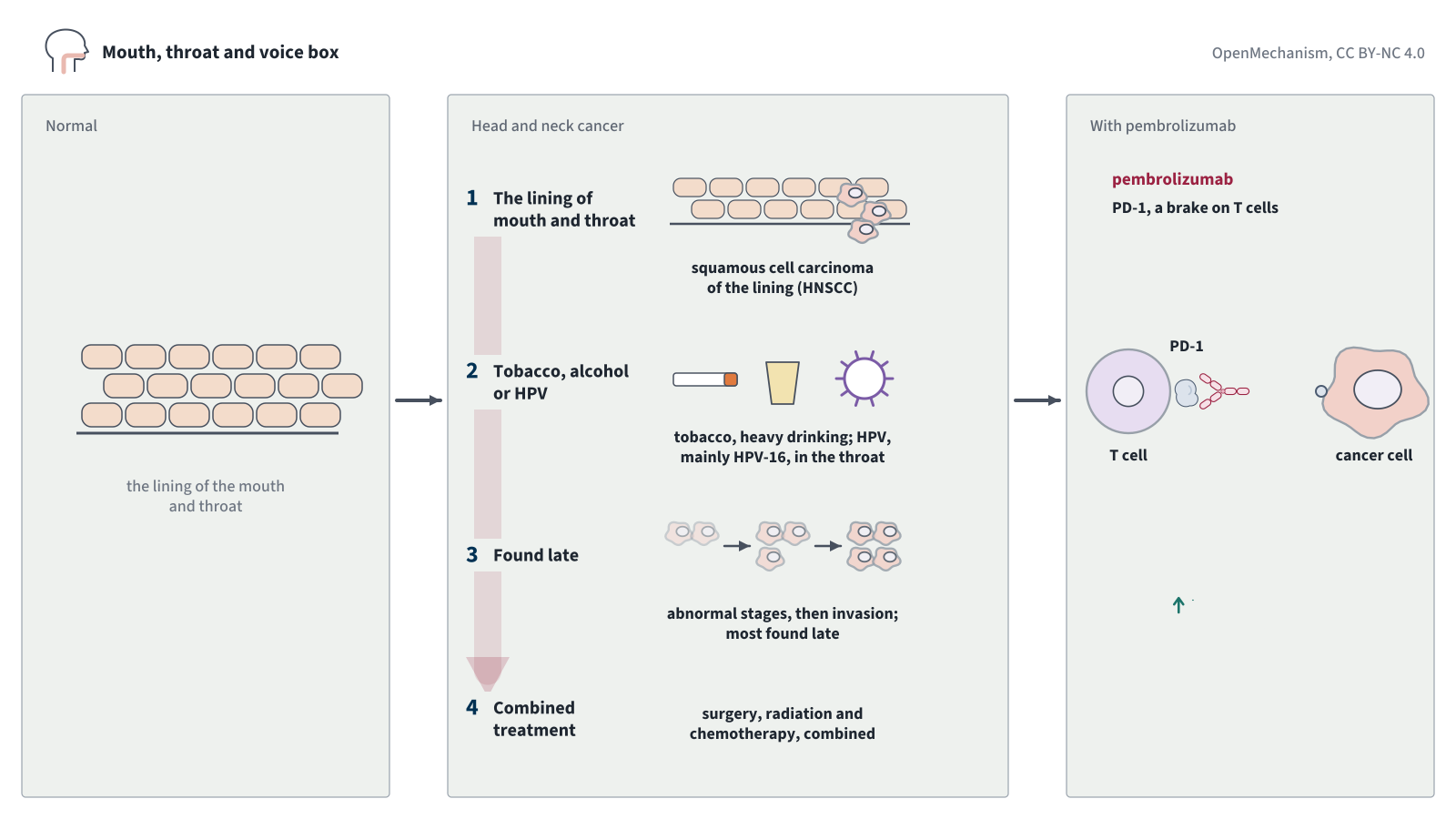
Most head and neck cancers are squamous cell carcinomas (HNSCC) of the lining of the mouth, throat (pharynx) and voice box (larynx). Mouth and voice-box cancers are linked to tobacco and alcohol; throat cancers are more and more often caused by HPV. Most are found late. Treatment combines surgery, radiation and chemotherapy; pembrolizumab releases a brake on T cells.
- Where
- Mouth, throat and voice box
- Body systems
- Cancer; Lungs & airways; Stomach, gut & liver
- Medicines
- 1 medicine
For teachers: download this drawing.
Key terms in this drawing
- HNSCC
- Head and neck squamous cell carcinoma. The cancers that start in the lining of the mouth, throat (pharynx) and voice box (larynx).
- HPV
- Human papillomavirus. The virus whose L1 proteins Gardasil 9 contains, assembled into noninfectious particles.
- PD-1
- Programmed cell death protein 1. A receptor on T cells that acts as a brake when PD-L1 or PD-L2 binds it.
- T cell
- T lymphocyte. A white blood cell of the immune system.
What goes wrong
The lining of mouth and throat. Most head and neck cancers start in the lining (mucosa) of the mouth, throat (pharynx) and voice box (larynx). Together they are called head and neck squamous cell carcinoma ().1
What the source says
“Most head and neck cancers are derived from the mucosal epithelium in the oral cavity, pharynx and larynx and are known collectively as head and neck squamous cell carcinoma (HNSCC).”
Source 1Tobacco, alcohol or HPV. Mouth and voice-box cancers are generally linked to tobacco, heavy drinking or both. Throat cancers are more and more often caused by human papillomavirus (), mainly HPV-16, so HNSCC is split into HPV-negative and HPV-positive.1
What the source says
“Oral cavity and larynx cancers are generally associated with tobacco consumption, alcohol abuse or both, whereas pharynx cancers are increasingly attributed to infection with human papillomavirus (HPV), primarily HPV-16.”
Source 1“Thus, HNSCC can be separated into HPV-negative and HPV-positive HNSCC.”
Source 1Found late. Cells pass through abnormal stages before the cancer invades, but most people are diagnosed late, with no early lesion having been seen.1
What the source says
“Despite evidence of histological progression from cellular atypia through various degrees of dysplasia, ultimately leading to invasive HNSCC, most patients are diagnosed with late-stage HNSCC without a clinically evident antecedent pre-malignant lesion.”
Source 1Combined treatment. Treatment combines surgery, radiation and chemotherapy, depending on where the cancer is. Immune checkpoint blockers are approved for cancer that comes back or spreads.1
What the source says
“Treatment is generally multimodal, consisting of surgery followed by chemoradiotherapy (CRT) for oral cavity cancers and primary CRT for pharynx and larynx cancers.”
Source 1“The FDA approved the immune checkpoint inhibitors pembrolizumab and nivolumab for treatment of recurrent or metastatic HNSCC and pembrolizumab as primary treatment for unresectable disease.”
Source 1
Where medicines act
- A
Pembrolizumab: the PD-1 brake released
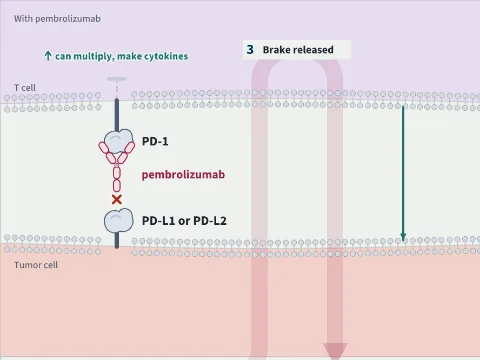
Pembrolizumab blocks , a brake on , and so releases the immune response against the cancer. It treats HNSCC that has spread or come back (with platinum and fluorouracil, alone when the tumor carries , or after platinum chemotherapy), and is given before and after surgery for resectable advanced HNSCC that carries PD-L1.2
What the source says
“Binding of the PD-1 ligands, PD-L1 and PD-L2, to the PD-1 receptor found on T cells, inhibits T cell proliferation and cytokine production.”
Source 2“Pembrolizumab is a monoclonal antibody that binds to the PD-1 receptor and blocks its interaction with PD-L1 and PD-L2, releasing PD-1 pathway-mediated inhibition of the immune response, including the anti-tumor immune response.”
Source 2“KEYTRUDA, in combination with platinum and fluorouracil (FU), is indicated for the first-line treatment of patients with metastatic or with unresectable, recurrent head and neck squamous cell carcinoma (HNSCC).”
Source 2“as a single agent for the first-line treatment of patients with metastatic or with unresectable, recurrent HNSCC whose tumors express PD-L1 [Combined Positive Score (CPS) ≥1] as determined by an FDA-authorized test.”
Source 2“KEYTRUDA, as a single agent, is indicated for the treatment of patients with recurrent or metastatic HNSCC with disease progression on or after platinum-containing chemotherapy.”
Source 2“for the treatment of adult patients with resectable locally advanced HNSCC whose tumors express PD-L1 [Combined Positive Score (CPS) ≥1] as determined by an FDA-authorized test, as a single agent as neoadjuvant treatment, continued as adjuvant treatment in combination with radiotherapy (RT) with or without cisplatin and then as a single agent.”
Source 2
See also
Body systems: cancer; lungs & airways; and stomach, gut & liver.
Also used for it: hydroxyurea (for locally advanced squamous cell cancers, with chemoradiation: “HYDREA is indicated for the treatment of: … Locally advanced squamous cell carcinomas of the head and neck (excluding the lip) in combination with chemoradiation.”3); and bleomycin (for squamous cell carcinoma: “It has been shown to be useful in the management of the following neoplasms either as a single agent or in proven combinations with other approved chemotherapeutic agents: … Squamous Cell Carcinoma: Head and neck”4).
Other conditions: cervical cancer, Hodgkin lymphoma, colorectal cancer, non-small cell lung cancer, stomach cancer and B-cell lymphomas.
Side effects: why bleomycin can scar the lungs.
Sources
- 1Head and neck squamous cell carcinomaJohnson DE et al. Nat Rev Dis Primers 2020 (abstract). Saved copy
- 2Keytruda (pembrolizumab): FDA label1 Indications and Usage; 12.1 Mechanism of Action. Saved copy
- 3Hydrea (hydroxyurea): FDA labelIndications and Usage. Saved copy
- 4Bleomycin for injection (Meitheal): FDA labelIndications and Usage. Saved copy
Notes and limits
- Markers that predict which treatment will work best, with the least harm, are still being sought.1
Notes that apply to every page are on How to read a page.
Spotted a mistake? Report an error (hello@openmechanism.com). Since launch, every published error we fix is listed on the corrections page.
Cite this page
Tran D. Head and neck cancer [Internet]. OpenMechanism; 2026 [updated 2026 Oct 21; cited 2026 Oct 21]. Available from: https://openmechanism.com/conditions/head-and-neck-cancer