Testicular cancer
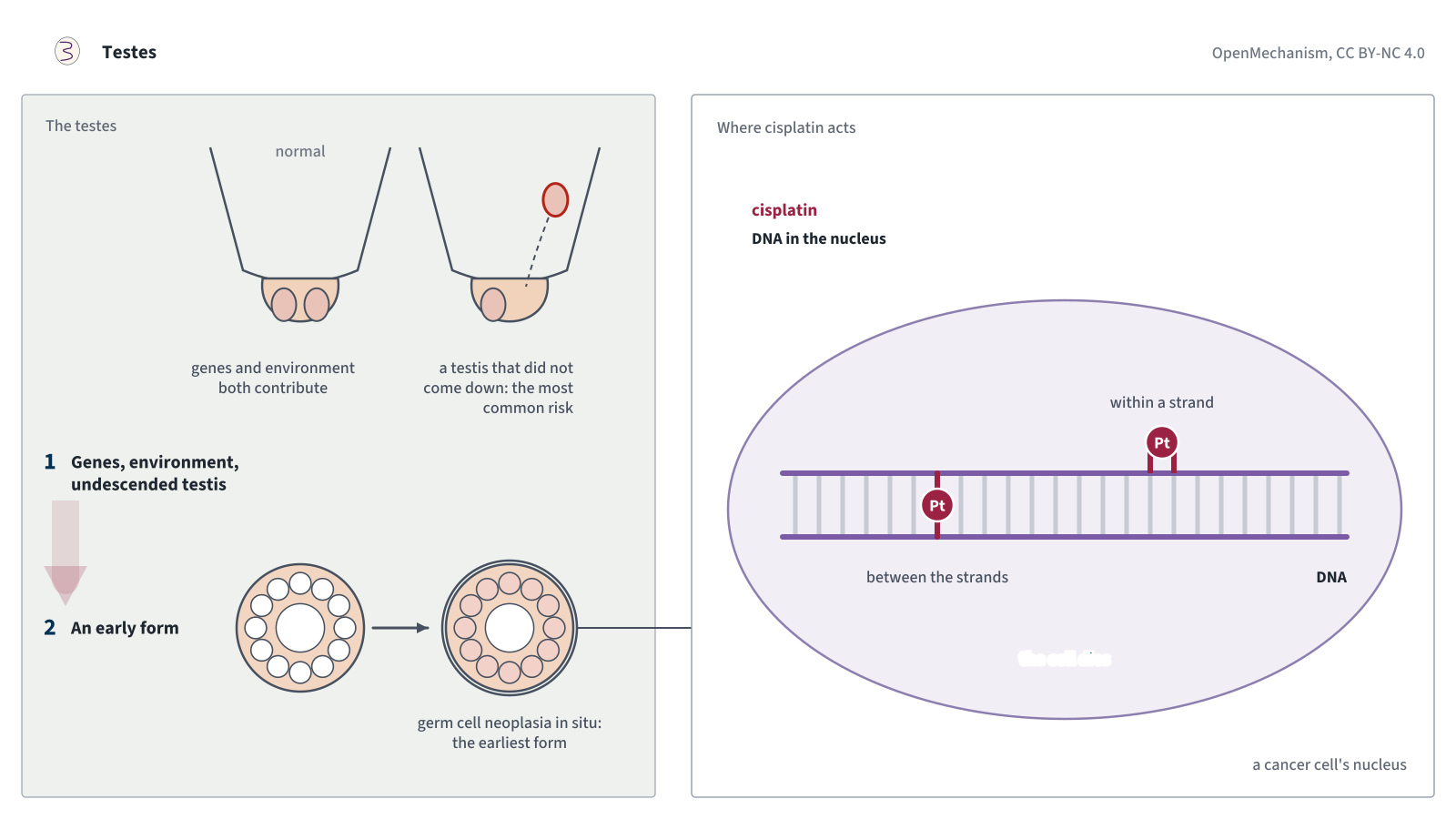
Testicular cancer is the most common cancer in men aged 14 to 44 and has become more common in Western countries. Genes and environment both contribute; an undescended testis is the most common risk factor. Surgery with cisplatin-based chemotherapy cures more than 90%, though some cancers stop responding or come back late. Cisplatin kills cells mainly by cross-linking DNA.
- Where
- Testes
- Body systems
- Cancer, Bladder & reproductive organs
- Medicines
- 1 medicine
For teachers: download this drawing.
Key terms in this drawing
- DNA
- Deoxyribonucleic acid. The molecule that stores genes.
What goes wrong
Genes, environment, undescended testis. Genes and the environment both contribute. The most common risk factor is a testis that did not come down into the scrotum (cryptorchidism).1
What the source says
“Both genetic and environmental factors contribute to the development of testicular cancer, for which cryptorchidism is the most common risk factor.”
Source 1An early form. Understanding of its earliest form, germ cell neoplasia in situ (first described in 1972 as carcinoma in situ of the testis), has improved treatment.1
What the source says
“Progress has been made in our understanding of the disease since the initial description of carcinoma in situ of the testis in 1972 (now referred to as germ cell neoplasia in situ), which has led to improved treatment options.”
Source 1
Where medicines act
- A
Cisplatin: DNA cross-linked
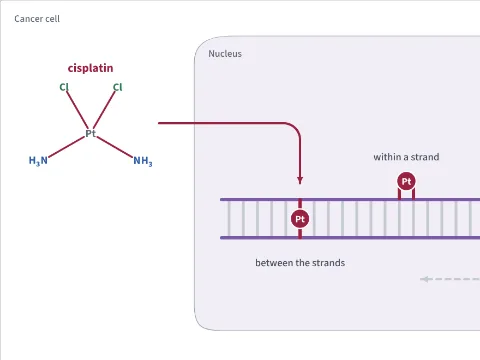
Cisplatin kills cells mainly by binding in the nucleus and cross-linking its strands. It treats advanced testicular cancer.2
See also
Body systems: cancer and bladder & reproductive organs.
Also used for it: etoposide (for refractory testicular tumors, with other chemotherapy: “ETOPOPHOS is indicated, in combination with other chemotherapeutic drugs, for treatment of patients with refractory testicular tumors.”3); and bleomycin (for embryonal cell carcinoma, choriocarcinoma and teratocarcinoma: “It has been shown to be useful in the management of the following neoplasms either as a single agent or in proven combinations with other approved chemotherapeutic agents: … Testicular Carcinoma: Embryonal cell, choriocarcinoma, and teratocarcinoma.”4).
Other conditions: bladder bleeding from chemotherapy (hemorrhagic cystitis); bladder cancer; cervical cancer; ovarian cancer; head and neck cancer; and Hodgkin lymphoma.
Side effects: why cisplatin can harm the kidneys, why cisplatin can harm hearing and why bleomycin can scar the lungs.
Sources
- 1Testicular cancerCheng L et al. Nat Rev Dis Primers 2018 (abstract). Saved copy
- 2Cisplatin for injection: FDA label1.1 Advanced Testicular Cancer; 12.1 Mechanism of Action. Saved copy
- 3Etopophos (etoposide phosphate): FDA labelIndications and Usage. Saved copy
- 4Bleomycin for injection (Meitheal): FDA labelIndications and Usage. Saved copy
Notes and limits
- Why some tumors resist chemotherapy is not yet understood well enough to design new treatments.1
Notes that apply to every page are on How to read a page.
Spotted a mistake? Report an error (hello@openmechanism.com). Since launch, every published error we fix is listed on the corrections page.
Cite this page
Tran D. Testicular cancer [Internet]. OpenMechanism; 2026 [updated 2026 Oct 21; cited 2026 Oct 21]. Available from: https://openmechanism.com/conditions/testicular-cancer