Hydroxyurea
Its precise mechanism cannot yet be described, but studies support the hypothesis that hydroxyurea blocks ribonucleotide reductase and so stops synthesis at once, while and protein are still made. How it helps in sickle cell anemia is uncertain; effects that may contribute include more fetal hemoglobin in red cells and fewer neutrophils.
- Acts on
- Ribonucleotide reductase
- Where
- Dividing cells; red blood cells in sickle cell anemia
- Medicine type
- Small molecule
- Used for
- Cancer
- Drug class
- Antimetabolites
Also called Hydrea and Droxia.
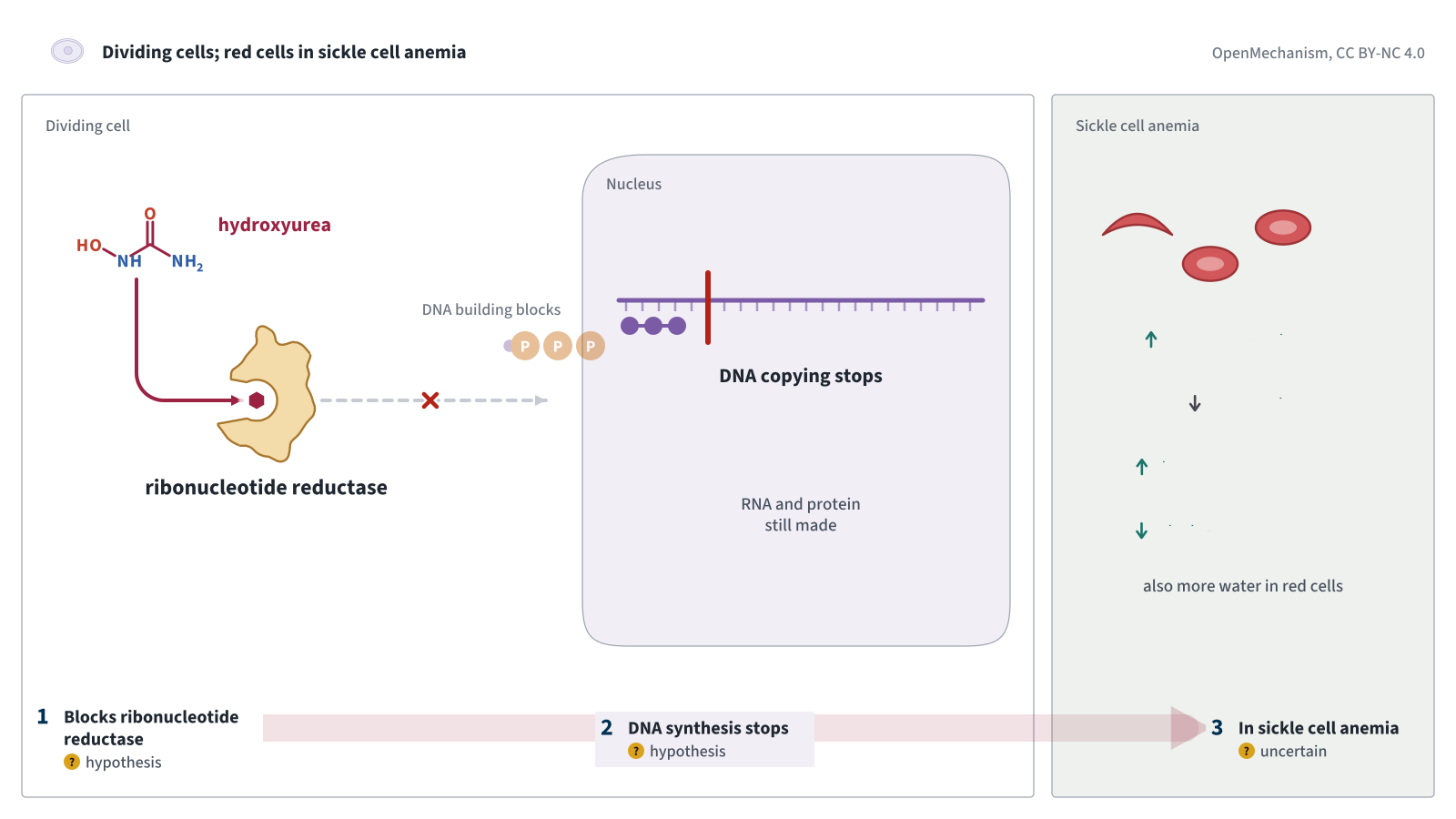
Step 1: hypothesis
The Hydrea label says: The precise mechanism by which hydroxyurea produces its antineoplastic effects cannot, at present, be described. However, the reports of various studies in tissue culture in rats and humans lend support to the hypothesis that hydroxyurea causes an immediate inhibition of DNA synthesis by acting as a ribonucleotide reductase inhibitor, without interfering with the synthesis of ribonucleic acid or of protein.
Source 1: Hydrea (hydroxyurea): FDA label, 12.1 Mechanism of Action
Clinical study: In a randomized, double-blind trial in 299 adults with sickle cell anemia and frequent painful crises; the trial measured crisis rates, not how hydroxyurea works: had lower annual rates of crises than the 147 patients given placebo (median, 2.5 vs. 4.5 crises per year
Charache S et al., N Engl J Med 1995 (PMID 7715639)
This study was picked with a literature search and is not yet checked by our reviewer.
Step 2: hypothesis
The Droxia label says: The precise mechanism by which hydroxyurea produces its cytotoxic and cytoreductive effects is not known. However, various studies support the hypothesis that hydroxyurea causes an immediate inhibition of DNA synthesis by acting as a ribonucleotide reductase inhibitor, without interfering with the synthesis of ribonucleic acid or of protein.
Source 2: Droxia (hydroxyurea): FDA label, 12.1 Mechanism of Action
Clinical study: In a randomized, double-blind trial in 299 adults with sickle cell anemia and frequent painful crises; the trial measured crisis rates, not how hydroxyurea works: had lower annual rates of crises than the 147 patients given placebo (median, 2.5 vs. 4.5 crises per year
Charache S et al., N Engl J Med 1995 (PMID 7715639)
This study was picked with a literature search and is not yet checked by our reviewer.
Step 3: uncertain
The Droxia label says: The mechanisms by which DROXIA produces its beneficial effects in patients with sickle cell anemia (SCA) are uncertain. Known pharmacologic effects of DROXIA that may contribute to its beneficial effects include increasing hemoglobin F levels in red blood cells (RBCs), decreasing neutrophils, increasing the water content of RBCs, increasing deformability of sickled cells, and altering the adhesion of RBCs to endothelium.
Source 2: Droxia (hydroxyurea): FDA label, 12.1 Mechanism of Action
Clinical study: In a randomized, double-blind trial in 299 adults with sickle cell anemia and frequent painful crises; the trial measured crisis rates, not how hydroxyurea works: had lower annual rates of crises than the 147 patients given placebo (median, 2.5 vs. 4.5 crises per year
Charache S et al., N Engl J Med 1995 (PMID 7715639)
This study was picked with a literature search and is not yet checked by our reviewer.
Key terms in this drawing
- DNA
- Deoxyribonucleic acid. The molecule that stores genes.
- HbF
- Fetal hemoglobin. The form of hemoglobin made mainly before birth.
- RNA
- Ribonucleic acid. A molecule copied from DNA; messenger RNA carries a gene's instructions.
How it works
Blocks ribonucleotide reductase. Studies in tissue culture, in rats and in humans support the hypothesis that hydroxyurea blocks ribonucleotide reductase; its precise mechanism cannot yet be described.1
DNA synthesis stops. On that hypothesis, it stops DNA synthesis at once, without interfering with the making of RNA or protein.1,2
In sickle cell anemia. How it helps in sickle cell anemia is uncertain; known effects that may contribute include more hemoglobin F (fetal hemoglobin) in red cells, fewer neutrophils, more water in red cells, more deformable sickled cells and red cells sticking less to the vessel wall.2
For teachers: download this drawing.
See also
Condition pages: chronic myeloid leukemia; head and neck cancer; and sickle cell disease.
Other antimetabolites: cytarabine, fluorouracil, gemcitabine, mercaptopurine and methotrexate.
Related drawings: gemcitabine (also blocks ribonucleotide reductase, through its diphosphate).
Body system: cancer.
Sources
- 1Hydrea (hydroxyurea): FDA label12.1 Mechanism of Action
- 2Droxia (hydroxyurea): FDA label12.1 Mechanism of Action
- 3ChEMBL CHEMBL467Target and action classification: Ribonucleoside-diphosphate reductase RR1 inhibitor
- 4Effect of hydroxyurea on the frequency of painful crises in sickle cell anemia. Investigators of the Multicenter Study of Hydroxyurea in Sickle Cell AnemiaCharache S et al. N Engl J Med 1995 (abstract)
Also used for the drawing
The ribonucleotide reductase outline is traced from the crystal structure below.
- 5Yeast ribonucleotide reductase large subunit (Rnr1) with gemcitabine diphosphatePDB 2EUD; Xu, H. et al. Proc.Natl.Acad.Sci.Usa 2006; 103:4028-4033
Spotted a mistake? Report an error (hello@openmechanism.com). Since launch, every published error we fix is listed on the corrections page.
Notes and limits
- A schematic teaching drawing: not to scale, not exact structures, binding poses or a complete pathway, and not a guide to dosing, treatment or how a person will respond.
- A hypothesis (the Hydrea label, 12.1).
- A hypothesis (the labels, 12.1).
- The Droxia label: the mechanisms are uncertain (12.1).
All recorded limits are on the evidence page, and notes that apply to every page are on How to read a page. Version 1.0.0, not yet medically reviewed.
Cite this page
Tran D. Hydroxyurea [Internet]. OpenMechanism; 2026 [updated 2026 Oct 18; cited 2026 Oct 18]. Available from: https://openmechanism.com/medicines/hydroxyurea