Bortezomib
Bortezomib blocks the , the machine that breaks down tagged proteins. Protein levels and signals inside the cell are thrown off balance, which can kill cells; laboratory and animal models show cancer-cell killing and slower tumor growth.
- Acts on
- 26S proteasome chymotrypsin-like activity
- Where
- Cancer cells' protein-disposal system
- Medicine type
- Small molecule
- Used for
- Cancer
Also called Velcade.
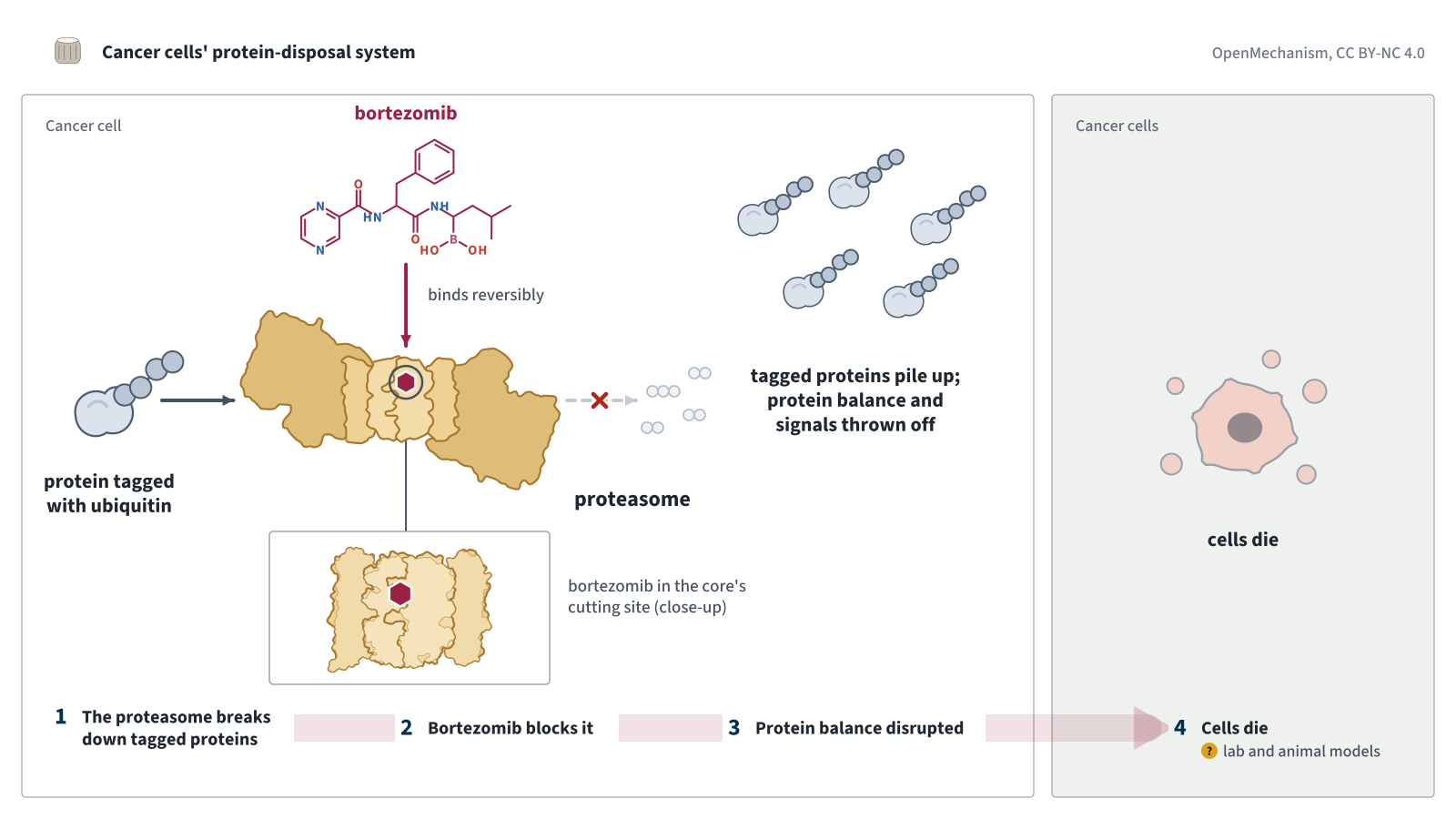
Step 4: lab and animal models
The Velcade label says: Experiments have demonstrated that bortezomib is cytotoxic to a variety of cancer cell types in vitro . … Bortezomib causes a delay in tumor growth in vivo in nonclinical tumor models, including multiple myeloma.
Source 1: Velcade (bortezomib): FDA label, 12.1 Mechanism of Action
Clinical study: In a randomized trial (APEX) in 669 people with multiple myeloma that had relapsed after one to three earlier treatments, comparing bortezomib with high-dose dexamethasone; the trial measured response, time to progression and survival, not how cancer cells die: Patients treated with bortezomib had higher response rates, a longer time to progression (the primary end point), and a longer survival than patients treated with dexamethasone.
Richardson PG et al., N Engl J Med 2005 (PMID 15958804)
This study was picked with a literature search and is not yet checked by our reviewer.
Key terms in this drawing
- proteasome
- 26S proteasome. The cell’s machine for breaking down proteins that have been tagged for destruction.
How it works
The proteasome breaks down tagged proteins. The 26S proteasome normally degrades ubiquitinated proteins.1
Bortezomib blocks it. Bortezomib reversibly inhibits its chymotrypsin-like activity.1
Protein balance disrupted. Reduced targeted proteolysis affects intracellular protein concentrations and multiple signaling cascades.1
Cells die. Disrupted homeostasis can cause cell death; cytotoxicity and tumor-growth delay are demonstrated in nonclinical models.1
For teachers: download this drawing or build a slide deck.
See also
Condition pages: B-cell lymphomas and multiple myeloma.
More medicines for cancer: abiraterone acetate, anastrozole, belzutifan, bevacizumab, bleomycin, blinatumomab, brentuximab vedotin, cisplatin and 38 more.
Body system: cancer.
Sources
- 1Velcade (bortezomib): FDA label12.1 Mechanism of Action
- 2ChEMBL CHEMBL325041Target and action classification: 26S proteasome inhibitor
- 3Bortezomib or high-dose dexamethasone for relapsed multiple myelomaRichardson PG et al. N Engl J Med 2005 (abstract)
Also used for the drawing
The proteasome outline is traced from the electron microscopy and crystal structures below.
- 4Human 26S proteasome (the core with a cap at each end)PDB 5GJR; Huang, X. et al. Nat. Struct. Mol. Biol. 2016; 23:778-785
- 5Human 20S proteasome (the core) with bortezomibPDB 5LF3; Schrader, J. et al. Science 2016; 353:594-598
Spotted a mistake? Report an error (hello@openmechanism.com). Since launch, every published error we fix is listed on the corrections page.
Notes and limits
- A schematic teaching drawing: not to scale, not exact structures, binding poses or a complete pathway, and not a guide to dosing, treatment or how a person will respond.
- The steps are in the order that explains them; one step is said to cause the next only where the source says so.
- This is inhibition of protein degradation, unlike E3-mediated degradation induction.
- No single downstream cascade is claimed to explain every cancer response.
All recorded limits are on the evidence page, and notes that apply to every page are on How to read a page. Version 1.0.0, not yet medically reviewed.
Cite this page
Tran D. Bortezomib [Internet]. OpenMechanism; 2026 [updated 2026 Oct 15; cited 2026 Oct 15]. Available from: https://openmechanism.com/medicines/bortezomib