Acute myeloid leukemia
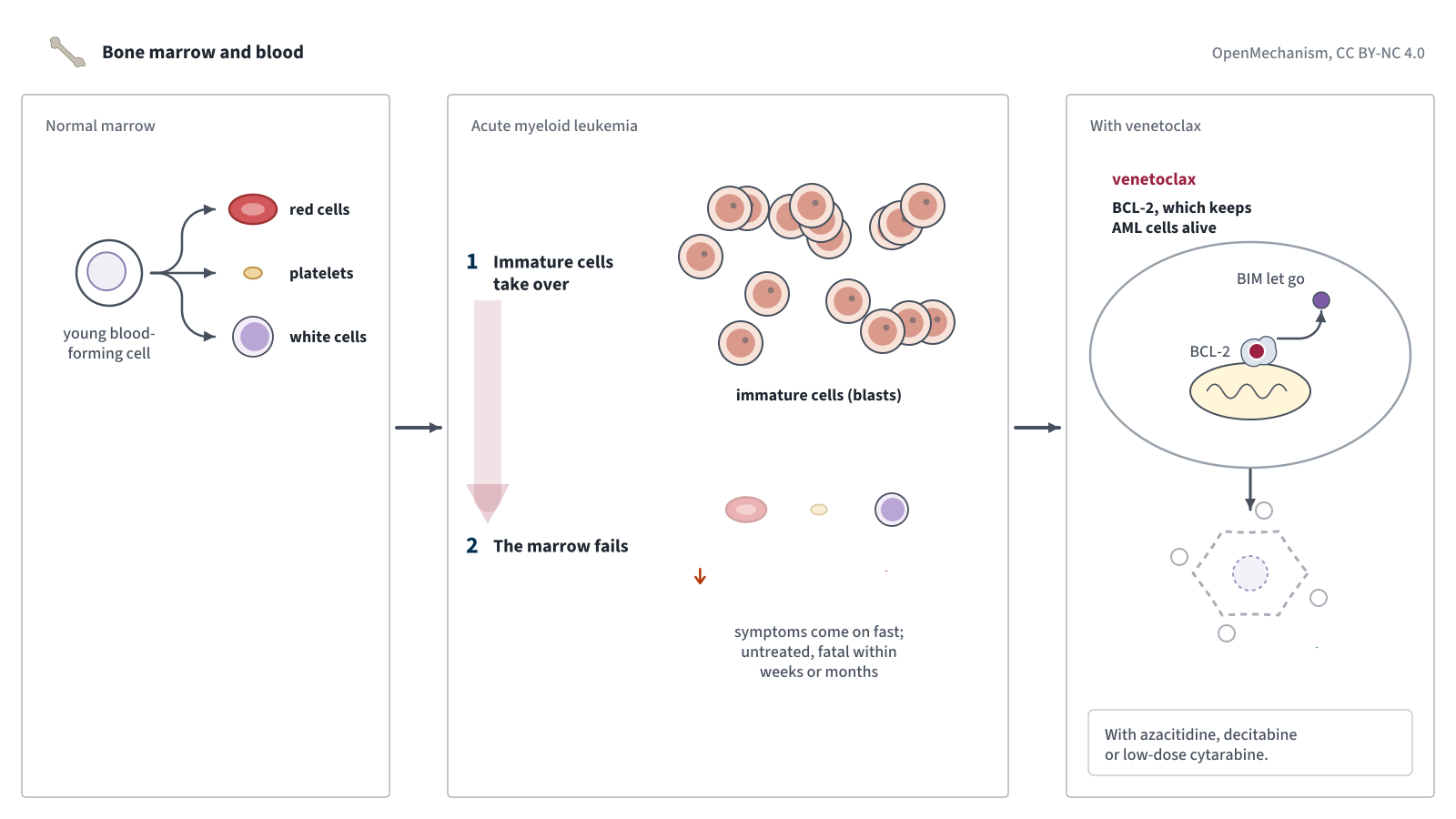
Acute myeloid leukemia (AML) starts in early blood-forming cells: immature cancer cells pile up and fewer normal blood cells are made. Symptoms come on fast from marrow failure; untreated, it can kill within weeks or months. It is most common in people over 60, and more than half die of it. Venetoclax blocks BCL-2, which keeps AML cells alive.
- Where
- Bone marrow and blood
- Body systems
- Cancer, Blood & clotting
- Medicines
- 1 medicine
For teachers: download this drawing.
Key terms in this drawing
- AML
- Acute myeloid leukemia. A blood cancer in which a clone of early blood-forming (stem or progenitor) cells multiplies out of control.
- BCL2
- BCL-2 protein. A protein that helps cells avoid programmed cell death.
- BIM
- BCL2-interacting mediator of cell death. A protein that triggers programmed cell death when it is set free.
What goes wrong
Immature cells take over. starts in early blood-forming cells; immature cancer cells pile up, and fewer red cells, platelets and white cells are made.1
What the source says
“Acute myeloid leukaemia (AML) is a disorder characterized by a clonal proliferation derived from primitive haematopoietic stem cells or progenitor cells.”
Source 1“Abnormal differentiation of myeloid cells results in a high level of immature malignant cells and fewer differentiated red blood cells, platelets and white blood cells.”
Source 1The marrow fails. Symptoms come on fast from bone marrow failure; untreated, it can be fatal within weeks or months.1
What the source says
“AML typically presents with a rapid onset of symptoms that are attributable to bone marrow failure and may be fatal within weeks or months when left untreated.”
Source 1
Where medicines act
- A
Venetoclax: BCL-2 blocked, the cell can die
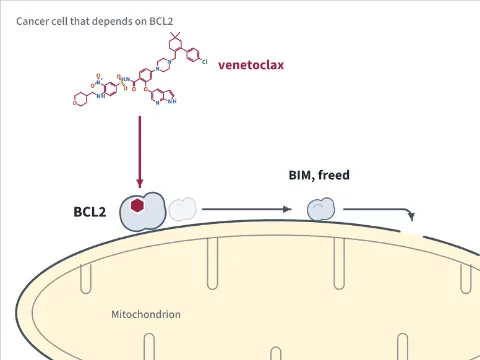
AML cells make too much , a protein that keeps them alive. Venetoclax binds BCL-2 and frees proteins such as , which set off apoptosis. With azacitidine, decitabine or low-dose cytarabine, it treats newly diagnosed AML in people 75 or older or who cannot have intensive chemotherapy.2
What the source says
“Venetoclax is a selective and orally bioavailable small-molecule inhibitor of BCL-2, an anti-apoptotic protein.”
Source 2“Overexpression of BCL-2 has been demonstrated in CLL and AML cells where it mediates tumor cell survival and has been associated with resistance to chemotherapeutics.”
Source 2“Venetoclax helps restore the process of apoptosis by binding directly to the BCL-2 protein, displacing pro-apoptotic proteins like BIM, triggering mitochondrial outer membrane permeabilization and the activation of caspases.”
Source 2“In combination with azacitidine, or decitabine, or low-dose cytarabine for the treatment of newly diagnosed acute myeloid leukemia (AML) in adults 75 years or older, or who have comorbidities that preclude use of intensive induction chemotherapy.”
Source 2
See also
Body systems: cancer and blood & clotting.
Also used for it: cyclophosphamide (“Cyclophosphamide Tablets is indicated for the treatment of: … acute myelogenous and monocytic leukemia”4); doxorubicin (“Doxorubicin Hydrochloride Injection is indicated for the treatment of … acute myeloblastic leukemia”5); filgrastim (for a faster return of neutrophils after chemotherapy for AML: “NEUPOGEN is indicated for reducing the time to neutrophil recovery and the duration of fever, following induction or consolidation chemotherapy treatment of patients with acute myeloid leukemia (AML)”6); and cytarabine (for bringing on remission, with other anticancer medicines: “Cytarabine Injection in combination with other approved anti-cancer drugs is indicated for remission induction in acute non-lymphocytic leukemia of adults and pediatric patients.”7).
Other conditions: acute lymphoblastic leukemia, chronic lymphocytic leukemia, chronic myeloid leukemia, Hodgkin lymphoma, B-cell lymphomas and breast cancer.
Sources
- 1Acute myeloid leukaemiaKhwaja A et al. Nat Rev Dis Primers 2016 (abstract). Saved copy
- 2Venclexta (venetoclax): FDA label1 Indications and Usage; 12.1 Mechanism of Action. Saved copy
- 3Acute myeloid leukaemiaShort NJ et al. Lancet 2018 (abstract). Saved copy
- 4Cyclophosphamide tablets (Baxter): FDA label1 Indications and Usage. Saved copy
- 5Doxorubicin hydrochloride injection (Pfizer): FDA label1 Indications and Usage. Saved copy
- 6Neupogen (filgrastim): FDA label1 Indications and Usage. Saved copy
- 7Cytarabine injection (Meitheal): FDA labelIndications and Usage. Saved copy
Notes and limits
- Outcomes remain poor: more than half of patients ultimately die of the disease.3
Notes that apply to every page are on How to read a page.
Spotted a mistake? Report an error (hello@openmechanism.com). Since launch, every published error we fix is listed on the corrections page.
Cite this page
Tran D. Acute myeloid leukemia [Internet]. OpenMechanism; 2026 [updated 2026 Oct 19; cited 2026 Oct 19]. Available from: https://openmechanism.com/conditions/acute-myeloid-leukemia