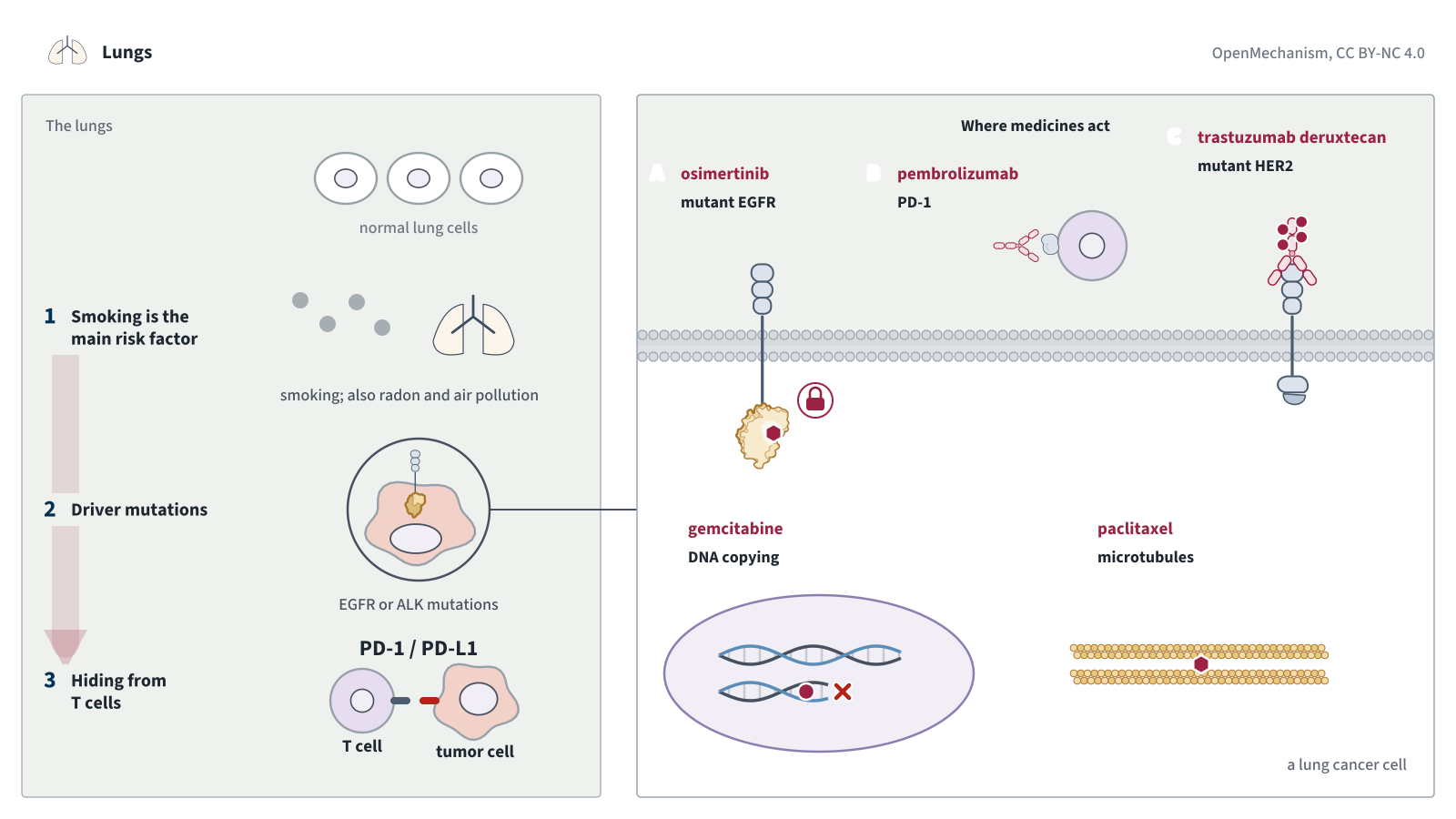
Non-small cell lung cancer makes up about 85 percent of new lung cancer diagnoses, in a 2015 review; smoking is the main risk factor. Some are driven by mutations in genes such as EGFR and ALK; some raise PD-1 ligands, which can help hold back T cells. Osimertinib blocks certain mutant forms of EGFR, pembrolizumab releases the PD-1 brake, trastuzumab deruxtecan targets HER2-mutant tumors, gemcitabine stops DNA copying, and paclitaxel stabilizes microtubules.
What goes wrong in non-small cell lung cancer, and where medicines act. Schematic, not to scale. EGFR outline from part of the protein (residues 696 to 1022). License CC BY-NC 4.0.
Anaplastic lymphoma kinase. A kinase; changes in its gene are one of the driver mutations in non-small cell lung cancer.
DNA
Deoxyribonucleic acid. The molecule that stores genes.
EGFR
Epidermal growth factor receptor. A receptor with a kinase part, in the same receptor family as HER2; changes in its gene are one of the driver mutations in non-small cell lung cancer.
HER2
Human epidermal growth factor receptor 2. A receptor that some cancer cells have in large amounts.
microtubule
Microtubule. A structure inside the cell, built from the protein tubulin, that the cell needs for dividing and for other vital work.
PD-1
Programmed cell death protein 1. A receptor on T cells that acts as a brake when PD-L1 or PD-L2 binds it.
PD-L1
Programmed death-ligand 1. One of the two PD-1 ligands (PD-L1 and PD-L2): it binds PD-1 on T cells and holds them back, and some tumors make more of it.
T cell
T lymphocyte. A white blood cell of the immune system.
What goes wrong
Smoking is the main risk factor. Radon and air pollution also play a part.1
What the source says
“Tobacco smoking remains the main risk factor for developing this disease, but radon exposure and air pollution also have a role.”
Driver mutations. Several driver mutations have been found, for example in and .1
What the source says
“Several of these driver mutations have been identified (for example, in epidermal growth factor receptor (EGFR) and anaplastic lymphoma kinase (ALK))”
Hiding from T cells. Some tumors raise , and signaling through PD-1 can help hold back the that watch for tumors.2
What the source says
“Upregulation of PD-1 ligands occurs in some tumors and signaling through this pathway can contribute to inhibition of active T-cell immune surveillance of tumors.”
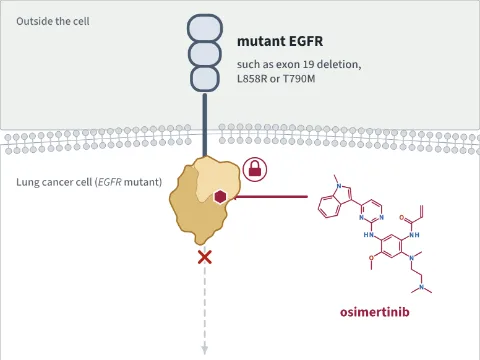
Osimertinib blocks EGFR's kinase: it binds certain mutant forms of EGFR permanently, at about a ninth of the concentration needed for normal EGFR. It treats adults whose non-small cell lung cancer has EGFR exon 19 deletions or the exon 21 mutation: after surgery to remove the tumor; for stage III cancer that cannot be removed and has not grown during or after platinum-based chemoradiation; and as a first treatment for cancer that has spread or, with pemetrexed and platinum-based chemotherapy, for cancer that is locally advanced or has spread. It also treats adults whose spread cancer has the EGFR mutation and has grown on or after EGFR tyrosine kinase inhibitor treatment.3
What the source says
“Osimertinib is a kinase inhibitor of the epidermal growth factor receptor (EGFR), which binds irreversibly to certain mutant forms of EGFR (T790M, L858R, and exon 19 deletions) at approximately 9-fold lower concentrations than wild-type.”
“adjuvant therapy after tumor resection in adult patients with non-small cell lung cancer (NSCLC) whose tumors have epidermal growth factor receptor (EGFR) exon 19 deletions or exon 21 L858R mutations, as detected by an FDA-approved test.”
“the treatment of adult patients with locally advanced, unresectable (stage III) NSCLC whose disease has not progressed during or following concurrent or sequential platinum-based chemoradiation therapy and whose tumors have EGFR exon 19 deletions or exon 21 L858R mutations, as detected by an FDA-approved test.”
“the first-line treatment of adult patients with metastatic NSCLC whose tumors have EGFR exon 19 deletions or exon 21 L858R mutations, as detected by an FDA-approved test.”
“in combination with pemetrexed and platinum-based chemotherapy, the first-line treatment of adult patients with locally advanced or metastatic NSCLC whose tumors have EGFR exon 19 deletions or exon 21 L858R mutations, as detected by an FDA-approved test.”
“the treatment of adult patients with metastatic EGFR T790M mutation-positive NSCLC, as detected by an FDA-approved test, whose disease has progressed on or after EGFR TKI therapy.”
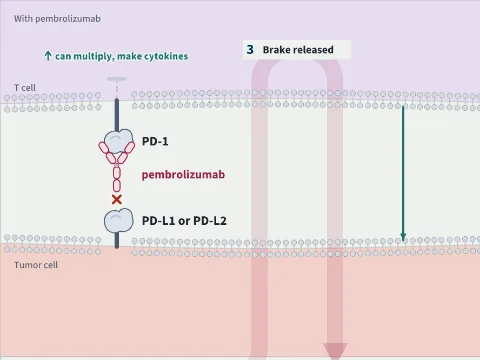
Pembrolizumab binds PD-1 on T cells and stops and from binding it, releasing the brake on the immune response, including the response against tumors. With pemetrexed and platinum chemotherapy, it is a first treatment for nonsquamous NSCLC that has spread, without EGFR or ALK changes. Its label lists other lung cancer uses too, among them: on its own, a first treatment when a test shows the tumor carries PD-L1 (TPS ≥1%) and there are no EGFR or ALK changes, for stage III cancer in people who are not candidates for surgery to remove it or definitive chemoradiation, or for cancer that has spread; and, for cancer that can be removed (tumors ≥4 cm or node positive), with platinum-containing chemotherapy before surgery and then on its own after it.2
What the source says
“Pembrolizumab is a monoclonal antibody that binds to the PD-1 receptor and blocks its interaction with PD-L1 and PD-L2, releasing PD-1 pathway-mediated inhibition of the immune response, including the anti-tumor immune response.”
“in combination with pemetrexed and platinum chemotherapy, as first-line treatment of patients with metastatic nonsquamous NSCLC, with no EGFR or ALK genomic tumor aberrations.”
“as a single agent for the first-line treatment of patients with NSCLC expressing PD-L1 [Tumor Proportion Score (TPS) ≥1%] as determined by an FDA-authorized test, with no EGFR or ALK genomic tumor aberrations, and is: Stage III where patients are not candidates for surgical resection or definitive chemoradiation, or metastatic.”
“KEYTRUDA is indicated for the treatment of patients with resectable (tumors ≥4 cm or node positive) NSCLC in combination with platinum-containing chemotherapy as neoadjuvant treatment, and then continued as a single agent as adjuvant treatment after surgery.”
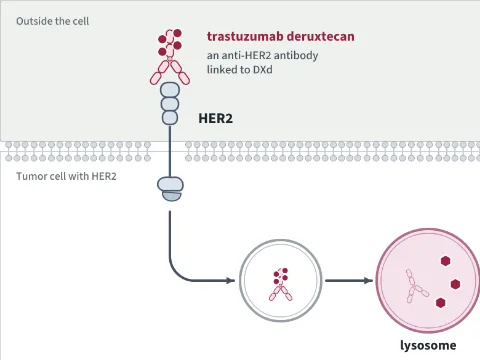
Trastuzumab deruxtecan is a antibody joined to a DNA-damaging compound, . After binding HER2 it is taken into the cell, where enzymes release DXd, which damages and kills the cell. On its own, it treats adults with NSCLC that cannot be removed or has spread when the tumor has an activating HER2 mutation, after an earlier systemic treatment.4
What the source says
“Fam-trastuzumab deruxtecan-nxki is a HER2-directed antibody-drug conjugate.”
“Following binding to HER2 on tumor cells, fam-trastuzumab deruxtecan-nxki undergoes internalization and intracellular linker cleavage by lysosomal enzymes. Upon release, the membrane-permeable DXd causes DNA damage and apoptotic cell death.”
“ENHERTU, as monotherapy, is indicated for the treatment of adult patients with unresectable or metastatic non-small cell lung cancer (NSCLC) whose tumors have activating HER2 (ERBB2) mutations, as detected by an FDA-authorized test, and who have received a prior systemic therapy.”
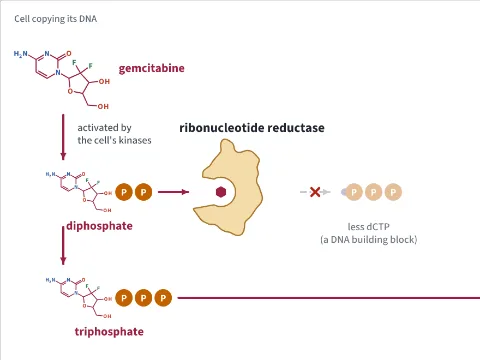
Gemcitabine is turned into gemcitabine triphosphate, which is built into new DNA and stops it growing, so it kills cells that are copying their DNA. With cisplatin, it is a first treatment for non-small cell lung cancer that cannot be operated on and is locally advanced (stage IIIA or IIIB) or has spread (stage IV).5
What the source says
“Gemcitabine kills cells undergoing DNA synthesis and blocks the progression of cells through the G1/S-phase boundary.”
“After the gemcitabine nucleotide is incorporated into DNA, only one additional nucleotide is added to the growing DNA strands which eventually results in the initiation of apoptotic cell death.”
“Gemcitabine Injection in combination with cisplatin is indicated for the first-line treatment of patients with inoperable, locally advanced (Stage IIIA or IIIB) or metastatic (Stage IV) non-small cell lung cancer (NSCLC).”
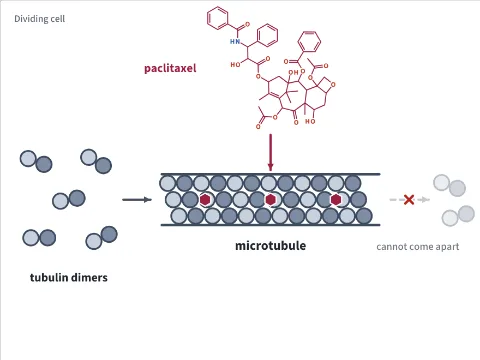
Paclitaxel helps build and stabilizes them so the cell cannot reorganize them, which it needs to divide. With cisplatin, it is a first treatment for non-small cell lung cancer in people who cannot have surgery or radiation aimed at a cure.6
What the source says
“Paclitaxel is a novel antimicrotubule agent that promotes the assembly of microtubules from tubulin dimers and stabilizes microtubules by preventing depolymerization.”
“This stability results in the inhibition of the normal dynamic reorganization of the microtubule network that is essential for vital interphase and mitotic cellular functions.”
“Paclitaxel Injection USP, in combination with cisplatin, is indicated for the first-line treatment of non-small cell lung cancer in patients who are not candidates for potentially curative surgery and/or radiation therapy.”
The National Cancer Institute's treatment summary for non-small cell lung cancer (updated 15 May 2025) describes these combinations. For the lettered medicines above, the page gives only the uses their own labels list. The quotes may name medicines, combinations or groups of patients that a medicine's own label does not list, and may leave out its label's limits.
Stages IIA and IIB NSCLC: “Surgery with or without adjuvant and/or neoadjuvant therapy. … Perioperative (neoadjuvant and adjuvant) immunotherapy with neoadjuvant chemotherapy. Perioperative pembrolizumab plus platinum-based chemotherapy. Perioperative durvalumab plus platinum-based chemotherapy. Perioperative nivolumab plus platinum-based chemotherapy. Perioperative toripalimab plus platinum-based chemotherapy.”9
Newly diagnosed stage IV, relapsed, and recurrent NSCLC (first-line therapy): “Cytotoxic combination chemotherapy with platinum (cisplatin or carboplatin) and paclitaxel, gemcitabine, docetaxel, vinorelbine, irinotecan, protein-bound paclitaxel, or pemetrexed.”9
Newly diagnosed stage IV, relapsed, and recurrent NSCLC (first-line therapy): “Immune checkpoint inhibitors with or without chemotherapy. Pembrolizumab plus chemotherapy. Pembrolizumab alone. Cemiplimab-rwlc plus chemotherapy. Cemiplimab-rwlc alone. Tremelimumab. Atezolizumab alone. Atezolizumab plus chemotherapy. Atezolizumab plus bevacizumab plus chemotherapy. Nivolumab plus ipilimumab.”9
Also used for it: bevacizumab (for advanced non-squamous non-small cell lung cancer, with chemotherapy: “Unresectable, locally advanced, recurrent or metastatic non-squamous non-small cell lung cancer, in combination with carboplatin and paclitaxel for first-line treatment.”7); and ipilimumab (for metastatic non-small cell lung cancer with PD-L1 and no EGFR or ALK changes, with nivolumab: “Treatment of adult patients with metastatic non-small cell lung cancer expressing PD-L1 (≥1%) as determined by an FDA-authorized test, with no EGFR or ALK genomic tumor aberrations, as first-line treatment in combination with nivolumab.”8).
Related medicines: cisplatin (named in the gemcitabine and paclitaxel labels: “Gemcitabine Injection in combination with cisplatin is indicated for the first-line treatment of patients with inoperable, locally advanced (Stage IIIA or IIIB) or metastatic (Stage IV) non-small cell lung cancer (NSCLC).”5, and “Paclitaxel Injection USP, in combination with cisplatin, is indicated for the first-line treatment of non-small cell lung cancer in patients who are not candidates for potentially curative surgery and/or radiation therapy.”6).
In a 2015 review, most people are diagnosed at an advanced stage, because screening is limited and symptoms come late. The steps are in the order that explains them; one step is said to cause the next only where a source says so. The Enhertu label says trastuzumab deruxtecan's lung cancer use is approved under accelerated approval, based on response rate and how long responses lasted, and that continued approval may depend on a confirmatory trial.1,4
The combinations quoted from the National Cancer Institute are examples of how these medicines are given together. They are not a full list of regimens, and nothing here is advice on choosing a treatment. The words are from the summary's version of 15 May 2025, and the summary may have changed since. The summary says: “It is intended as a resource to inform and assist clinicians in the care of their patients. It does not provide formal guidelines or recommendations for making health care decisions.”9
Claude Opus 5.5 (AI source check), 14 November 2026: 51 statements compared with their sources, 6 flagged for the reviewer. An automated check, not a medical review.
Conflict of interest
Gemcitabine: Pfizer, the reviewer's former employer, makes or markets this medicine. Details
Key terms
Definitions reworded since this review: ligand and microtubule. Definitions are shared across pages, so a later rewording does not take the review line off (what a review covers).
Next review due
16 May 2028
Cite this page
Tran D. Non-small cell lung cancer [Internet]. OpenMechanism; 2026 [updated 2026 Nov 15; cited 2026 Nov 15]. Available from: https://openmechanism.com/conditions/non-small-cell-lung-cancer