Pegaspargase
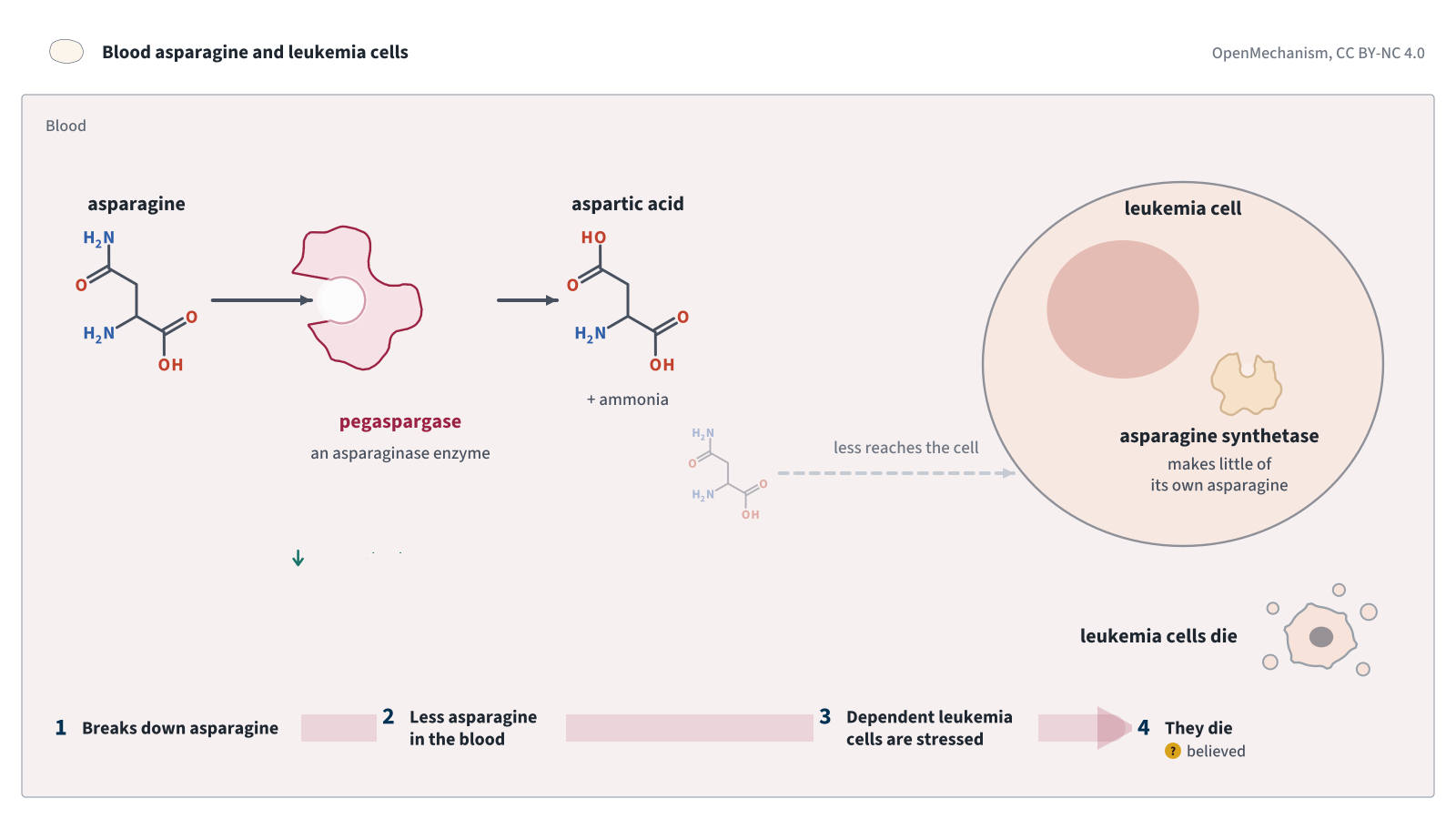
Pegaspargase breaks down asparagine, an amino acid, in the blood. Some leukemia cells cannot make enough of their own asparagine, and the label describes killing of these dependent cells as the believed basis of its effect.
- Acts on
- L-asparagine
- Where
- Blood asparagine and leukemia cells
- Medicine type
- Enzyme
- Used for
- Cancer
Also called Oncaspar.
Step 4: believed
The Oncaspar label says: The pharmacological effect of ONCASPAR is thought to be based on the killing of leukemic cells due to depletion of plasma asparagine.
Source 1: Oncaspar (pegaspargase): FDA label, 12.1 Mechanism of Action
Clinical study: In a randomized trial in 118 children with standard-risk acute lymphoblastic leukemia, pegaspargase was compared with native asparaginase; the trial measured how fast leukemia cells cleared and how far asparagine fell, not whether one causes the other: Patients treated with pegaspargase had more rapid clearance of lymphoblasts from day 7 and day 14 bone marrow aspirates and more prolonged asparaginase activity than those treated with native asparaginase. … There was correlation between asparaginase enzymatic activity and depletion of asparagine or glutamine in serum.
Avramis VI et al., Blood 2002 (PMID 11877270)
This study was picked with a literature search and is not yet checked by our reviewer.
How it works
Breaks down asparagine. Asparaginase activity converts L-asparagine to aspartic acid and ammonia.1
Less asparagine in the blood. The reaction depletes plasma asparagine.1
Dependent leukemia cells are stressed. Cells with low asparagine-synthetase expression have limited capacity to supply their own asparagine.1
They die. The label describes killing of these dependent cells as the believed basis of the pharmacological effect.1
For teachers: download this drawing or build a slide deck.
See also
Condition pages: acute lymphoblastic leukemia.
Body system: cancer.
Sources
- 1Oncaspar (pegaspargase): FDA label12.1 Mechanism of Action
- 2ChEMBL CHEMBL2108546Target and action classification: Asparagine hydrolytic enzyme
- 3
Also used for the drawing
The asparaginase and asparagine synthetase outlines are traced from the crystal structures below.
- 4Escherichia coli L-asparaginasePDB 3ECA; Swain, A.L. et al. Proc.Natl.Acad.Sci.USA 1993; 90:1474-1478
- 5Human asparagine synthetase with the glutamine analog DON (6-diazo-5-oxo-L-norleucine)PDB 6GQ3; Zhu, W. et al. Commun Biol 2019; 2:345
Spotted a mistake? Report an error (hello@openmechanism.com). Since launch, every published error we fix is listed on the corrections page.
Notes and limits
- A schematic teaching drawing: not to scale, not exact structures, binding poses or a complete pathway, and not a guide to dosing, treatment or how a person will respond.
- Other medicines in the same family may not follow every step or share the same clinical endpoint.
- The steps are in the order that explains them; one step is said to cause the next only where the source says so.
- The selected mechanism is thought-based in the label and applies to substrate-dependent cells.
- The enzyme does not need to enter the leukemic cell in this illustrated nutrient-depletion route.
All recorded limits are on the evidence page, and notes that apply to every page are on How to read a page. Version 1.0.0, not yet medically reviewed.
Cite this page
Tran D. Pegaspargase [Internet]. OpenMechanism; 2026 [updated 2026 Oct 16; cited 2026 Oct 16]. Available from: https://openmechanism.com/medicines/pegaspargase