Trastuzumab
Trastuzumab is an antibody that binds . It slows the growth of HER2-rich cancer cells in laboratory and animal studies and helps immune cells attack them. It carries no cytotoxic payload.
- Where
- HER2-positive cancer cells
- Used for
- Cancer
- Drug class
- Antibody medicines
Also called Herceptin.
Models; association
The 2004 study by Nagata and colleagues says: Reducing PTEN in breast cancer cells by antisense oligonucleotides conferred trastuzumab resistance in vitro and in vivo. … Patients with PTEN-deficient breast cancers had significantly poorer responses to trastuzumab-based therapy than those with normal PTEN.
Clinical study: In a randomized trial in 469 women with metastatic breast cancer that overexpressed HER2, standard chemotherapy alone or with trastuzumab; the trial measured time to disease progression, response and survival, not PTEN or resistance: Trastuzumab increases the clinical benefit of first-line chemotherapy in metastatic breast cancer that overexpresses HER2.
Slamon DJ et al., N Engl J Med 2001 (PMID 11248153)
This study was picked with a literature search and is not yet checked by our reviewer.
Step 3: models
The Herceptin label says: Herceptin has been shown, in both in vitro assays and in animals, to inhibit the proliferation of human tumor cells that overexpress HER2.
Source 1: Herceptin (trastuzumab): FDA label, §11; §12.1; §12.3 washout
Clinical study: In a randomized trial in 469 women with metastatic breast cancer that overexpressed HER2, standard chemotherapy alone or with trastuzumab; the trial measured time to disease progression, response and survival, not whether the cancer cells grow more slowly: Trastuzumab increases the clinical benefit of first-line chemotherapy in metastatic breast cancer that overexpresses HER2.
Slamon DJ et al., N Engl J Med 2001 (PMID 11248153)
This study was picked with a literature search and is not yet checked by our reviewer.
Step 4: lab
The Herceptin label says: Herceptin is a mediator of antibody-dependent cellular cytotoxicity (ADCC). … In vitro , Herceptin-mediated ADCC has been shown to be preferentially exerted on HER2 overexpressing cancer cells compared with cancer cells that do not overexpress HER2.
Source 1: Herceptin (trastuzumab): FDA label, §11; §12.1; §12.3 washout
Clinical study: In a randomized trial in 469 women with metastatic breast cancer that overexpressed HER2, standard chemotherapy alone or with trastuzumab; the trial measured time to disease progression, response and survival, not immune-cell attack: Trastuzumab increases the clinical benefit of first-line chemotherapy in metastatic breast cancer that overexpresses HER2.
Slamon DJ et al., N Engl J Med 2001 (PMID 11248153)
This study was picked with a literature search and is not yet checked by our reviewer.
Step 5: models
The 2004 study by Nagata and colleagues says: Here we report that PTEN activation contributes to trastuzumab's antitumor activity. … Trastuzumab treatment quickly increased PTEN membrane localization and phosphatase activity by reducing PTEN tyrosine phosphorylation via Src inhibition.
Clinical study: In a randomized trial in 469 women with metastatic breast cancer that overexpressed HER2, standard chemotherapy alone or with trastuzumab; the trial measured time to disease progression, response and survival, not PTEN: Trastuzumab increases the clinical benefit of first-line chemotherapy in metastatic breast cancer that overexpresses HER2.
Slamon DJ et al., N Engl J Med 2001 (PMID 11248153)
This study was picked with a literature search and is not yet checked by our reviewer.
Key terms in this drawing (5)
- ADCC
- Antibody-dependent cellular cytotoxicity. The killing of a cell that antibodies have bound, carried out by other cells (effector cells).
- HER2
- Human epidermal growth factor receptor 2. A receptor that some cancer cells have in large amounts.
- IgG
- Immunoglobulin G. A type of antibody; IgG1 and IgG4 are among its subclasses.
- LVEF
- Left ventricular ejection fraction. The share of blood the heart's main pumping chamber pushes out with each beat.
- PTEN
- Phosphatase and tensin homolog. A protein inside cells that holds back growth signals.
How it works
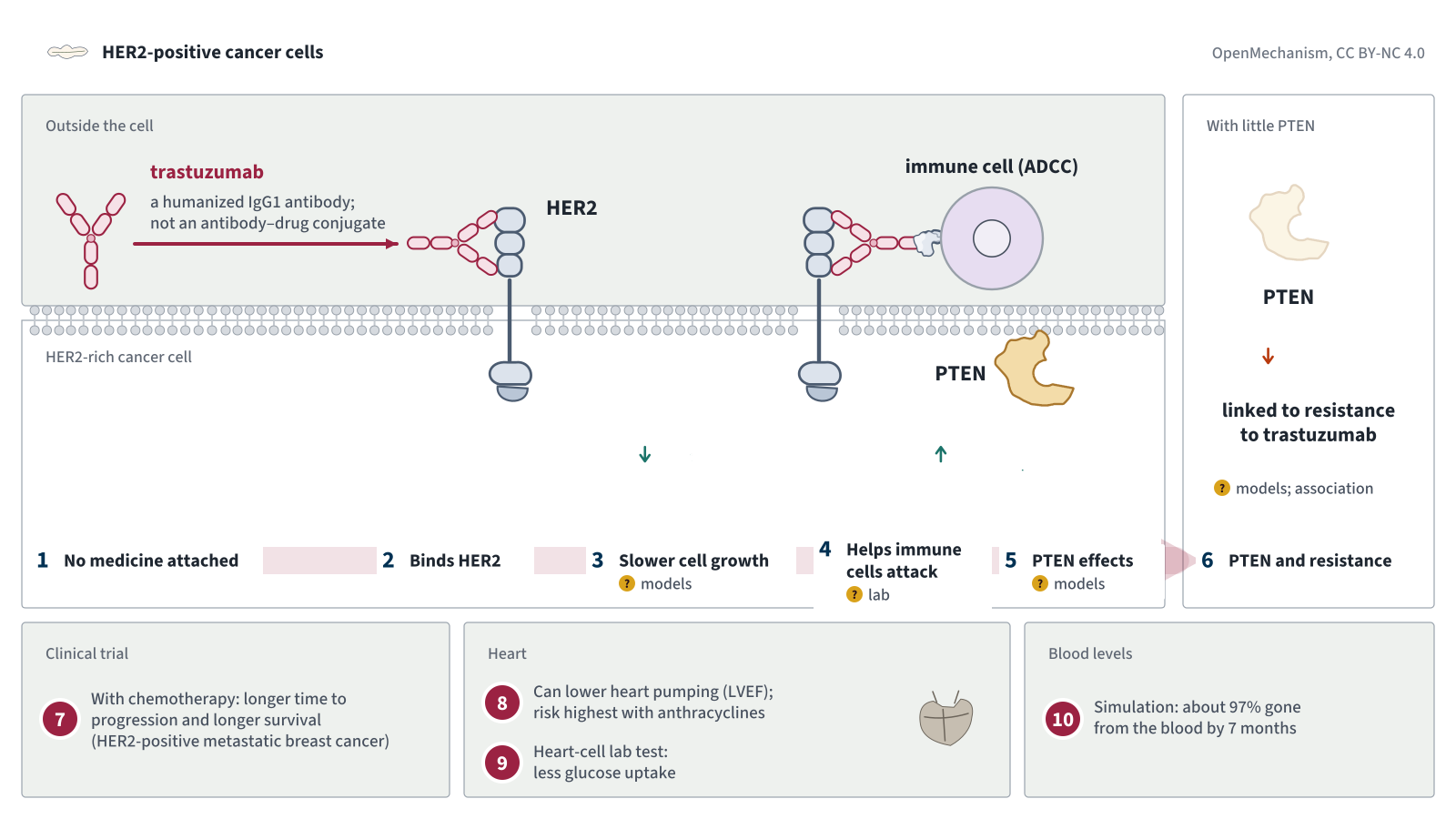
No medicine attached. Intravenous trastuzumab is a humanized antibody; it is not a trastuzumab antibody–drug conjugate.1
Binds HER2. Trastuzumab binds with high to the extracellular domain of HER2.1
Slower cell growth. Trastuzumab inhibits proliferation of HER2-overexpressing human tumor cells in vitro and in animals.1
Helps immune cells attack. Trastuzumab-mediated preferentially targets HER2-overexpressing cancer cells in vitro.1
PTEN effects. Trastuzumab reduced Src-linked phosphorylation and increased PTEN membrane localization and phosphatase activity.2
PTEN and resistance. Antisense PTEN reduction caused resistance in cell/mouse models; PTEN-deficient patient tumors had poorer trastuzumab-based responses.2
Result in a clinical trial. Adding trastuzumab to chemotherapy improved time to progression and survival in a randomized HER2-overexpressing metastatic breast-cancer trial.3
Heart side effects. Trastuzumab can cause decline and cardiac dysfunction; risk is greatest with concurrent anthracyclines.1
Heart-cell experiment. Trastuzumab reduced glucose uptake and altered metabolic gene expression in human iPSC-derived cardiomyocytes.4
How long it stays in the blood. Population PK simulations predict about 97% serum washout by seven months in at least 95% of studied breast/gastric-cancer patients.1
For teachers: download this drawing or build a slide deck.
More detail
An antibody that binds HER2
No medicine attached. Intravenous trastuzumab is a humanized IgG1 antibody; it is not a trastuzumab antibody–drug conjugate.1
Binds HER2. Trastuzumab binds with high affinity to the extracellular domain of HER2.1
Slower cell growth (models). Trastuzumab inhibits proliferation of HER2-overexpressing human tumor cells in vitro and in animals.1
What the source says
“Trastuzumab is a humanized IgG1 kappa monoclonal antibody that selectively binds with high affinity to the extracellular domain of the human epidermal growth factor receptor 2 protein, HER2.”
Source 1
“Herceptin has been shown, in both in vitro assays and in animals, to inhibit the proliferation of human tumor cells that overexpress HER2.”
Source 1
Helping immune cells attack (lab studies)
PTEN and resistance (lab and patient studies)
PTEN effects (models). Trastuzumab reduced Src-linked PTEN phosphorylation and increased PTEN membrane localization and phosphatase activity.2
PTEN and resistance. Antisense PTEN reduction caused resistance in cell/mouse models; PTEN-deficient patient tumors had poorer trastuzumab-based responses.2
What the source says
“Trastuzumab treatment quickly increased PTEN membrane localization and phosphatase activity by reducing PTEN tyrosine phosphorylation via Src inhibition.”
Source 2
“Patients with PTEN-deficient breast cancers had significantly poorer responses to trastuzumab-based therapy than those with normal PTEN.”
Source 2
A trial with chemotherapy
Result in a clinical trial. Adding trastuzumab to chemotherapy improved time to progression and survival in a randomized HER2-overexpressing metastatic breast-cancer trial.3
What the source says
“Trastuzumab increases the clinical benefit of first-line chemotherapy in metastatic breast cancer that overexpresses HER2.”
Source 3
Heart side effects
Heart side effects. Trastuzumab can cause LVEF decline and cardiac dysfunction; risk is greatest with concurrent anthracyclines.1
Heart-cell experiment. Trastuzumab reduced glucose uptake and altered metabolic gene expression in human iPSC-derived cardiomyocytes.4
What the source says
“Herceptin can result in subclinical and clinical cardiac failure manifesting as CHF, and decreased LVEF, with greatest risk when administered concurrently with anthracyclines.”
Source 1
“We observed significantly decreased glucose uptake from the media of iPSC-derived cardiomyocytes treated with trastuzumab as early as 24 h (p = 0.001) and consistently up to 96 h (p = 0.03).”
Source 4
How long it stays in the blood
How long it stays in the blood. Population PK simulations predict about 97% serum washout by seven months in at least 95% of studied breast/gastric-cancer patients.1
What the source says
“Population PK based simulations indicate that following discontinuation of Herceptin, concentrations in at least 95% of breast cancer and MGC patients will decrease to approximately 3% of the population predicted steady-state trough serum concentration (approximately 97% washout) by 7 months”
Source 1
See also
Condition pages: breast cancer and stomach cancer.
Other antibody medicines: adalimumab, bevacizumab, bezlotoxumab, blinatumomab, burosumab, denosumab, dupilumab, eculizumab and 14 more.
Explained: why trastuzumab can weaken the heart.
Body system: cancer.
Sources
- 1Herceptin (trastuzumab): FDA label§2.3 non-substitution; §5.1 cardiomyopathy; §11; §12.1; §12.3 washout
- 2PTEN activation contributes to tumor inhibition by trastuzumab, and loss of PTEN predicts trastuzumab resistance in patientsNagata Y et al., Cancer Cell 2004 (abstract)
- 3Use of chemotherapy plus a monoclonal antibody against HER2 for metastatic breast cancer that overexpresses HER2Slamon DJ et al., N Engl J Med 2001 (abstract)
- 4The antineoplastic drug, trastuzumab, dysregulates metabolism in iPSC-derived cardiomyocytesNecela BM et al., Clin Transl Med 2017 (abstract)
- 5ChEMBL CHEMBL1201585Target and action classification: Receptor protein-tyrosine kinase erbB-2 inhibitor
Also used on this page
The Fc receptor and PTEN outlines are traced from the crystal structures below.
- 6Human Fc gamma receptor IIIa (CD16a), from its structure with the stem (Fc) of an IgG1 antibodyPDB 3SGJ; Ferrara, C. et al. Proc.Natl.Acad.Sci.USA 2011; 108:12669-12674
- 7Human PTEN with tartrate in its active sitePDB 1D5R; Lee, J.O. et al. Cell(Cambridge,Mass.) 1999; 99:323-334
Spotted a mistake? Report an error (hello@openmechanism.com). Since launch, every published error we fix is listed on the corrections page.
Notes and limits
- Pure trastuzumab identity; no linker, deruxtecan, emtansine, topoisomerase payload, or bystander-payload mechanism.
- HER2-overexpressing model context is retained; target presence is not a guarantee of response.
- PTEN experiments and patient associations are not a universal resistance diagnostic.
- Cardiomyocyte metabolism experiments do not prove the complete human cardiotoxicity mechanism.
- No inferred epitope geometry or binding pose.
- Selected overexpressing models.
- Preferential, not exclusive; no payload-mediated killing.
- Specific experimental breast-cancer pathway; not every tumor.
- Causal model manipulation; separate observational human association.
- Combination regimen; not pure-antibody monotherapy attribution.
- Clinical risk; complete intracellular mechanism remains unresolved.
- In vitro mechanism clue; no causal arrow from this result to every human cardiomyopathy.
- Simulation of serum concentration decline; no dosing or scheduling advice.
All recorded limits are on the evidence page, and notes that apply to every page are on How to read a page. Version 1.0.0, not yet medically reviewed.
Cite this page
Tran D. Trastuzumab [Internet]. OpenMechanism; 2026 [updated 2026 Oct 16; cited 2026 Oct 16]. Available from: https://openmechanism.com/medicines/trastuzumab