Osteosarcoma
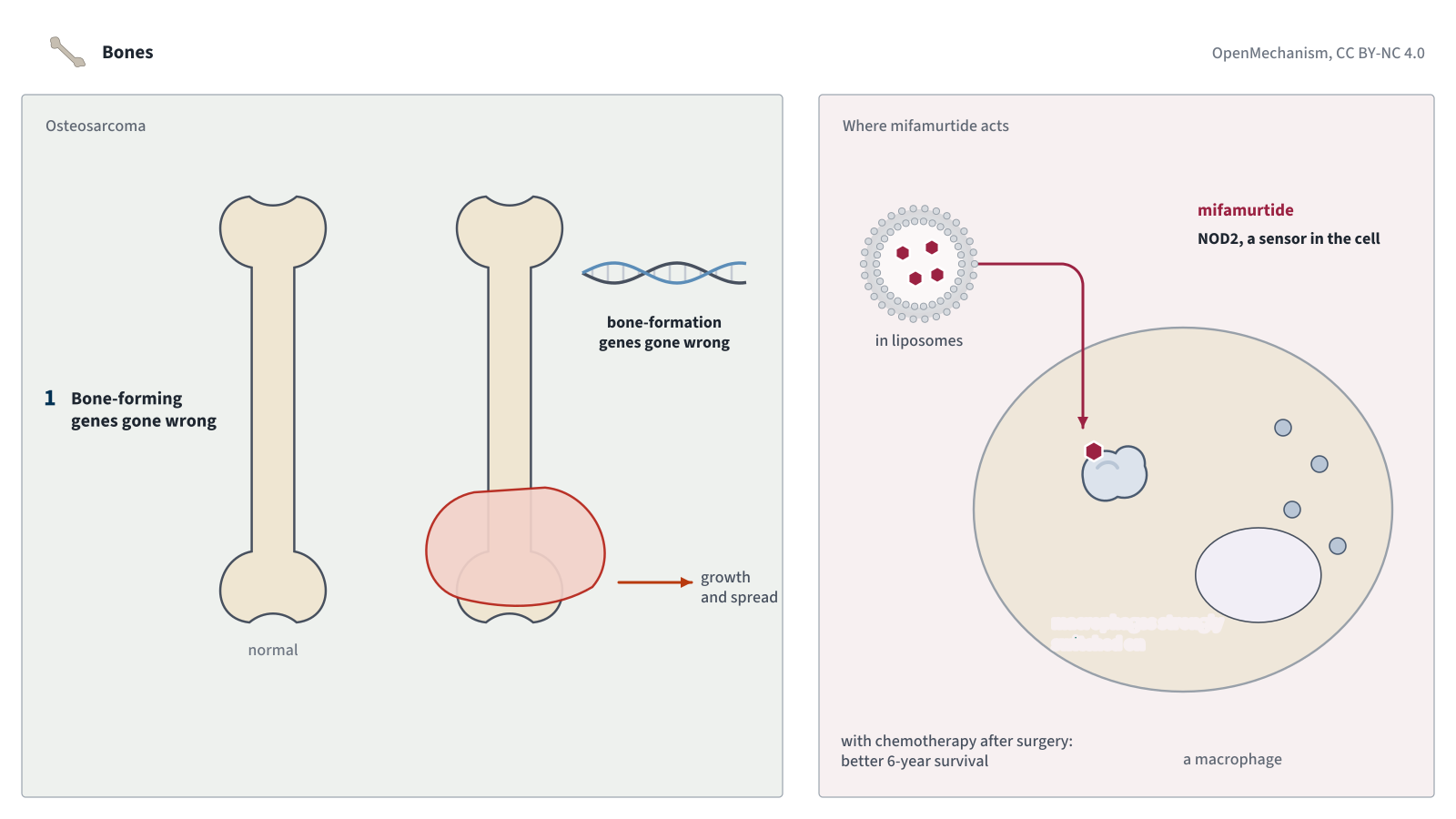
Osteosarcoma, the most common cancer that starts in bone, peaks at ages 18 and 60 and is slightly more common in males. Several possible genetic drivers linked to bone formation cause its growth and spread. Without spread, over 60% live relapse-free; with spread, under 30%. Mifamurtide activates macrophages through NOD2; added to chemotherapy after surgery, it improved survival.
- Where
- Bones
- Body systems
- Cancer; Muscles, bones & joints
- Medicines
- 1 medicine
For teachers: download this drawing.
Key terms in this drawing
- NOD2
- Nucleotide-binding oligomerization domain 2. A sensor inside immune cells that recognizes parts of bacterial cell walls.
What goes wrong
Bone-forming genes gone wrong. Several possible genetic drivers linked to bone formation cause its growth and spread.1
What the source says
“The key pathophysiological mechanism involves several possible genetic drivers of disease linked to bone formation, causing malignant progression and metastasis.”
Source 1
Where medicines act
- A
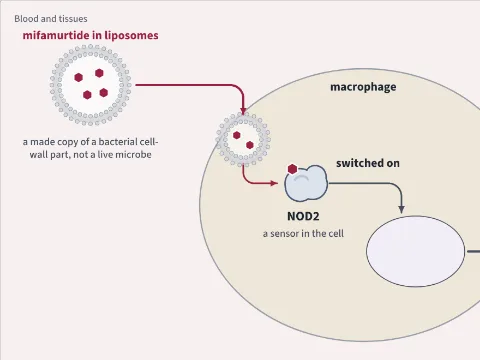
Mifamurtide: macrophages switched on
Mifamurtide, a man-made copy of part of a mycobacterial cell wall, binds and strongly activates monocytes and macrophages. Added to chemotherapy after surgery in newly diagnosed high-grade osteosarcoma, it improved 6-year survival.2
What the source says
“MTP-PE is a specific ligand of NOD2, a receptor found primarily on monocytes, dendritic cells and macrophages.”
Source 2“MTP-PE is a potent activator of monocytes and macrophages.”
Source 2“with newly-diagnosed resectable high-grade osteosarcoma, the addition of adjuvant mifamurtide to chemotherapy (either doxorubicin cisplatin and methotrexate with or without ifosfamide), significantly increased the 6-year overall survival”
Source 2
See also
Body systems: cancer; and muscles, bones & joints.
Also used for it: doxorubicin (“with newly-diagnosed resectable high-grade osteosarcoma, the addition of adjuvant mifamurtide to chemotherapy (either doxorubicin cisplatin and methotrexate with or without ifosfamide), significantly increased the 6-year overall survival”2); and leucovorin (for rescue after high-dose methotrexate: “Leucovorin calcium rescue is indicated after high dose methotrexate therapy in osteosarcoma.”3).
Other conditions: acute lymphoblastic leukemia, acute myeloid leukemia, B-cell lymphomas, bladder cancer, breast cancer and colorectal cancer.
Interactions: leucovorin with methotrexate and with fluorouracil.
Sources
- 1OsteosarcomaBeird HC et al. Nat Rev Dis Primers 2022 (abstract). Saved copy
- 2Mepact (mifamurtide): EU product information5.1 Pharmacodynamic properties. Saved copy
- 3Leucovorin calcium injection (Fresenius Kabi): FDA labelIndications and Usage. Saved copy
Notes and limits
- Exactly how activated macrophages act against the tumor is not yet known.2
Notes that apply to every page are on How to read a page.
Spotted a mistake? Report an error (hello@openmechanism.com). Since launch, every published error we fix is listed on the corrections page.
Cite this page
Tran D. Osteosarcoma [Internet]. OpenMechanism; 2026 [updated 2026 Oct 20; cited 2026 Oct 20]. Available from: https://openmechanism.com/conditions/osteosarcoma