Cyclophosphamide
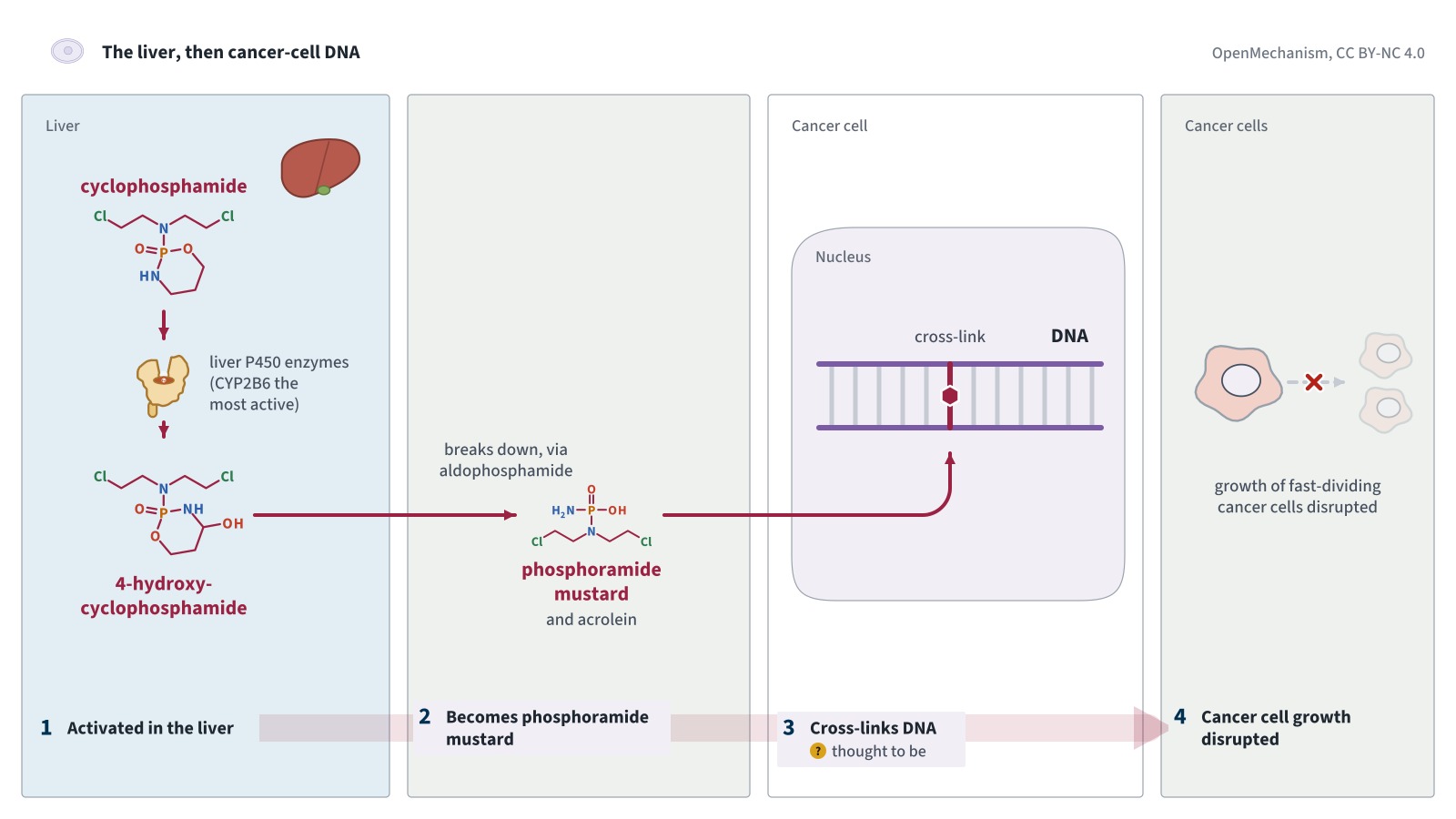
Cyclophosphamide is activated in the liver: P450 enzymes there, the most active, turn about 75% of a dose into 4-hydroxycyclophosphamide, which through its open form, aldophosphamide, breaks down into the active forms phosphoramide mustard and acrolein. It is thought to work by cross-linking the of tumor cells, and its active forms interfere with the growth of rapidly dividing cancer cells.
- Acts on
- Tumor-cell DNA, through its active metabolite phosphoramide mustard (thought to cross-link it)
- Where
- The liver, which activates it; cancer cells
- Medicine type
- Small molecule
- Used for
- Cancer
- Drug class
- Alkylating agents
Step 3: thought to be
The cyclophosphamide label says: The mechanism of action is thought to involve cross-linking of tumor cell DNA.
Clinical study: In individual-patient-data meta-analyses of randomised trials of chemotherapy after surgery for early breast cancer, with regimens that include cyclophosphamide (the C in CMF, 4AC and CAF); the trials measured breast cancer mortality, not how cyclophosphamide works: Trials versus no chemotherapy also suggested greater mortality reductions with CAF (RR 0·64, SE 0·09, 2p<0·0001) than with standard 4AC (RR 0·78, SE 0·09, 2p=0·01) or standard CMF (RR 0·76, SE 0·05, 2p<0·0001).
Early Breast Cancer Trialists' Collaborative Group (EBCTCG) et al., Lancet 2012 (PMID 22152853)
This study was picked with a literature search and is not yet checked by our reviewer.
Key terms in this drawing
- CYP2B6
- Cytochrome P450 2B6. One of the cytochrome P450 enzymes that break down medicines; with CYP3A4, it turns ketamine into norketamine.
- DNA
- Deoxyribonucleic acid. The molecule that stores genes.
How it works
Activated in the liver. The liver is the main site of cyclophosphamide's activation: liver cytochrome P450 enzymes, including CYP2A6, 2B6, 3A4, 3A5, 2C9, 2C18 and 2C19, with CYP2B6 the most active, activate about 75% of a dose to 4-hydroxycyclophosphamide, which is in balance with its ring-open form, aldophosphamide.1
Becomes phosphoramide mustard. Aldophosphamide breaks down (beta-elimination) to the active metabolites phosphoramide mustard and acrolein; albumin and other proteins can speed this up.1
Cross-links DNA. How cyclophosphamide works is thought to involve cross-linking of the DNA of tumor cells.1
Cancer cell growth disrupted. These active alkylating metabolites interfere with the growth of susceptible, rapidly dividing cancer cells.1
For teachers: download this drawing.
See also
Condition pages: acute lymphoblastic leukemia, acute myeloid leukemia, B-cell lymphomas, breast cancer, chronic lymphocytic leukemia, chronic myeloid leukemia, cutaneous T-cell lymphoma, Hodgkin lymphoma, lupus nephritis, multiple myeloma, neuroblastoma and ovarian cancer.
Side effects: bladder bleeding from chemotherapy (hemorrhagic cystitis).
Explained: why cyclophosphamide can make the bladder bleed.
Related drawings: cisplatin (its platinum cross-links DNA, between the two strands and within one); and mesna (binds acrolein and the other ifosfamide metabolites that harm the bladder).
Body system: cancer.
Sources
- 1Cyclophosphamide tablets (Baxter): FDA label12.1 Mechanism of Action; 12.2 Pharmacodynamics; 12.3 Pharmacokinetics
- 2ChEMBL CHEMBL88Target and action classification: DNA inhibitor
- 3Comparisons between different polychemotherapy regimens for early breast cancer: meta-analyses of long-term outcome among 100,000 women in 123 randomised trialsEarly Breast Cancer Trialists' Collaborative Group (EBCTCG) et al. Lancet 2012 (abstract)
Also used for the drawing
The CYP2B6 outline is traced from the crystal structure below.
- 4Human CYP2B6 (a natural variant) with an inhibitorPDB 3IBD; Gay, S.C. et al. Mol.Pharmacol. 2010; 77:529-538
Spotted a mistake? Report an error (hello@openmechanism.com). Since launch, every published error we fix is listed on the corrections page.
Notes and limits
- A schematic teaching drawing: not to scale, not exact structures, binding poses or a complete pathway, and not a guide to dosing, treatment or how a person will respond.
- The label says the mechanism of action is thought to involve cross-linking of tumor cell DNA.
All recorded limits are on the evidence page, and notes that apply to every page are on How to read a page. Version 1.0.0, not yet medically reviewed.
Cite this page
Tran D. Cyclophosphamide [Internet]. OpenMechanism; 2026 [updated 2026 Oct 17; cited 2026 Oct 17]. Available from: https://openmechanism.com/medicines/cyclophosphamide