Olaparib
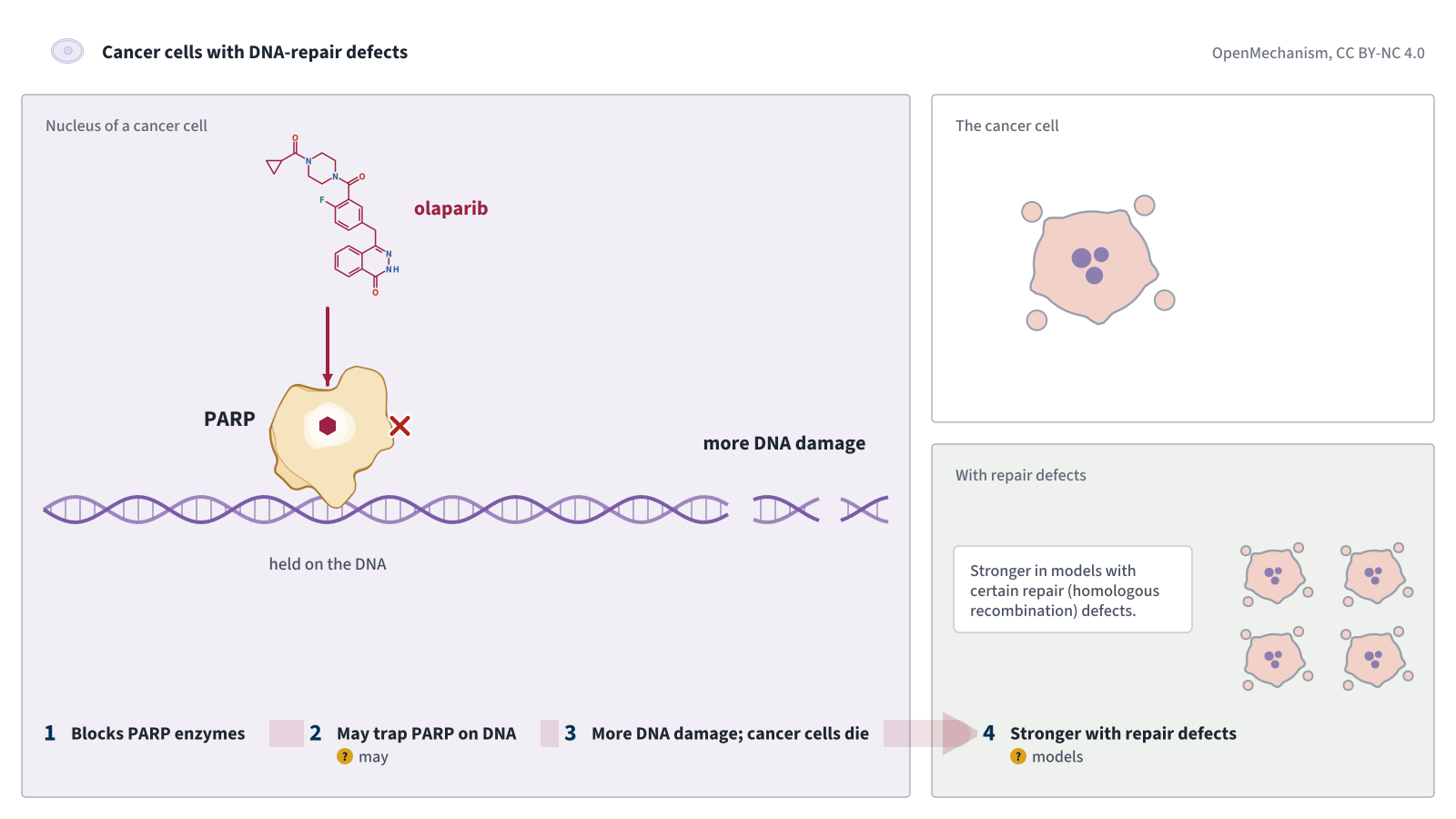
Olaparib blocks enzymes involved in repair and may trap PARP on DNA. This increases DNA damage and cancer-cell death; the effect was greater in models with certain DNA-repair (homologous recombination) defects.
- Acts on
- PARP1, PARP2, PARP3
- Where
- Cancer cells with DNA-repair defects (models)
- Medicine type
- Small molecule
- Used for
- Cancer
Also called Lynparza.
Step 2: may
The Lynparza label says: In vitro studies have shown that olaparib-induced cytotoxicity may involve inhibition of PARP enzymatic activity and increased formation of PARP-DNA complexes, resulting in DNA damage and cancer cell death.
Source 1: Lynparza (olaparib): FDA label, 12.1 Mechanism of Action
Clinical study: In SOLO1, a double-blind, phase 3 trial of olaparib or placebo as maintenance treatment in 391 people with newly diagnosed advanced ovarian cancer and a BRCA1/2 mutation; the trial measured progression-free survival, not whether olaparib holds PARP on DNA: The use of maintenance therapy with olaparib provided a substantial benefit with regard to progression-free survival among women with newly diagnosed advanced ovarian cancer and a BRCA1/2 mutation, with a 70% lower risk of disease progression or death with olaparib than with placebo.
Moore K et al., N Engl J Med 2018 (PMID 30345884)
This study was picked with a literature search and is not yet checked by our reviewer.
Step 4: models
The Lynparza label says: Increased cytotoxicity and anti-tumor activity following treatment with olaparib were noted in cell lines and mouse tumor models with deficiencies in BRCA1/2 , ATM , or other genes involved in the homologous recombination repair (HRR) of DNA damage and correlated with platinum response.
Source 1: Lynparza (olaparib): FDA label, 12.1 Mechanism of Action
Clinical study: In the same trial (SOLO1), which enrolled only people with a BRCA1/2 mutation and measured progression-free survival, so it did not compare cancers with and without repair defects: After a median follow-up of 41 months, the risk of disease progression or death was 70% lower with olaparib than with placebo (Kaplan-Meier estimate of the rate of freedom from disease progression and from death at 3 years, 60% vs. 27%; hazard ratio for disease progression or death, 0.30; 95% confidence interval, 0.23 to 0.41; P<0.001).
Moore K et al., N Engl J Med 2018 (PMID 30345884)
This study was picked with a literature search and is not yet checked by our reviewer.
Key terms in this drawing
- DNA
- Deoxyribonucleic acid. The molecule that stores genes.
- PARP
- Poly(ADP-ribose) polymerase. An enzyme involved in repairing DNA.
How it works
Blocks PARP enzymes. Olaparib inhibits PARP enzymes involved in DNA repair and transcription.1
May trap PARP on DNA. In-vitro cytotoxicity may involve enzyme inhibition and increased PARP-DNA complex formation.1
More DNA damage; cancer cells die. The label links these model effects to DNA damage and cancer-cell death.1
Stronger with repair defects. Greater cytotoxicity was observed in cell and mouse models with selected homologous-recombination repair defects.1
For teachers: download this drawing or build a slide deck.
See also
Condition pages: breast cancer, ovarian cancer, pancreatic cancer and prostate cancer.
More medicines for cancer: abiraterone acetate, anastrozole, belzutifan, bevacizumab, bleomycin, blinatumomab, bortezomib, brentuximab vedotin and 38 more.
Body system: cancer.
Sources
- 1Lynparza (olaparib): FDA label12.1 Mechanism of Action
- 2ChEMBL CHEMBL521686Target and action classification: PARP 1, 2 and 3 inhibitor
- 3Maintenance Olaparib in Patients with Newly Diagnosed Advanced Ovarian CancerMoore K et al. N Engl J Med 2018 (abstract)
Also used for the drawing
The PARP outline is traced from the crystal structure below.
- 4PARP1 catalytic domain with olaparibPDB 7KK4; Ryan, K. et al. J.Biol.Chem. 2021; 296:100251
Spotted a mistake? Report an error (hello@openmechanism.com). Since launch, every published error we fix is listed on the corrections page.
Notes and limits
- A schematic teaching drawing: not to scale, not exact structures, binding poses or a complete pathway, and not a guide to dosing, treatment or how a person will respond.
- Other medicines in the same family may not follow every step or share the same clinical endpoint.
- The steps are in the order that explains them; one step is said to cause the next only where the source says so.
- PARP trapping and cell death are selected nonclinical model routes; not all tumors or repair variants share the same response.
All recorded limits are on the evidence page, and notes that apply to every page are on How to read a page. Version 1.0.0, not yet medically reviewed.
Cite this page
Tran D. Olaparib [Internet]. OpenMechanism; 2026 [updated 2026 Oct 15; cited 2026 Oct 15]. Available from: https://openmechanism.com/medicines/olaparib