Pancreatic cancer
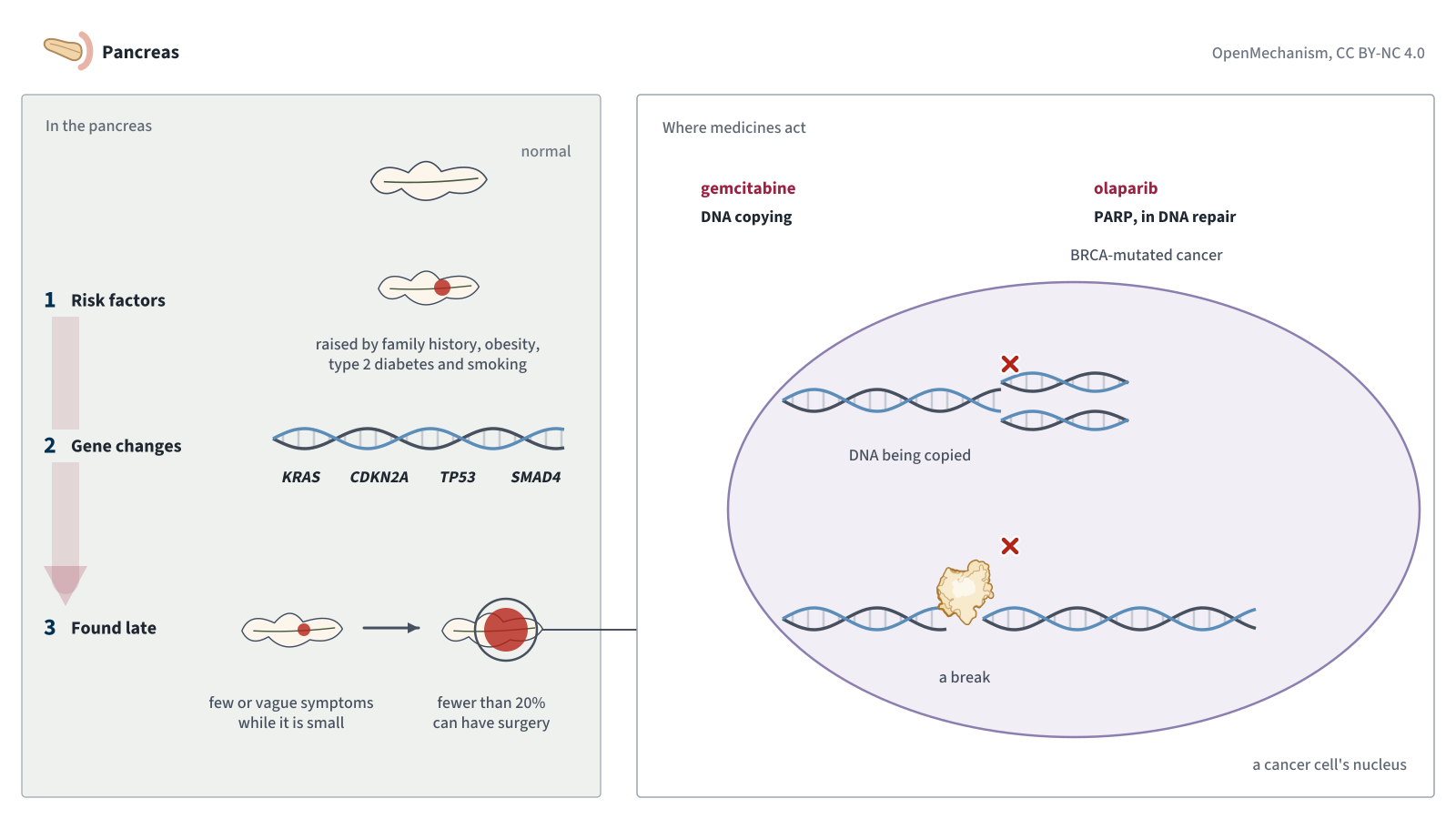
Pancreatic cancer is highly fatal: in the USA about 10% of people are alive 5 years after diagnosis. Family history, obesity, type 2 diabetes and smoking raise the risk; KRAS, CDKN2A, TP53 and SMAD4 are the genes most often changed. It is usually found late. Gemcitabine stops cells making DNA; olaparib blocks PARP in BRCA-mutated cancer after platinum chemotherapy.
- Where
- Pancreas
- Body systems
- Cancer; Stomach, gut & liver
- Medicines
- 2 medicines
For teachers: download this drawing.
Key terms in this drawing (7)
- BRCA
- BRCA1 and BRCA2 genes. Genes for the BRCA1 and BRCA2 proteins, which repair breaks across both strands of DNA; cancers that lack them can be targeted by PARP inhibitors.
- CDKN2A
- CDKN2A gene (encodes p16). A gene that makes the protein p16; one of the genes most often mutated in pancreatic cancer.
- DNA
- Deoxyribonucleic acid. The molecule that stores genes.
- KRAS
- KRAS gene. One of the genes most often mutated in pancreatic cancer, with CDKN2A, TP53 and SMAD4.
- PARP
- Poly(ADP-ribose) polymerase. An enzyme involved in repairing DNA.
- SMAD4
- SMAD4 gene. One of the genes most often mutated in pancreatic cancer, with KRAS, CDKN2A and TP53.
- TP53
- TP53 tumor suppressor gene. A tumor suppressor gene; in some cancers it is switched off, lost or mutated.
What goes wrong
Risk factors. Family history, obesity, type 2 diabetes and smoking raise the risk.1
What the source says
“Risk factors for developing pancreatic cancer include family history, obesity, type 2 diabetes, and tobacco use.”
Source 1Gene changes. The genes most often changed are , , and .2
What the source says
“the most commonly mutated genes are KRAS, CDKN2A (encoding p16), TP53 and SMAD4”
Source 2Found late. It is usually found late, because symptoms are few or vague while it is still small. Fewer than 20% of people can have surgery, the only chance of cure.1,2
Where medicines act
- A
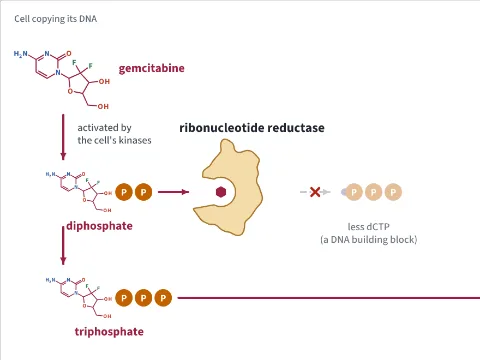
Gemcitabine: DNA copying stopped
Gemcitabine kills cells that are copying their . It is a first treatment for pancreatic cancer that cannot be removed or has spread.3
What the source says
“Gemcitabine kills cells undergoing DNA synthesis and blocks the progression of cells through the G1/S-phase boundary.”
Source 3“Gemcitabine Injection is indicated as first-line treatment for patients with locally advanced (nonresectable Stage II or Stage III) or metastatic (Stage IV) adenocarcinoma of the pancreas.”
Source 3 - B
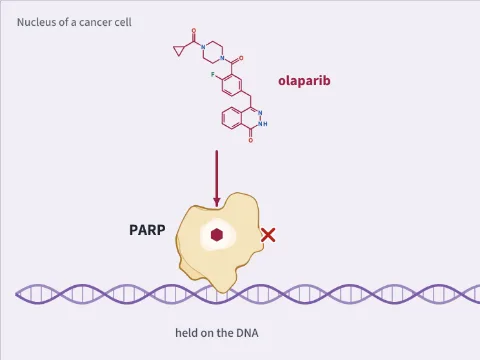
Olaparib: PARP blocked
Olaparib blocks enzymes, which take part in DNA repair. It is maintenance treatment for spread pancreatic cancer with an inherited (germline) mutation that has not grown during platinum chemotherapy.4
What the source says
“Olaparib is an inhibitor of poly (ADP-ribose) polymerase (PARP) enzymes, including PARP1, PARP2, and PARP3. PARP enzymes are involved in normal cellular functions, such as DNA transcription and DNA repair.”
Source 4“for the maintenance treatment of adult patients with deleterious or suspected deleterious gBRCA m metastatic pancreatic adenocarcinoma whose disease has not progressed on at least 16 weeks of a first-line platinum-based chemotherapy regimen.”
Source 4
See also
Body systems: cancer; and stomach, gut & liver.
Also used for it: fluorouracil (for pancreatic adenocarcinoma: “Fluorouracil is a nucleoside metabolic inhibitor indicated for the treatment of patients with … Pancreatic Adenocarcinoma”5).
Other conditions: breast cancer, ovarian cancer, colorectal cancer, stomach cancer, non-small cell lung cancer and prostate cancer.
The medicine in the body: fluorouracil and the DPYD gene.
Sources
- 1Pancreatic cancerMizrahi JD et al. Lancet 2020 (abstract). Saved copy
- 2Pancreatic cancerKleeff J et al. Nat Rev Dis Primers 2016 (abstract). Saved copy
- 3Gemcitabine injection: FDA label1.4 Pancreatic Cancer; 12.1 Mechanism of Action. Saved copy
- 4Lynparza (olaparib): FDA label1 Indications and Usage; 12.1 Mechanism of Action. Saved copy
- 5Fluorouracil injection (Fresenius Kabi): FDA labelIndications and Usage. Saved copy
- 6PARP1 catalytic domain with olaparibPDB 7KK4; Ryan, K. et al. J.Biol.Chem. 2021;296:100251. The PARP outline in the drawing is traced from this structure. Saved copy
Notes and limits
- About 80% of people relapse after surgery and die of the disease.2
Notes that apply to every page are on How to read a page.
Spotted a mistake? Report an error (hello@openmechanism.com). Since launch, every published error we fix is listed on the corrections page.
Cite this page
Tran D. Pancreatic cancer [Internet]. OpenMechanism; 2026 [updated 2026 Oct 20; cited 2026 Oct 20]. Available from: https://openmechanism.com/conditions/pancreatic-cancer