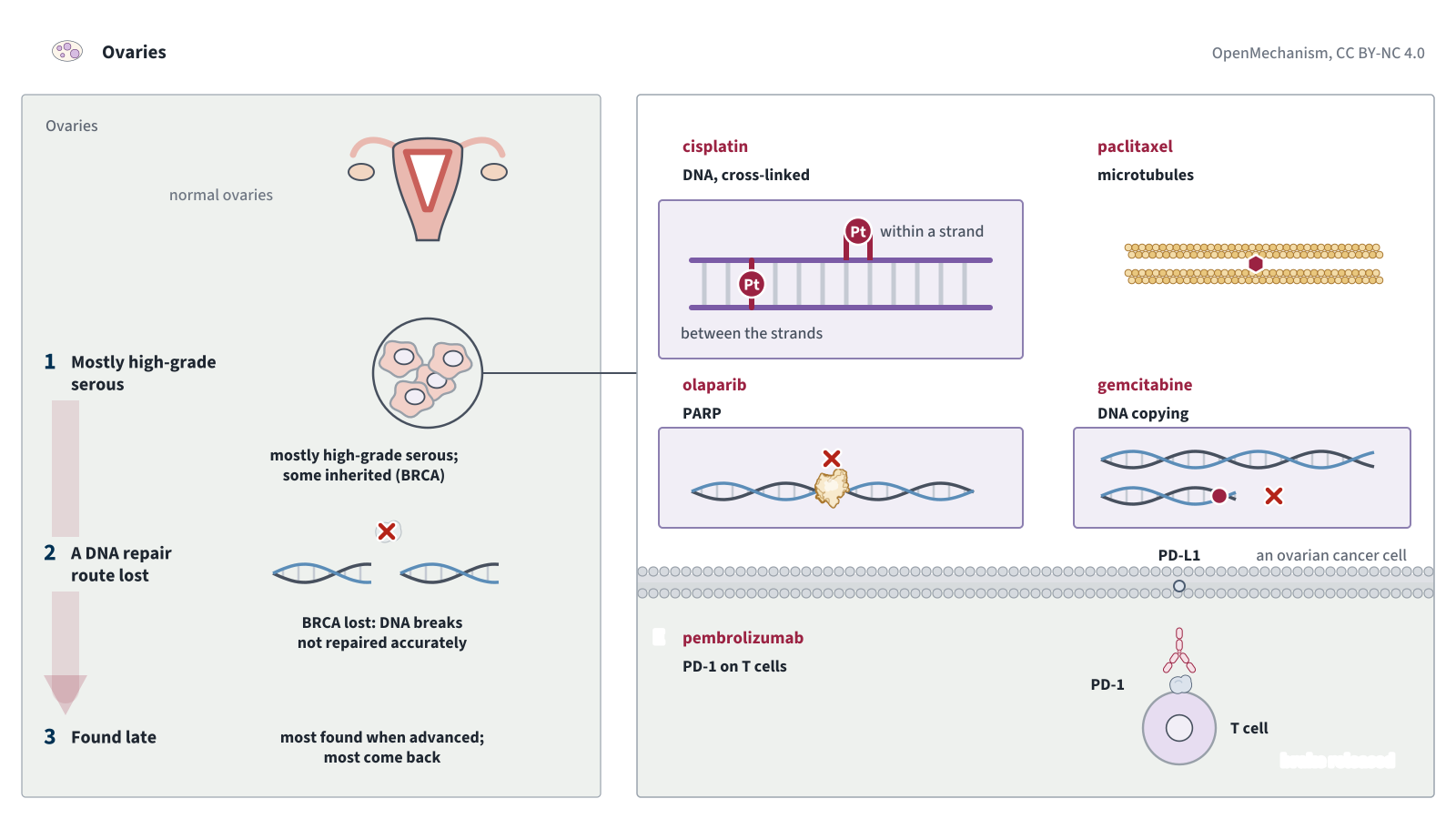
In a 2025 review, about 90 percent of ovarian cancers are epithelial, mostly high-grade serous; hereditary factors are linked to a quarter of cases, mostly BRCA1 or BRCA2 variants. Cancers that lack BRCA's DNA repair are a target for PARP blockers. Most are found when advanced. Cisplatin cross-links DNA; paclitaxel stabilizes microtubules; olaparib blocks PARP; gemcitabine stops DNA copying; pembrolizumab releases a T-cell brake.
BRCA1 and BRCA2 genes. Genes for the BRCA1 and BRCA2 proteins, which repair breaks across both strands of DNA; cancers that lack them can be targeted by PARP inhibitors.
DNA
Deoxyribonucleic acid. The molecule that stores genes.
microtubule
Microtubule. A structure inside the cell, built from the protein tubulin, that the cell needs for dividing and for other vital work.
PARP
Poly(ADP-ribose) polymerase. An enzyme involved in repairing DNA.
PD-1
Programmed cell death protein 1. A receptor on T cells that acts as a brake when PD-L1 or PD-L2 binds it.
PD-L1
Programmed death-ligand 1. One of the two PD-1 ligands (PD-L1 and PD-L2): it binds PD-1 on T cells and holds them back, and some tumors make more of it.
T cell
T lymphocyte. A white blood cell of the immune system.
What goes wrong
Mostly high-grade serous. In a 2025 review, about 90 percent of ovarian cancers are epithelial, and 70 to 80 percent of these are high-grade serous; hereditary factors are linked to a quarter of cases, mostly or BRCA2 variants.1
What the source says
“Approximately 90% of ovarian cancers are epithelial malignancies, of which 70% to 80% are high-grade serous ovarian cancers.”
A DNA repair route lost. BRCA1 and BRCA2 repair double-strand breaks by homologous recombination; in a 2016 review, around 20 percent of high-grade serous cancers carry a BRCA mutation, and cancers lacking this route are a target for inhibitors.2
What the source says
“BRCA1 and BRCA2 proteins are essential for high-fidelity repair of double-strand breaks of DNA through the homologous recombination repair (HRR) pathway. Deficiency in HRR (HRD) is a target for PARP inhibitors.”
Found late. In a 2025 review, about 80 percent have advanced disease at diagnosis, and most advanced cancers come back within two years.1
What the source says
“At diagnosis, approximately 95% of patients experience nonspecific symptoms, such as abdominal pain, bloating, and urinary urgency and frequency, and about 80% have advanced-stage disease (stage III-IV)”
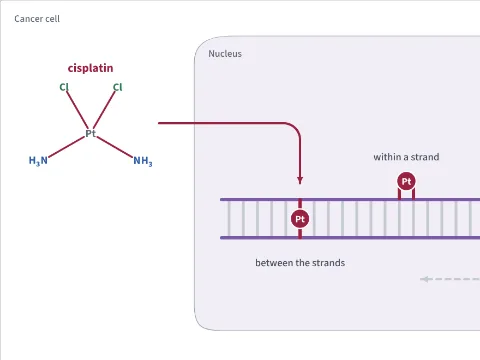
Cisplatin works mainly by binding DNA and cross-linking it, which interferes with reading or copying the DNA and leads to the cell's death. It treats advanced ovarian cancer.3
What the source says
“The main mechanism of the cytotoxic action involves the binding of cisplatin to genomic DNA in the cell nucleus to form interstrand and intrastrand cross-links. This interferes with normal transcription and/or DNA replication mechanisms and triggers cytotoxic processes that lead to cell death.”
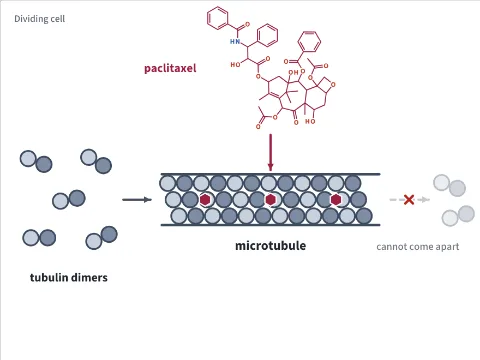
Paclitaxel helps build and stabilizes them so the cell cannot reorganize them, which it needs to divide. It treats advanced ovarian cancer as a later treatment and, with cisplatin, as a first treatment.4
What the source says
“Paclitaxel is a novel antimicrotubule agent that promotes the assembly of microtubules from tubulin dimers and stabilizes microtubules by preventing depolymerization.”
“This stability results in the inhibition of the normal dynamic reorganization of the microtubule network that is essential for vital interphase and mitotic cellular functions.”
“Paclitaxel Injection USP is indicated as subsequent therapy for the treatment of advanced carcinoma of the ovary. As first-line therapy, paclitaxel injection is indicated in combination with cisplatin.”
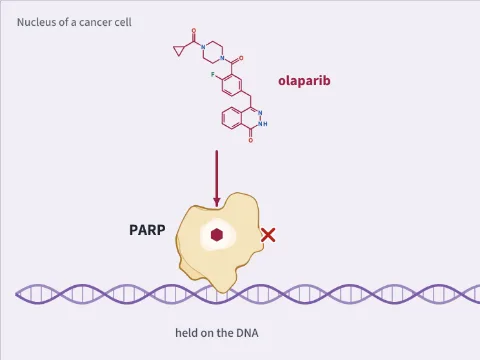
Olaparib blocks PARP enzymes, which take part in DNA repair; in cells with a BRCA mutation, PARP inhibitors block an essential DNA repair pathway. It is maintenance treatment for adults with BRCA-mutated advanced epithelial ovarian, fallopian tube or primary peritoneal cancer that has responded fully or partly to first-line platinum-based chemotherapy.2,5
What the source says
“Olaparib is an inhibitor of poly (ADP-ribose) polymerase (PARP) enzymes, including PARP1, PARP2, and PARP3. PARP enzymes are involved in normal cellular functions, such as DNA transcription and DNA repair.”
“Lynparza is indicated for the maintenance treatment of adult patients with deleterious or suspected deleterious germline or somatic BRCA -mutated advanced epithelial ovarian, fallopian tube or primary peritoneal cancer who are in complete or partial response to first-line platinum-based chemotherapy.”
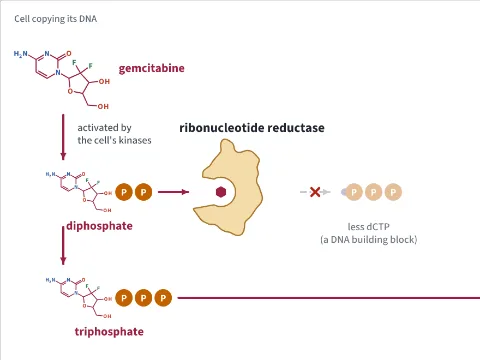
Gemcitabine is turned into gemcitabine triphosphate, which is built into new DNA and stops it growing, so it kills cells that are copying their DNA. With carboplatin, it treats advanced ovarian cancer that has come back at least 6 months after platinum-based treatment.6
What the source says
“Gemcitabine kills cells undergoing DNA synthesis and blocks the progression of cells through the G1/S-phase boundary.”
“After the gemcitabine nucleotide is incorporated into DNA, only one additional nucleotide is added to the growing DNA strands which eventually results in the initiation of apoptotic cell death.”
“in combination with carboplatin, for the treatment of advanced ovarian cancer that has relapsed at least 6 months after completion of platinum-based therapy.”
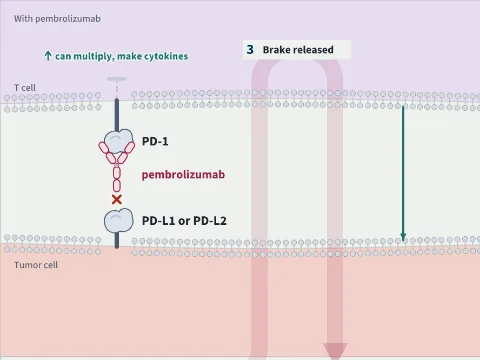
Pembrolizumab blocks , a brake on , and so releases the immune response, including the response against the cancer. With paclitaxel, with or without bevacizumab, it treats adults with platinum-resistant epithelial ovarian, fallopian tube or primary peritoneal cancer when the tumor carries , after one or two earlier systemic treatments.7
What the source says
“Binding of the PD-1 ligands, PD-L1 and PD-L2, to the PD-1 receptor found on T cells, inhibits T cell proliferation and cytokine production.”
“Pembrolizumab is a monoclonal antibody that binds to the PD-1 receptor and blocks its interaction with PD-L1 and PD-L2, releasing PD-1 pathway-mediated inhibition of the immune response, including the anti-tumor immune response.”
“in combination with paclitaxel, with or without bevacizumab, for the treatment of adult patients with platinum-resistant epithelial ovarian, fallopian tube, or primary peritoneal carcinoma whose tumors express PD-L1 (CPS ≥1) as determined by an FDA-authorized test, and who have received one or two prior systemic treatment regimens.”
The National Cancer Institute's treatment summary for ovarian epithelial, fallopian tube and primary peritoneal cancer (updated 14 May 2025) describes these combinations. For the lettered medicines above, the page gives only the uses their own labels list. The quotes may name medicines, combinations or groups of patients that a medicine's own label does not list, and may leave out its label's limits.
Advanced-stage cancer, surgery followed by platinum-based chemotherapy: “With the introduction of the taxane paclitaxel, two trials confirmed the superiority of cisplatin combined with paclitaxel when compared with the previous standard treatment of cisplatin plus cyclophosphamide. However, two trials that compared single-agent paclitaxel with either cisplatin or carboplatin (ICON3 and GOG-132) failed to confirm such superiority in all outcome parameters (i.e., response, time-to-progression, and survival) (see Table 7 for a list of these studies). Based on the evidence, the initial standard treatment for patients with ovarian cancer is the combination of cisplatin or carboplatin with paclitaxel (defined as induction chemotherapy).”11
Advanced-stage cancer, treatment options: “Surgery before or after platinum-based chemotherapy and the addition of bevacizumab to induction therapy and/or consolidation therapy. … Surgery before or after platinum-based chemotherapy and the addition of PARP inhibitors to induction therapy and/or consolidation therapy.”11
Platinum-sensitive recurrence: “In a phase III trial, carboplatin plus pegylated liposomal doxorubicin was compared with carboplatin plus paclitaxel in patients with platinum-sensitive recurrence (>6 months). The primary end point was PFS. The median PFS for the carboplatin-plus-pegylated-liposomal-doxorubicin arm was 11.3 months versus 9.4 months for the carboplatin-plus-paclitaxel arm (HR, 0.823; 95% CI, 0.72–0.94; P = .005). Long-term follow-up revealed no difference in OS rates between the two arms (30.7 months for carboplatin plus pegylated liposomal doxorubicin vs. 33.0 months for carboplatin plus paclitaxel). The carboplatin-plus-paclitaxel arm was associated with increased severe neutropenia, alopecia, neuropathy, and allergic reaction. The carboplatin-plus-pegylated-liposomal-doxorubicin arm was associated with increased severe thrombocytopenia, nausea, and hand-foot syndrome. Given its toxicity profile and noninferiority to the standard regimen, carboplatin plus pegylated liposomal doxorubicin is an important option for patients with platinum-sensitive recurrence. Carboplatin plus paclitaxel has been considered the standard regimen for platinum-sensitive recurrence in the absence of residual neurological toxic effects.”11
Also used for it: cyclophosphamide (“Cyclophosphamide Tablets is indicated for the treatment of: … adenocarcinoma of the ovary”8); doxorubicin (“Doxorubicin Hydrochloride Injection is indicated for the treatment of … metastatic ovarian carcinoma”9); and bevacizumab (for stage III or IV epithelial ovarian cancer after surgery, with chemotherapy: “Epithelial ovarian, fallopian tube, or primary peritoneal cancer: in combination with carboplatin and paclitaxel, followed by Avastin as a single agent, for stage III or IV disease following initial surgical resection”10).
Symptoms at diagnosis are usually vague, such as belly pain, bloating and needing to pass urine urgently or often. The steps are in the order that explains them; one step is said to cause the next only where a source says so. The paclitaxel label pairs it with cisplatin as a first treatment; a 2025 review says advanced ovarian cancer may be treated with surgery and chemotherapy with carboplatin and paclitaxel.1,4
The combinations quoted from the National Cancer Institute are examples of how these medicines are given together. They are not a full list of regimens, and nothing here is advice on choosing a treatment. The words are from the summary's version of 14 May 2025, and the summary may have changed since. The summary says: “It is intended as a resource to inform and assist clinicians in the care of their patients. It does not provide formal guidelines or recommendations for making health care decisions.”11
Claude Opus 5.5 (AI source check), 14 November 2026: 46 statements compared with their sources, 7 flagged for the reviewer. An automated check, not a medical review.
Conflict of interest
Gemcitabine: Pfizer, the reviewer's former employer, makes or markets this medicine. Doxorubicin: Pfizer, the reviewer's former employer, makes or markets this medicine. Details
Key terms
Definitions reworded since this review: microtubule. Definitions are shared across pages, so a later rewording does not take the review line off (what a review covers).
Next review due
16 May 2028
Cite this page
Tran D. Ovarian cancer [Internet]. OpenMechanism; 2026 [updated 2026 Nov 15; cited 2026 Nov 15]. Available from: https://openmechanism.com/conditions/ovarian-cancer