Anemia from cancer treatment
Anemia is common in cancer: more than 30% of people have it at diagnosis. Chemotherapy that suppresses the bone marrow, blood loss, iron shortage, low erythropoietin and inflammation (mainly IL-6) all contribute. Iron, red-cell boosters and transfusions are the usual treatments. Epoetin alfa works like the body's erythropoietin to make more red cells.
- Where
- Bone marrow and blood
- Body systems
- Blood & clotting, Cancer
- Medicines
- 1 medicine
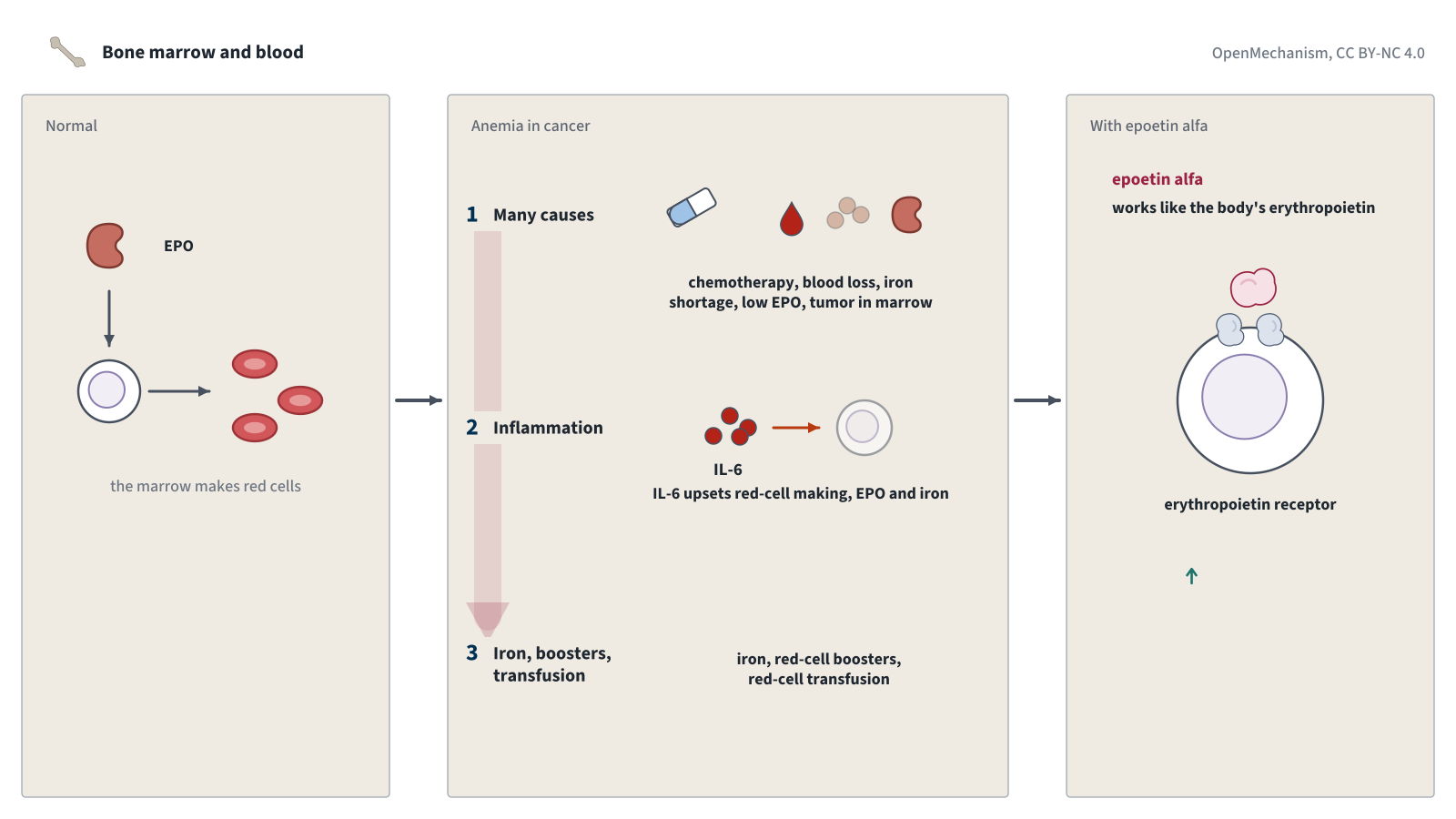
For teachers: download this drawing.
Key terms in this drawing
- EPO
- Erythropoietin. Made by the body, it drives the making of red blood cells (erythropoiesis).
- IL-6
- Interleukin-6. An inflammatory cytokine, released by tumor and immune cells, that plays a central part in anemia linked to cancer.
What goes wrong
Many causes. Causes include chemotherapy suppressing the bone marrow, blood loss, iron shortage, low from kidney disease and tumor in the marrow.1
What the source says
“Cancer-related anemia (CRA) is due to multiple etiologies, including chemotherapy-induced myelosuppression, blood loss, functional iron deficiency, erythropoietin deficiency due to renal disease, marrow involvement with tumor as well as other factors.”
Source 1Inflammation. Inflammatory signals, mainly from tumor and immune cells, upset red-cell making, erythropoietin production and iron balance.2
Iron, boosters, transfusion. The usual treatments are iron, red-cell boosters (erythropoiesis-stimulating agents) and red-cell transfusion.1
What the source says
“The most common treatment options for CRA include iron therapy, erythropoietic-stimulating agents (ESAs), and red cell transfusion.”
Source 1
Where medicines act
- A
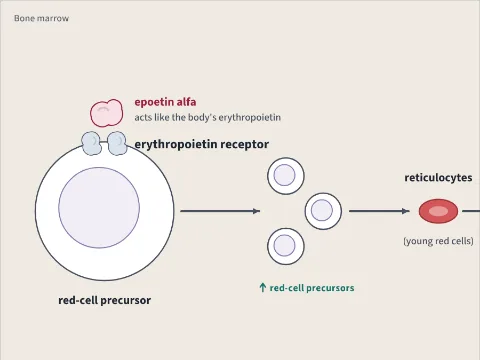
Epoetin alfa: red-cell making boosted
Epoetin alfa works the same way as the body's own erythropoietin to make red cells. It treats anemia caused by bone-marrow-suppressing chemotherapy when at least two more months of chemotherapy are planned.3
See also
Body systems: blood & clotting and cancer.
Other conditions: chronic kidney disease, acute lymphoblastic leukemia, acute myeloid leukemia, chronic lymphocytic leukemia, chronic myeloid leukemia and Hodgkin lymphoma.
Sources
- 1Diagnosis and treatment of cancer-related anemiaGilreath JA et al. Am J Hematol 2014 (abstract). Saved copy
- 2Pathogenesis and treatment options of cancer related anemia: perspective for a targeted mechanism-based approachMadeddu C et al. Front Physiol 2018 (abstract). Saved copy
- 3Epogen (epoetin alfa): FDA label1 Indications and Usage; 12.1 Mechanism of Action. Saved copy
Notes and limits
- The epoetin alfa label says it has not been shown to improve quality of life, tiredness or well-being, and that it is not for chemotherapy expected to cure.3
- Good trials comparing treatments are scarce.2
Notes that apply to every page are on How to read a page.
Spotted a mistake? Report an error (hello@openmechanism.com). Since launch, every published error we fix is listed on the corrections page.
Cite this page
Tran D. Anemia from cancer treatment [Internet]. OpenMechanism; 2026 [updated 2026 Nov 18; cited 2026 Nov 18]. Available from: https://openmechanism.com/conditions/anemia-from-cancer-treatment