Brentuximab vedotin
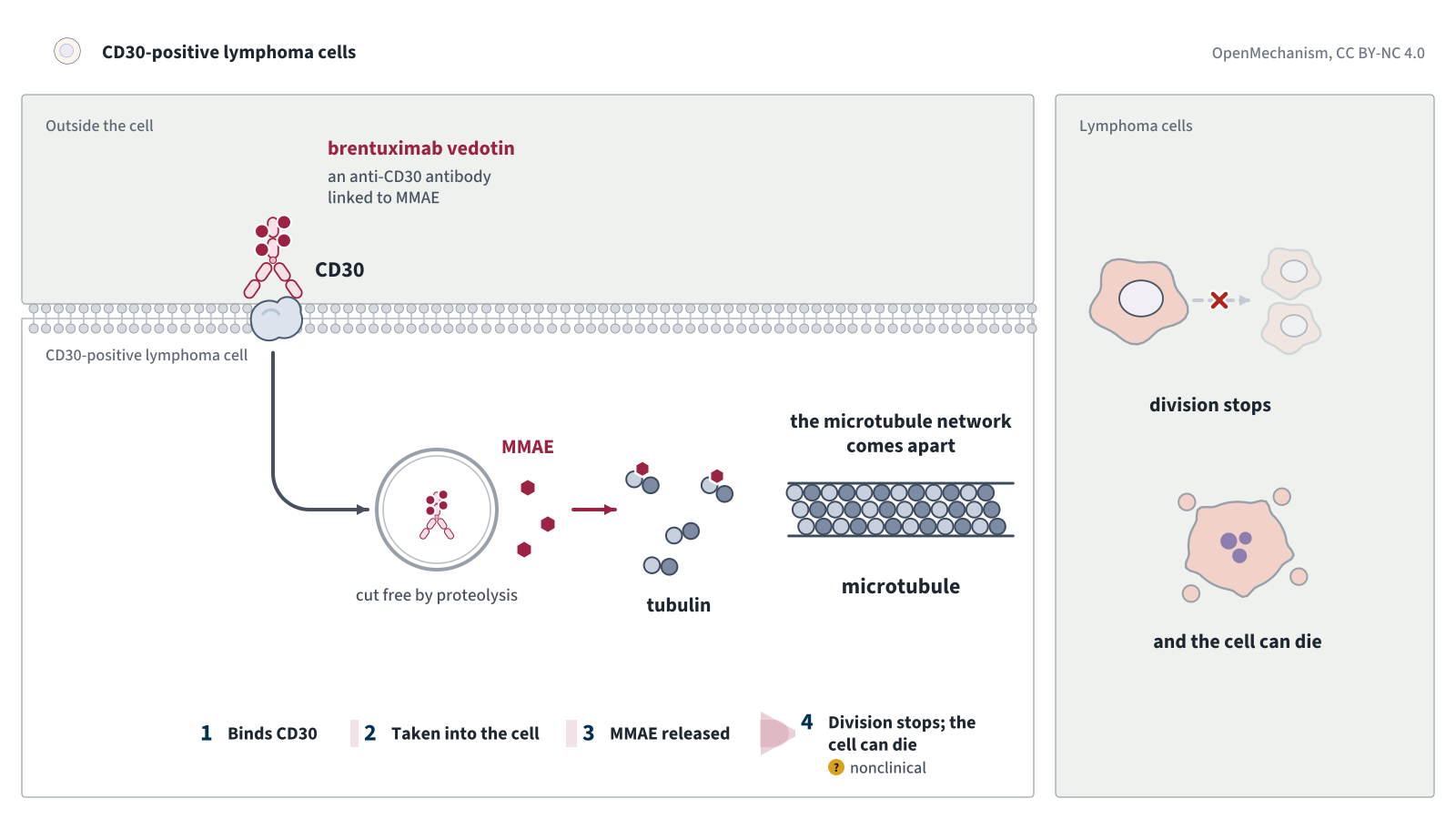
Brentuximab vedotin is an antibody joined to a medicine called . The antibody binds on lymphoma cells and is taken inside, where MMAE is released, disrupts and can stop cell division and trigger cell death.
- Acts on
- CD30, tubulin
- Where
- CD30-positive lymphoma cells
- Medicine type
- Antibody drug conjugate
- Used for
- Cancer
Also called Adcetris.
Step 4: nonclinical
The Adcetris label says: Nonclinical data suggest that the anticancer activity of ADCETRIS is due to the binding of the ADC to CD30-expressing cells, followed by internalization of the ADC‑CD30 complex, and the release of MMAE via proteolytic cleavage. … Binding of MMAE to tubulin disrupts the microtubule network within the cell, subsequently inducing cell cycle arrest and apoptotic death of the cells.
Source 1: Adcetris (brentuximab vedotin): FDA label, 12.1 Mechanism of Action
Clinical study: In an open-label, randomized phase 3 trial (ECHELON-1) in 1334 people with untreated stage III or IV classic Hodgkin lymphoma, brentuximab vedotin with doxorubicin, vinblastine and dacarbazine (A+AVD) or the standard doxorubicin, bleomycin, vinblastine and dacarbazine (ABVD); the trial measured modified progression-free survival, not whether the cells stop dividing or die: A+AVD had superior efficacy to ABVD in the treatment of patients with advanced-stage Hodgkin's lymphoma, with a 4.9 percentage-point lower combined risk of progression, death, or noncomplete response and use of subsequent anticancer therapy at 2 years.
Connors JM et al., N Engl J Med 2018 (PMID 29224502)
This study was picked with a literature search and is not yet checked by our reviewer.
Key terms in this drawing
- CD30
- CD30. A receptor in the tumor necrosis factor receptor family, found on the surface of some lymphoma cells.
- microtubule
- Microtubule. A structure inside the cell, built from the protein tubulin, that the cell needs for dividing and for other vital work.
- MMAE
- MMAE. The small molecule carried by brentuximab vedotin; it disrupts microtubules.
How it works
Binds CD30. The chimeric anti-CD30 component binds the selected lymphoma-cell antigen.1
Taken into the cell. The ADC-CD30 complex enters the cell.1
MMAE released. Proteolytic cleavage releases MMAE from the conjugate.1
Division stops; the cell can die. MMAE binds tubulin, disrupts microtubules and can induce cell-cycle arrest and apoptosis.1
For teachers: download this drawing or build a slide deck.
See also
Condition pages: B-cell lymphomas, cutaneous T-cell lymphoma and Hodgkin lymphoma.
Body system: cancer.
Sources
- 1Adcetris (brentuximab vedotin): FDA label12.1 Mechanism of Action
- 2ChEMBL CHEMBL1742994Target and action classification: Tubulin inhibitor; Tumor necrosis factor receptor superfamily member 8 binding agent
- 3Brentuximab Vedotin with Chemotherapy for Stage III or IV Hodgkin's LymphomaConnors JM et al. N Engl J Med 2018 (abstract)
Spotted a mistake? Report an error (hello@openmechanism.com). Since launch, every published error we fix is listed on the corrections page.
Notes and limits
- A schematic teaching drawing: not to scale, not exact structures, binding poses or a complete pathway, and not a guide to dosing, treatment or how a person will respond.
- The steps are in the order that explains them; one step is said to cause the next only where the source says so.
- The label qualifies this causal anticancer chain as nonclinical data.
- ADCP is an additional in-vitro branch, not an obligatory step in the payload sequence.
All recorded limits are on the evidence page, and notes that apply to every page are on How to read a page. Version 1.0.0, not yet medically reviewed.
Cite this page
Tran D. Brentuximab vedotin [Internet]. OpenMechanism; 2026 [updated 2026 Oct 15; cited 2026 Oct 15]. Available from: https://openmechanism.com/medicines/brentuximab-vedotin