Small cell lung cancer
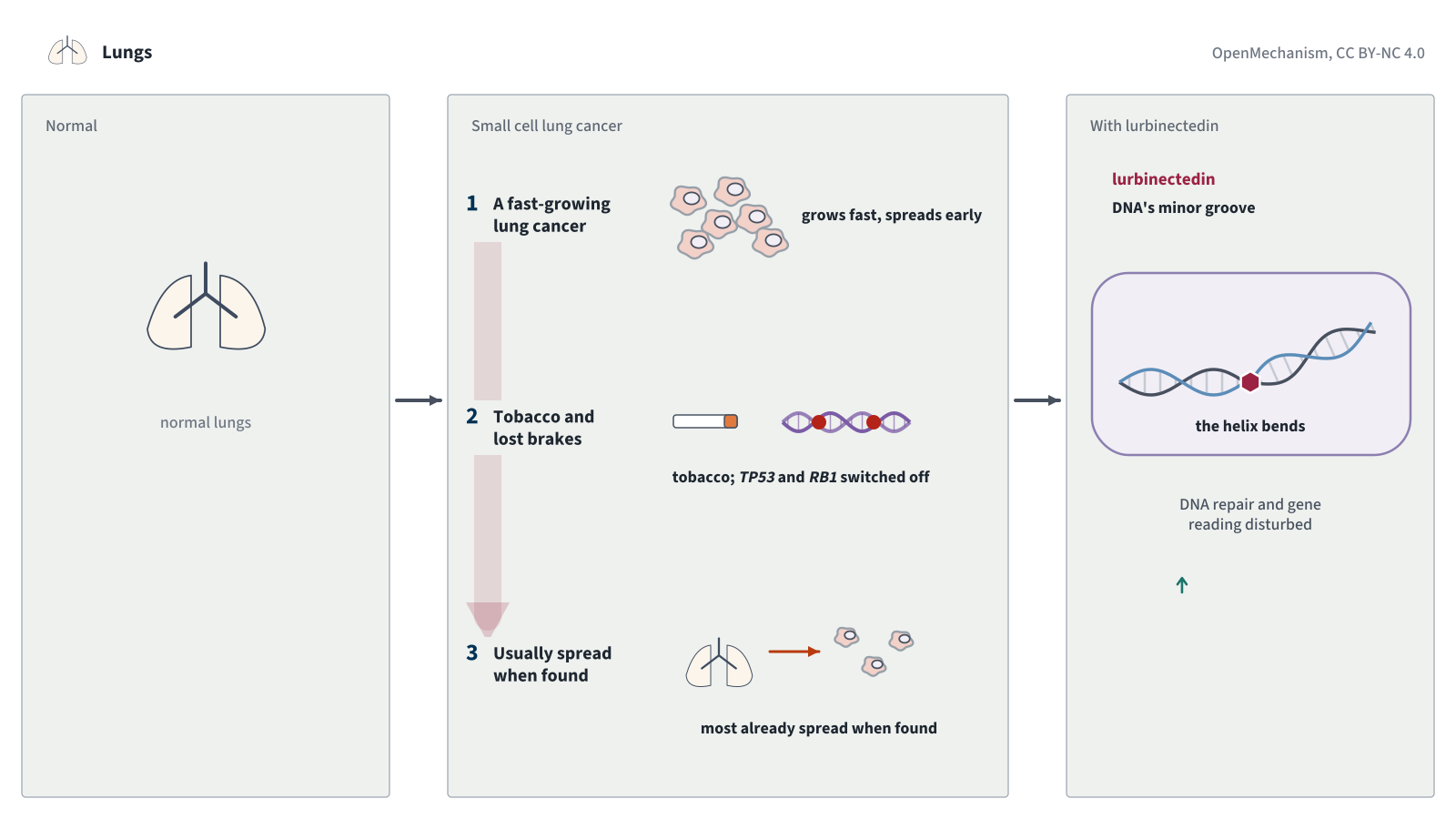
Small cell lung cancer, about 15% of lung cancers, grows exceptionally fast, spreads early and has a poor outlook; most people already have spread disease when it is found. It is strongly linked to tobacco, and the tumor suppressor genes TP53 and RB1 are almost always switched off. Lurbinectedin binds and bends DNA, disturbing DNA repair so the cell dies.
- Where
- Lungs
- Body systems
- Cancer, Lungs & airways
- Medicines
- 1 medicine
For teachers: download this drawing.
Key terms in this drawing
- DNA
- Deoxyribonucleic acid. The molecule that stores genes.
- RB1
- RB1 tumor suppressor gene. A tumor suppressor gene; it is almost always switched off in small cell lung cancer, along with TP53.
- TP53
- TP53 tumor suppressor gene. A tumor suppressor gene; in some cancers it is switched off, lost or mutated.
What goes wrong
A fast-growing lung cancer. Small cell lung cancer is about 15% of lung cancers; it grows exceptionally fast, spreads early and has a poor outlook.1
What the source says
“Small-cell lung cancer (SCLC) represents about 15% of all lung cancers and is marked by an exceptionally high proliferative rate, strong predilection for early metastasis and poor prognosis.”
Source 1Tobacco and lost brakes. It is strongly linked to tobacco, and the tumor suppressor genes and are almost always switched off.1
Usually spread when found. Most people already have metastatic disease at diagnosis; only a third have earlier-stage disease that might be cured.1
What the source says
“Most patients have metastatic disease at diagnosis, with only one-third having earlier-stage disease that is amenable to potentially curative multimodality therapy.”
Source 1
Where medicines act
- A
Lurbinectedin: DNA bent
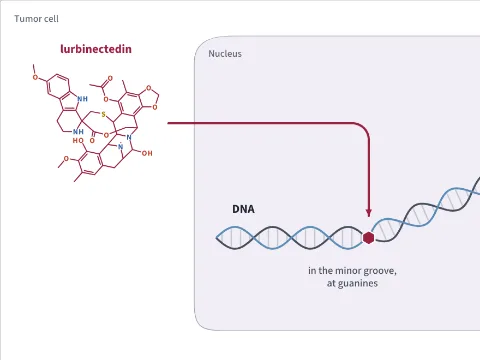
Lurbinectedin binds guanine in the minor groove of and bends the helix; this disturbs DNA-binding proteins and DNA repair, and the cell cycle stalls and the cell dies. With atezolizumab, it is used as maintenance treatment in extensive-stage small cell lung cancer.2
What the source says
“Lurbinectedin is an alkylating drug that binds guanine residues in the minor groove of DNA, forming adducts and resulting in a bending of the DNA helix towards the major groove.”
Source 2“resulting in perturbation of the cell cycle and eventual cell death.”
Source 2“for the maintenance treatment of adult patients with extensive-stage small cell lung cancer”
Source 2
See also
Body systems: cancer and lungs & airways.
Also used for it: etoposide (for first-line treatment, with cisplatin: “ETOPOPHOS is indicated, in combination with cisplatin, for first-line treatment of patients with small cell lung cancer.”3).
Other conditions: testicular cancer; head and neck cancer; and non-small cell lung cancer.
Sources
- 1Small-cell lung cancerRudin CM et al. Nat Rev Dis Primers 2021 (abstract). Saved copy
- 2Zepzelca (lurbinectedin): FDA label1 Indications and Usage; 12.1 Mechanism of Action. Saved copy
- 3Etopophos (etoposide phosphate): FDA labelIndications and Usage. Saved copy
Notes and limits
- Progress in treating it has been notoriously slow.1
Notes that apply to every page are on How to read a page.
Spotted a mistake? Report an error (hello@openmechanism.com). Since launch, every published error we fix is listed on the corrections page.
Cite this page
Tran D. Small cell lung cancer [Internet]. OpenMechanism; 2026 [updated 2026 Oct 19; cited 2026 Oct 19]. Available from: https://openmechanism.com/conditions/small-cell-lung-cancer