Pembrolizumab
When or binds on a , it holds the T cell back. Pembrolizumab blocks PD-1, releasing this brake, and the freed response can include attacking tumors. Releasing the brake can also cause immune reactions, which may be severe or fatal, in any organ or tissue. The Keytruda label lists its uses in many cancers, among them melanoma, non-small cell lung cancer and classical Hodgkin lymphoma, each with its own limits, such as the cancer's stage, earlier treatment, the patient's age or a test of the tumor.
- Acts on
- PD-1
- Where
- T cells meeting tumor cells
- Medicine type
- Antibody
- Used for
- Cancer
- Drug class
- Immune checkpoint inhibitors
Also called Keytruda.
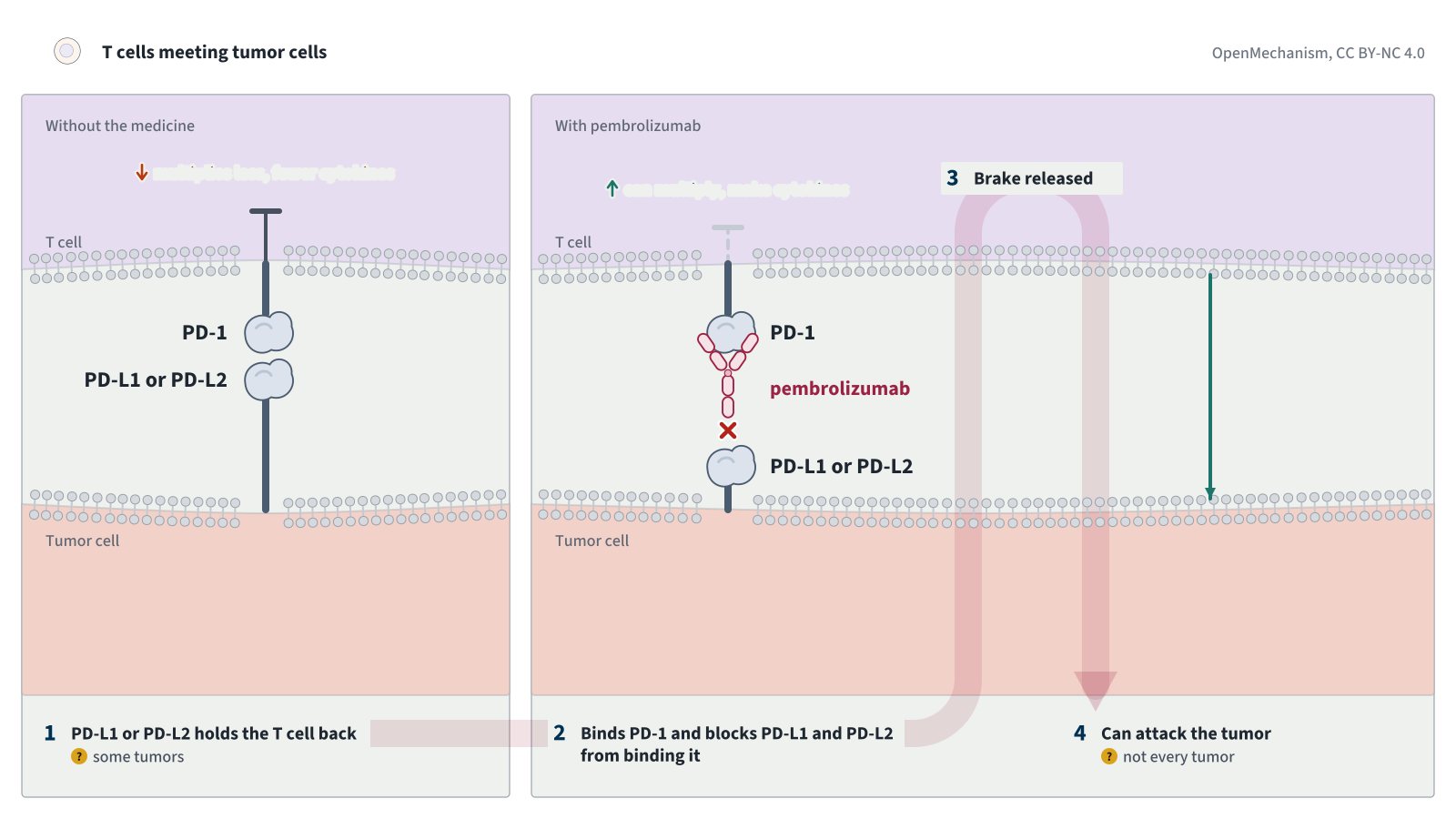
Step 1: some tumors
The pembrolizumab label says: Upregulation of PD-1 ligands occurs in some tumors and signaling through this pathway can contribute to inhibition of active T-cell immune surveillance of tumors.
Source 1: Keytruda (pembrolizumab): FDA label, 12.1 Mechanism of Action
Clinical study: In a 2014 study of tumor samples from 46 people with metastatic melanoma, taken before and during pembrolizumab treatment (its abstract gives no doses), those who went on to respond had, before treatment: higher numbers of CD8-, PD-1- and PD-L1-expressing cells at the invasive tumour margin
. Tumeh PC et al., Nature 2014 (PMID 25428505)
Step 4: not every tumor
The pembrolizumab label says: Pembrolizumab is a monoclonal antibody that binds to the PD-1 receptor and blocks its interaction with PD-L1 and PD-L2, releasing PD-1 pathway-mediated inhibition of the immune response, including the anti-tumor immune response. In syngeneic mouse tumor models, blocking PD-1 activity resulted in decreased tumor growth.
Source 1: Keytruda (pembrolizumab): FDA label, 12.1 Mechanism of Action
Clinical study: In a 2015 randomized, controlled phase 3 trial in 834 people with advanced melanoma, pembrolizumab (10 mg per kilogram of body weight every 2 or 3 weeks) was compared with ipilimumab (four doses of 3 mg per kilogram every 3 weeks): The response rate was improved with pembrolizumab administered every 2 weeks (33.7%) and every 3 weeks (32.9%), as compared with ipilimumab (11.9%)
. Robert C et al., N Engl J Med 2015 (PMID 25891173)
Key terms in this drawing (5)
- cytokines
- Cytokines. Signal molecules involved in inflammation, such as interleukin-2, interferon-γ, interleukin-4 and TNF-α, which T cells make.
- PD-1
- Programmed cell death protein 1. A receptor on T cells that acts as a brake when PD-L1 or PD-L2 binds it.
- PD-L1
- Programmed death-ligand 1. One of the two PD-1 ligands (PD-L1 and PD-L2): it binds PD-1 on T cells and holds them back, and some tumors make more of it.
- PD-L2
- PD-L2. One of the two PD-1 ligands (PD-L1 and PD-L2): it binds PD-1 on T cells and holds them back.
- T cell
- T lymphocyte. A white blood cell of the immune system.
How it works
PD-L1 or PD-L2 holds the T cell back. PD-L1/PD-L2 binding to T-cell PD-1 inhibits T-cell proliferation and production.1
Binds PD-1 and blocks PD-L1 and PD-L2 from binding it. Pembrolizumab binds PD-1 and blocks its interaction with these .1
Brake released. This removes inhibition mediated through the PD-1 pathway.1
Can attack the tumor. The released response can include antitumor immune activity.1
For teachers: download this drawing or build a slide deck.
More detail
Immune reactions in any organ or tissue
Immune-mediated reactions. Blocking the PD-1 pathway removes inhibition of the immune response, potentially breaking peripheral tolerance; immune-mediated reactions, which may be severe or fatal, can occur in any organ system or tissue.1
See also
Condition pages: B-cell lymphomas; bladder cancer; breast cancer; cervical cancer; colorectal cancer; endometrial cancer; head and neck cancer; Hodgkin lymphoma; kidney cancer; melanoma; non-small cell lung cancer; ovarian cancer; and stomach cancer.
Other immune checkpoint inhibitors: ipilimumab.
Explained: why checkpoint inhibitors can inflame healthy organs.
Related drawings: ipilimumab (releases another brake on T cells, CTLA-4).
Body system: cancer.
Inside the body: immune attack on a tumor.
Sources
- 1Keytruda (pembrolizumab): FDA label1 Indications and Usage; 12.1 Mechanism of Action; §11, §12.1, §12.3 elimination; §5.1 immune-mediated adverse reactions; 5.1 Severe and Fatal Immune-Mediated Adverse Reactions
- 2Pembrolizumab versus Ipilimumab in Advanced MelanomaRobert C et al., N Engl J Med 2015 (abstract)
- 3PD-1 blockade induces responses by inhibiting adaptive immune resistanceTumeh PC et al., Nature 2014 (abstract)
- 4Mutations Associated with Acquired Resistance to PD-1 Blockade in MelanomaZaretsky JM et al., N Engl J Med 2016 (abstract)
- 5ChEMBL CHEMBL3137343Target and action classification: Programmed cell death protein 1 inhibitor
Spotted a mistake? Report an error (hello@openmechanism.com). Since launch, every published error we fix is listed on the corrections page.
Notes and limits
- A schematic teaching drawing: not to scale, not exact structures, binding poses or a complete pathway, and not a guide to dosing, treatment or how a person will respond.
- The steps are in the order that explains them; one step is said to cause the next only where the source says so.
- Releasing the PD-1 brake does not make every tumor respond or switch on every T cell.
- The link between CD8 T cells at a tumor's invasive margin (its edge) and response is an observed association, not a test that works for everyone.
- The findings on how melanoma stopped responding (JAK1, JAK2 and B2M) come from four people whose melanoma first shrank on pembrolizumab and then grew again, plus cell experiments.
- The drawing does not show how the body breaks the antibody down, what the T cells recognize on the tumor, or exactly how the antibody sits on PD-1.
- The depicted response is not exclusive to tumor tissue and is not a guaranteed tumor-killing event.
All recorded limits are on the evidence page, and notes that apply to every page are on How to read a page. Version 1.1.2, medically reviewed by Daniel Tran, PharmD, on 15 November 2026.
Cite this page
Tran D. Pembrolizumab [Internet]. OpenMechanism; 2026 [updated 2026 Nov 15; cited 2026 Nov 15]. Available from: https://openmechanism.com/medicines/pembrolizumab