Infections
How microbes get in and multiply, and how medicines hit parts of a microbe that our own cells lack.
For teachers: download this drawing.
Key terms in this drawing
- 50S
- 50S ribosomal subunit. The large part of the bacterial ribosome.
- 70S
- 70S ribosome. The bacterial ribosome. The Zyvox label says linezolid prevents a functional 70S initiation complex from forming.
- DNA
- Deoxyribonucleic acid. The molecule that stores genes.
How it works
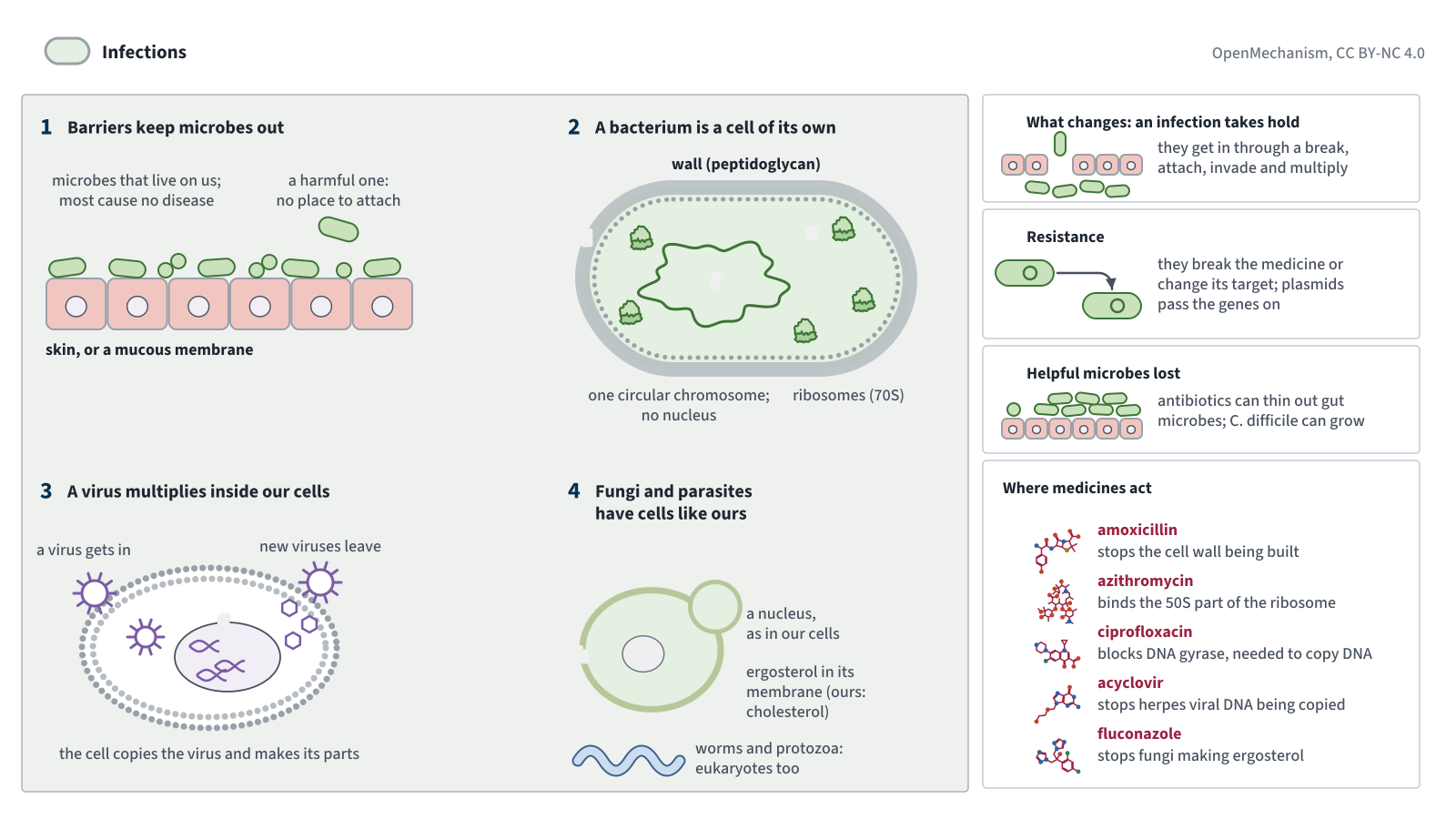
Barriers keep microbes out. The skin and the mucous membranes that line the nose, mouth, lungs and the urinary and digestive tracts are barriers to microbes. Most microbes that live on the body cause no disease, and they compete with harmful ones for places to attach and for food.1,2
What the source says
“They include physical barriers to microbes, such as the skin and mucous membranes, as well as mechanical defenses that physically remove microbes and debris from areas of the body where they might cause harm or infection.”
Source 1“The mucous membranes lining the nose, mouth, lungs, and urinary and digestive tracts provide another nonspecific barrier against potential pathogens.”
Source 1“The human body can be colonized by a variety of microorganisms, most of which are non-pathogenic.”
Source 2“Through their occupation of cellular binding sites and competition for available nutrients, the resident microbiota prevent the critical early steps of pathogen attachment and proliferation required for the establishment of an infection.”
Source 1A bacterium is a cell of its own. Bacteria are prokaryotes: their cells have no nucleus and usually one circular chromosome. The main part of their wall is peptidoglycan, which only bacteria have, and their ribosomes () differ from those in our cells (80S).3,4
What the source says
“Prokaryotic microorganisms are classified within the domains Archaea and Bacteria, whereas eukaryotic organisms are classified within the domain Eukarya.”
Source 3“Prokaryotic cells lack a nucleus surrounded by a complex nuclear membrane and generally have a single, circular chromosome located in a nucleoid.”
Source 3“The major component of bacterial cell walls is called peptidoglycan (or murein); it is only found in bacteria.”
Source 3“The cytoplasmic ribosomes found in animal cells (80S) are structurally distinct from those found in bacterial cells (70S), making protein biosynthesis a good selective target for antibacterial drugs.”
Source 4A virus multiplies inside our cells. A virus is not a cell, so it can only multiply inside one: it attaches, gets in and has the cell make its parts; new viruses are assembled and released to infect more cells.5,6
What the source says
“In terms of taxonomy, they are not included in the tree of life because they are acellular (not consisting of cells).”
Source 5“In order to survive and reproduce, viruses must infect a cellular host, making them obligate intracellular parasites.”
Source 5“Lytic animal viruses follow similar infection stages to bacteriophages: attachment, penetration, biosynthesis, maturation, and release”
Source 6“The genome of a virus enters a host cell and directs the production of the viral components, proteins and nucleic acids, needed to form new virus particles called virions.”
Source 5“New virions are made in the host cell by assembly of viral components.”
Source 5“The new virions transport the viral genome to another host cell to carry out another round of infection.”
Source 5Fungi and parasites have cells like ours. Fungi, protozoa and worms are eukaryotes: their cells have a nucleus and are very like ours, which makes medicines that spare our cells harder to find. One difference: most fungi build their cell membranes with ergosterol, where ours use cholesterol.3,7
What the source says
“Because fungi, protozoa, and helminths are eukaryotic, their cells are very similar to human cells, making it more difficult to develop drugs with selective toxicity.”
Source 7“Eukaryotic cells have a nucleus surrounded by a complex nuclear membrane that contains multiple, rod-shaped chromosomes.”
Source 3“For most fungi, the predominant membrane sterol is ergosterol.”
Source 7“Because human cell membranes use cholesterol, instead of ergosterol, antifungal drugs that target ergosterol synthesis are selectively toxic”
Source 7
What changes in disease
An infection takes hold. An infection can start where the skin barrier is broken. To cause disease, a microbe must reach the body, attach, invade and then multiply.1,8
What the source says
“Infections can occur when the skin barrier is compromised or broken.”
Source 1“To cause disease, a pathogen must successfully achieve four steps or stages of pathogenesis: exposure (contact), adhesion (colonization), invasion, and infection.”
Source 8“Following invasion, successful multiplication of the pathogen leads to infection.”
Source 8Resistance. Bacteria can resist a medicine by breaking it down, changing its target or keeping it out. Enzymes called beta-lactamases, which break beta-lactam medicines such as penicillin, are the most common way bacteria resist those medicines. Using a medicine can select resistant bacteria, and resistance genes can pass between bacteria on plasmids.4,9
What the source says
“These mechanisms include enzymatic modification of the drug, modification of the antimicrobial target, and prevention of drug penetration or accumulation.”
Source 9“Penicillin, the first antibiotic discovered, is one of several antibacterials within a class called β-lactams.”
Source 4“For β-lactams, bacterial resistance can involve the enzymatic hydrolysis of the β-lactam bond within the β-lactam ring of the drug molecule.”
Source 9“This mechanism of resistance is mediated by β-lactamases, which are the most common mechanism of β-lactam resistance.”
Source 9“Exposure of a pathogen to an antimicrobial compound can select for chromosomal mutations conferring resistance, which can be transferred vertically to subsequent microbial generations and eventually become predominant in a microbial population that is repeatedly exposed to the antimicrobial.”
Source 9“Alternatively, many genes responsible for drug resistance are found on plasmids or in transposons that can be transferred easily between microbes through horizontal gene transfer”
Source 9Helpful microbes lost. Antibiotics can greatly reduce the microbes that normally live in the gut, which gives harmful bacteria an advantage to settle and cause diarrhea; colitis caused by Clostridioides difficile is one example.1,10
What the source says
“Treatment with antibiotics can significantly deplete the normal microbiota of the gastrointestinal tract, providing an advantage for pathogenic bacteria to colonize and cause diarrheal infection.”
Source 1“Common examples of superinfections that develop as a result of antimicrobial usage include yeast infections (candidiasis) and pseudomembranous colitis caused by Clostridioides difficile, which can be fatal.”
Source 10
Where medicines act
- d
Amoxicillin
Stops bacteria building their cell wall, which leads to their death.
- e
Azithromycin
Binds the 50S part of the bacterial ribosome and stops the bacterium making proteins.
- f
Ciprofloxacin
Blocks DNA gyrase and topoisomerase IV, enzymes the bacterium needs to copy its DNA.
- g
Acyclovir
Is switched on by the herpes virus's own enzyme, then stops the virus copying its DNA.
- h
Fluconazole
Blocks the fungal enzyme that makes ergosterol; the same step in our cells is much less sensitive.
See also
Zoom in: the bacterial cell wall.
Body systems: immune system.
Conditions
- Antibiotic-resistant infections
- Bloodstream infections and endocarditis
- C. difficile infection
- COVID-19
- Cryptosporidiosis
- Giardiasis and amebiasis
- Hepatitis B
- Hepatitis C
- Hepatitis D
- Herpes infections
- HIV infection
- Influenza
- Invasive fungal infections
- Leishmaniasis
- Leprosy
- Malaria
- Nail fungus
- Pneumocystis pneumonia (PCP)
- Pneumonia
- Ringworm (tinea)
- RSV infection
- Scabies and lice
- Skin and soft-tissue infections
- Sleeping sickness
- Syphilis
- Tapeworm larva infections
- Thrush and vaginal yeast infections
- Trichomoniasis and bacterial vaginosis
- Tuberculosis
- Urinary tract infections
- Worm infections
More medicines for this area
- Albendazole
- Amoxicillin and clavulanate
- Amphotericin B
- Artesunate
- Atovaquone
- Baloxavir marboxil
- Bedaquiline
- Bezlotoxumab
- Bulevirtide
- Caspofungin
- Ceftazidime and avibactam
- Ceftriaxone
- Cephalexin
- Chloroquine
- Clindamycin
- Clofazimine
- Daptomycin
- Darunavir
- Doravirine
- Doxycycline
- Eflornithine
- Enfuvirtide
- Flucytosine
- Fosfomycin
- Gentamicin
- Glecaprevir and pibrentasvir
- Hepatitis B vaccine (HBsAg)
- Hydroxychloroquine
- Isoniazid
- Ivermectin
- Lenacapavir
- Levamisole
- Linezolid
- Metronidazole
- Miltefosine
- Nirmatrelvir
- Nirsevimab
- Nitazoxanide
- Nitrofurantoin
- Oseltamivir
- Penicillin G
- Pentamidine
- Permethrin
- Praziquantel
- Primaquine
- Raltegravir
- Remdesivir
- Rifampin
- Sodium stibogluconate
- Sofosbuvir
- Sulfamethoxazole and trimethoprim
- Tenofovir
- Tozinameran (mRNA COVID-19 vaccine)
- Valacyclovir
- Vancomycin
Sources
- 1Physical defensesOpenStax Microbiology, section 17.1 (CC BY-NC-SA 4.0). Saved copy
- 2Characteristics of infectious diseaseOpenStax Microbiology, section 15.1 (CC BY-NC-SA 4.0). Saved copy
- 3Unique characteristics of prokaryotic cellsOpenStax Microbiology, section 3.3 (CC BY-NC-SA 4.0). Saved copy
- 4Mechanisms of antibacterial drugsOpenStax Microbiology, section 14.3 (CC BY-NC-SA 4.0). Saved copy
- 5VirusesOpenStax Microbiology, section 6.1 (CC BY-NC-SA 4.0). Saved copy
- 6The viral life cycleOpenStax Microbiology, section 6.2 (CC BY-NC-SA 4.0). Saved copy
- 7Mechanisms of other antimicrobial drugsOpenStax Microbiology, section 14.4 (CC BY-NC-SA 4.0). Saved copy
- 8How pathogens cause diseaseOpenStax Microbiology, section 15.2 (CC BY-NC-SA 4.0). Saved copy
- 9Drug resistanceOpenStax Microbiology, section 14.5 (CC BY-NC-SA 4.0). Saved copy
- 10Fundamentals of antimicrobial chemotherapyOpenStax Microbiology, section 14.2 (CC BY-NC-SA 4.0). Saved copy
- 11Amoxicillin: FDA label12.4 Microbiology: Mechanism of Action. Saved copy
- 12Zithromax (azithromycin): FDA label12.4 Microbiology: Mechanism of Action. Saved copy
- 13Cipro (ciprofloxacin): FDA label12.4 Microbiology: Mechanism of Action. Saved copy
- 14Acyclovir tablets: FDA labelVirology: Mechanism of Antiviral Action. Saved copy
- 15Diflucan (fluconazole): FDA labelMicrobiology: Mechanism of Action. Saved copy
- 16Escherichia coli stalled ribosome with linezolidPDB 7S1G; Tsai, K. et al. Nat.Struct.Mol.Biol. 2022;29:162-171. The ribosome outline in the drawing is traced from this structure. Saved copy
Notes and limits
- Most medicines for infections act on bacteria: a bacterial cell offers more targets that our cells lack than fungi, parasites or viruses do.4
- Viruses multiply inside our own cells, which makes medicines that harm only the virus hard to find.7
- Aiming at a target the microbe has does not make a medicine free of side effects: those linked to fluoroquinolones, the class ciprofloxacin belongs to, include a higher risk of a torn tendon.4
- The drawing shows one kind of bacterium; in gram-negative bacteria the wall is thinner, with a second, outer membrane outside it.3
- The drawing is schematic and not to scale; it shows only what the statements above say.
Spotted a mistake? Report an error (hello@openmechanism.com). Since launch, every published error we fix is listed on the corrections page.
Cite this page
Tran D. Infections [Internet]. OpenMechanism; 2026 [updated 2026 Nov 13; cited 2026 Nov 13]. Available from: https://openmechanism.com/body/infections