Hydroxychloroquine
Hydroxychloroquine acts on malaria parasites inside red blood cells, perhaps by collecting in their acid vesicles and blocking the polymerization of heme; the precise mechanism is not known, and it does not act on the parasites' liver forms. It is also used for rheumatoid arthritis and lupus, where how it calms the immune system is not fully known. It spreads widely into tissues and lingers for weeks.
- Acts on
- Plasmodium blood stages (malaria); the immune system (mechanism not fully known)
- Where
- Malaria parasites; the immune system
- Medicine type
- Small molecule
- Used for
- Infections
Also called Plaquenil.
Step 1: not known
The hydroxychloroquine label says: The precise mechanism by which hydroxychloroquine exhibits activity against Plasmodium is not known. … Hydroxychloroquine is a weak base and may exert its effect by concentrating in the acid vesicles of the parasite and inhibiting polymerization of heme.
Source 1: Hydroxychloroquine sulfate tablets (Zydus): FDA label, 12.4 Microbiology
Clinical study: A laboratory study of cultured malaria parasites with the related quinolines chloroquine and quinidine (not hydroxychloroquine itself) found that the medicines bound to the parasite's heme polymer; the authors' data: suggest that a quinoline heme complex incorporates into the growing polymer to terminate chain extension, blocking further sequestration of toxic heme
Sullivan DJ et al., Proc Natl Acad Sci U S A 1996 (PMID 8876229)
This study was picked with a literature search and is not yet checked by our reviewer.
Step 3: not fully known
The Plaquenil (hydroxychloroquine) label says: The mechanisms underlying the anti-inflammatory and immunomodulatory effects of PLAQUENIL in the treatment of rheumatoid arthritis, chronic discoid lupus erythematosus and systemic lupus erythematosus are not fully known.
Clinical study: In a randomized, double-blind trial in 47 people with stable lupus, continuing hydroxychloroquine was compared with switching to placebo for 24 weeks; the trial measured flare-ups, not how hydroxychloroquine works: Patients with quiescent systemic lupus erythematosus who are taking hydroxychloroquine are less likely to have a clinical flare-up if they are maintained on the drug.
Canadian Hydroxychloroquine Study Group, N Engl J Med 1991 (PMID 1984192)
This study was picked with a literature search and is not yet checked by our reviewer.
Key terms in this drawing (6)
- CYP2C8
- Cytochrome P450 2C8. One of the cytochrome P450 enzymes that break down medicines; in lab studies, with CYP3A4 and CYP2D6, it breaks down hydroxychloroquine.
- CYP2D6
- Cytochrome P450 2D6. A liver enzyme that breaks down several medicines; for tramadol it makes the active metabolite M1.
- CYP3A4
- Cytochrome P450 3A4. One of the cytochrome P450 enzymes that break down medicines, atorvastatin among them; some antibiotics and antifungals can block it.
- DNA
- Deoxyribonucleic acid. The molecule that stores genes.
- half-life
- Half-life. The time it takes for the amount in the blood to fall by half.
- hypnozoite
- Dormant liver-stage malaria parasite. A malaria parasite that stays dormant in a liver cell; primaquine and tafenoquine act on it.
How it works
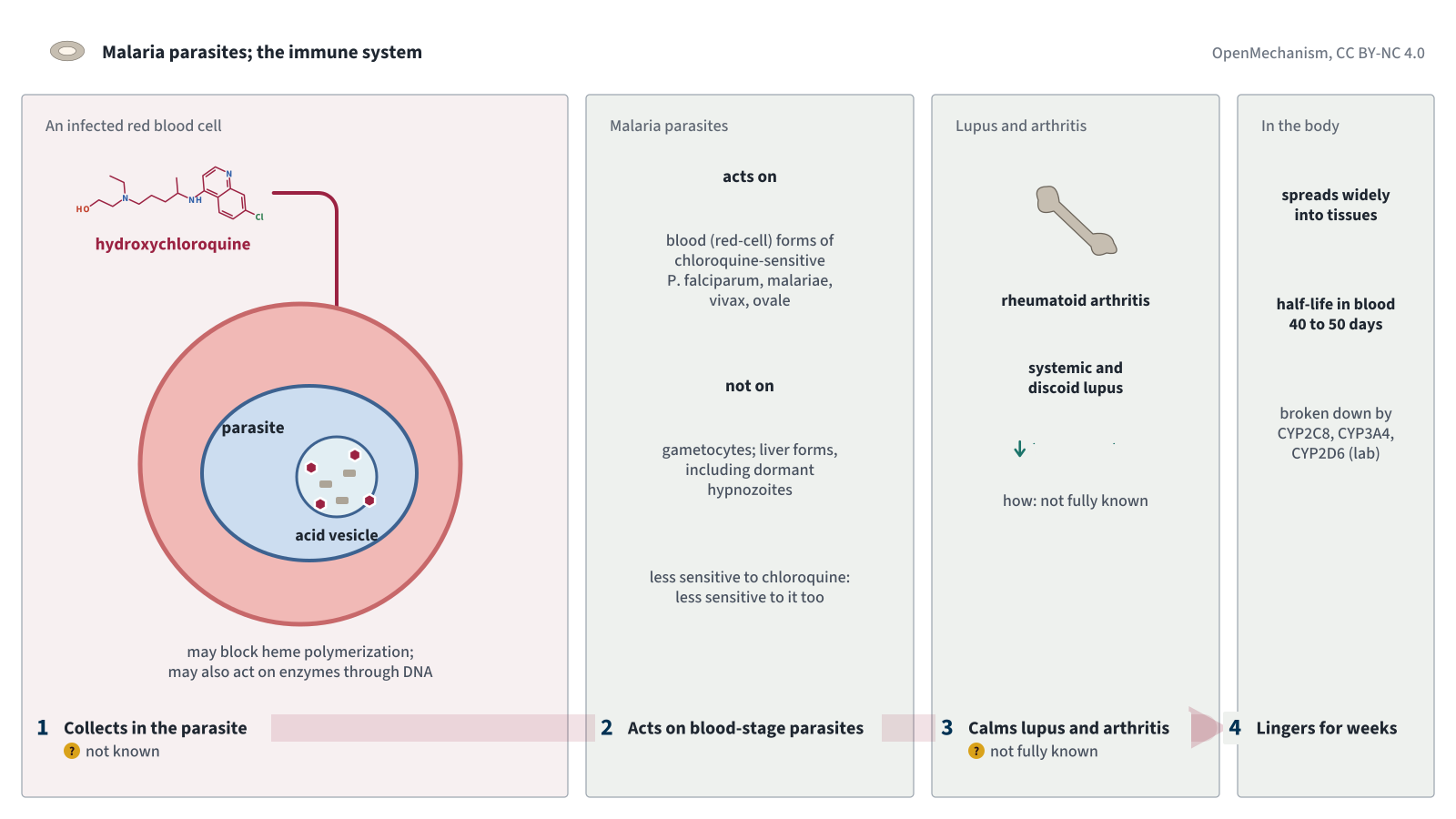
Collects in the parasite. How hydroxychloroquine acts against Plasmodium is not precisely known. A weak base, it may concentrate in the parasite's acid vesicles and inhibit the polymerization of heme; it can also inhibit certain enzymes by interacting with .1
Acts on blood-stage parasites. It is active against the red-blood-cell (erythrocytic) forms of chloroquine-sensitive P. falciparum, P. malariae, P. vivax and P. ovale, but not against gametocytes or the liver forms, including the dormant of P. vivax and P. ovale. Parasites less sensitive to chloroquine are less sensitive to hydroxychloroquine too.1
Calms lupus and arthritis. Hydroxychloroquine is also an antirheumatic, used for rheumatoid arthritis, systemic lupus erythematosus and chronic discoid lupus; how its anti-inflammatory and immunomodulatory effects work is not fully known.2
Lingers for weeks. It spreads extensively into tissues and about half is bound to plasma proteins. In the laboratory it is broken down mainly by , and ; with long-term use its terminal in whole blood is 40 to 50 days.2
For teachers: download this drawing.
See also
Condition pages: malaria and rheumatoid arthritis.
Body system: infections.
Sources
- 1Hydroxychloroquine sulfate tablets (Zydus): FDA label12.4 Microbiology
- 2Plaquenil (hydroxychloroquine sulfate) tablets: FDA label1 Indications and Usage; 12.1 Mechanism of Action; 12.3 Pharmacokinetics
- 3ChEMBL CHEMBL1535Target and action classification: Ferriprotoporphyrin IX inhibitor; Toll-like receptor 7 antagonist; Toll-like receptor 9 antagonist
- 4On the molecular mechanism of chloroquine's antimalarial actionSullivan DJ et al. Proc Natl Acad Sci U S A 1996 (abstract)
- 5A randomized study of the effect of withdrawing hydroxychloroquine sulfate in systemic lupus erythematosusCanadian Hydroxychloroquine Study Group. N Engl J Med 1991 (abstract)
Spotted a mistake? Report an error (hello@openmechanism.com). Since launch, every published error we fix is listed on the corrections page.
Notes and limits
- A schematic teaching drawing: not to scale, not exact structures, binding poses or a complete pathway, and not a guide to dosing, treatment or how a person will respond.
- The label says the precise mechanism by which hydroxychloroquine is active against Plasmodium is not known.
- The label says the mechanisms underlying the anti-inflammatory and immunomodulatory effects of Plaquenil in rheumatoid arthritis and lupus are not fully known.
All recorded limits are on the evidence page, and notes that apply to every page are on How to read a page. Version 1.0.0, not yet medically reviewed.
Cite this page
Tran D. Hydroxychloroquine [Internet]. OpenMechanism; 2026 [updated 2026 Oct 11; cited 2026 Oct 11]. Available from: https://openmechanism.com/medicines/hydroxychloroquine