HIV infection
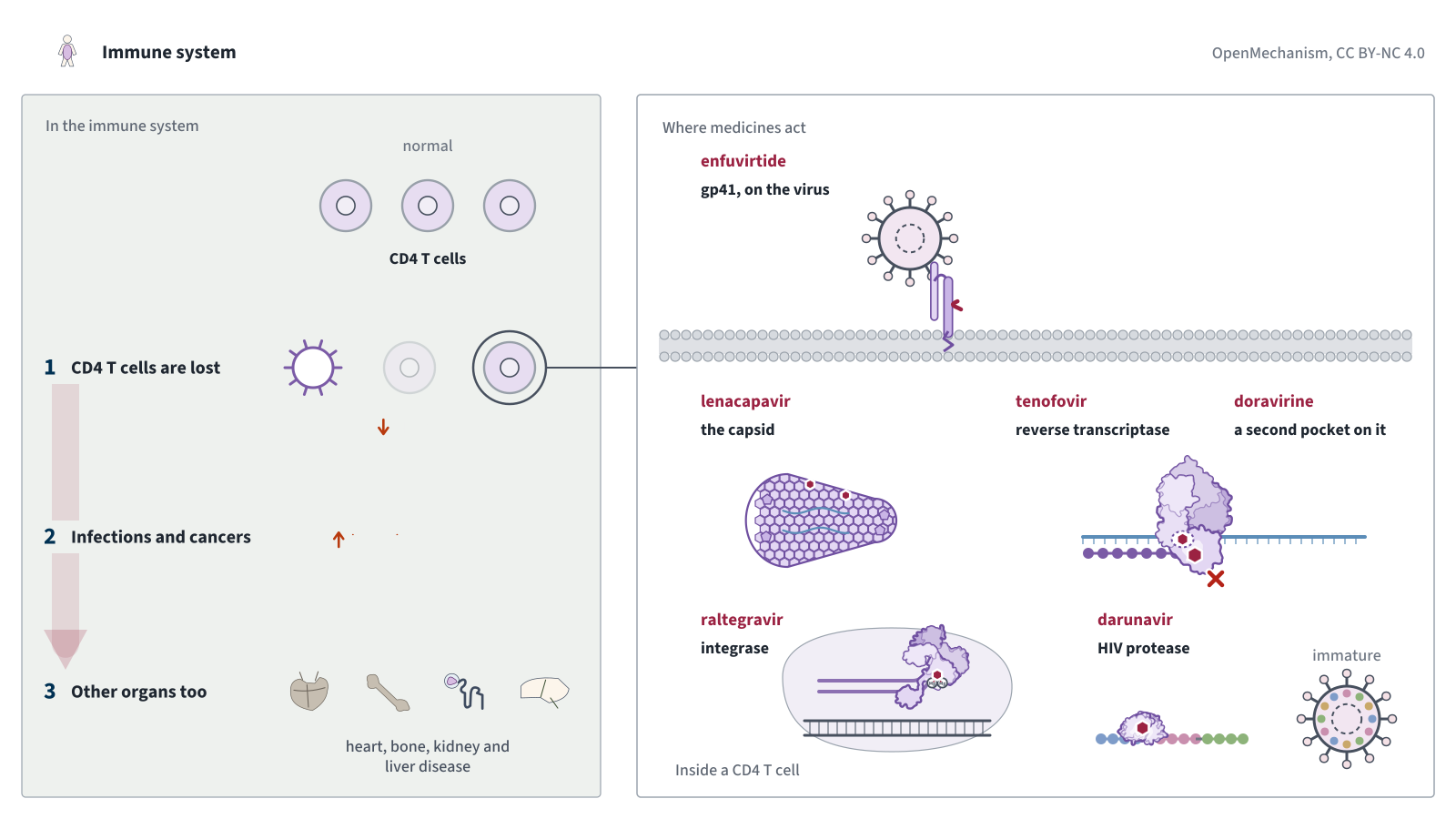
Untreated, HIV keeps multiplying and destroys CD4 T cells, which raises the risk of infections and cancers; it also adds to heart, bone, kidney and liver disease. Combination treatment blocks the virus at several steps: entry, the capsid, copying its into DNA, inserting that DNA and maturing new virus.
- Where
- Immune system
- Body systems
- Infections, Immune system
- Medicines
- 6 medicines
For teachers: download this drawing.
Key terms in this drawing (5)
- capsid
- Viral capsid. The protein shell around a virus's genome; HIV-1's is a cone built from p24 proteins.
- CD4
- CD4 receptor. A protein on some immune cells that HIV-1's gp120 binds first; ibalizumab binds it too.
- gp41
- Glycoprotein 41. An HIV-1 surface protein that helps the virus fuse with a cell.
- HIV
- Human immunodeficiency virus. A virus that, left untreated, destroys CD4 T cells over time and raises the risk of infections and cancers.
- T cell
- T lymphocyte. A white blood cell of the immune system.
What goes wrong
CD4 T cells are lost. Untreated, keeps multiplying and steadily destroys , with many other immune disturbances.1
What the source says
“Untreated HIV replication causes progressive CD4(+) T cell loss and a wide range of immunological abnormalities”
Source 1Infections and cancers. This raises the risk of infections and cancers.1
What the source says
“leading to an increased risk of infectious and oncological complications.”
Source 1Other organs too. HIV infection also adds to heart, bone, kidney and liver disease and other common illnesses.1
What the source says
“HIV infection also contributes to cardiovascular disease, bone disease, renal and hepatic dysfunction and several other common morbidities.”
Source 1
Where medicines act
- A
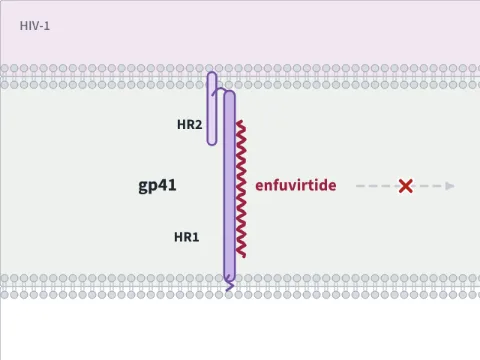
Enfuvirtide targets gp41 on the virus
Binds on the virus envelope and stops the shape change that fuses the virus with the cell.2
Used forHIV-1 infection: with other antiretrovirals, treatment-experienced, virus still multiplying
What the label says
“Enfuvirtide binds to the first heptad-repeat (HR1) in the gp41 subunit of the viral envelope glycoprotein and prevents the conformational changes required for the fusion of viral and cellular membranes.”
Source 2“FUZEON is an HIV-1 gp41 fusion inhibitor indicated for use in combination”
Source 2“with other antiretroviral agents for the treatment of HIV-1 infection in”
Source 2“treatment-experienced patients with HIV-1 replication despite ongoing”
Source 2“antiretroviral therapy.”
Source 2 - B
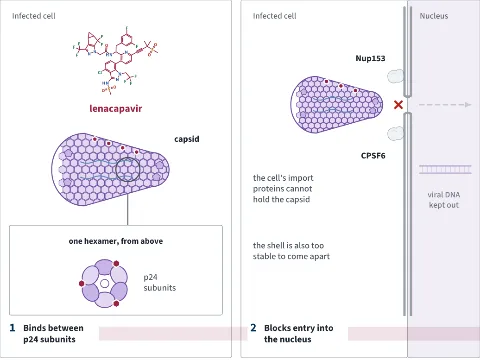
Lenacapavir targets the capsid
Binds between the 's protein units and blocks the capsid's work at several stages.3
Used forMultidrug-resistant HIV-1: heavily treatment-experienced adults
What the label says
“Lenacapavir is a multistage, selective inhibitor of HIV-1 capsid function that directly binds to the interface between capsid protein (p24) subunits in hexamers.”
Source 3“for the treatment of HIV-1 infection in heavily treatment-experienced adults with multidrug resistant HIV-1”
Source 3 - C
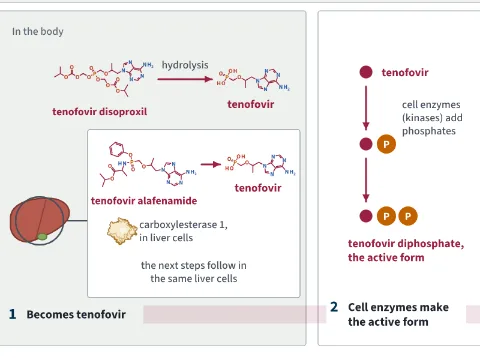
Tenofovir targets reverse transcriptase
Its active form competes with a building block for reverse transcriptase and, once built into the DNA, ends the chain.4
Used forHIV-1 infection: with other antiretrovirals
What the label says
“Tenofovir diphosphate inhibits the activity of HIV-1 reverse transcriptase (RT) and HBV RT by competing with the natural substrate deoxyadenosine 5'-triphosphate and, after incorporation into DNA, by DNA chain termination.”
Source 4“VIREAD is indicated in combination with other antiretroviral agents for the treatment of human immunodeficiency virus type 1 (HIV-1) infection”
Source 4 - D
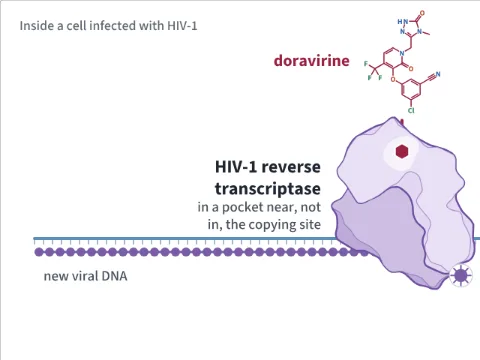
Doravirine targets reverse transcriptase, away from its active site
Binds reverse transcriptase away from its active site and blocks it.5
Used forHIV-1 infection: with other antiretrovirals
What the label says
“Doravirine is a pyridinone non-nucleoside reverse transcriptase inhibitor of HIV-1 and inhibits HIV-1 replication by non-competitive inhibition of HIV-1 reverse transcriptase (RT).”
Source 5“is indicated in combination with other antiretroviral agents for the treatment of HIV-1 infection”
Source 5 - E
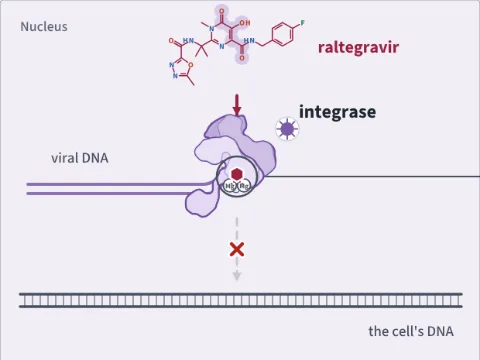
Raltegravir targets integrase
Blocks HIV integrase, so the viral DNA cannot be inserted into the cell's DNA.6
Used forHIV-1 infection: with other antiretrovirals
What the label says
“Raltegravir inhibits the catalytic activity of HIV-1 integrase, an HIV-1 encoded enzyme that is required for viral replication. Inhibition of integrase prevents the covalent insertion, or integration, of unintegrated linear HIV-1 DNA”
Source 6“indicated in combination with other antiretroviral agents for the treatment of HIV-1 infection in adult patients”
Source 6 - F
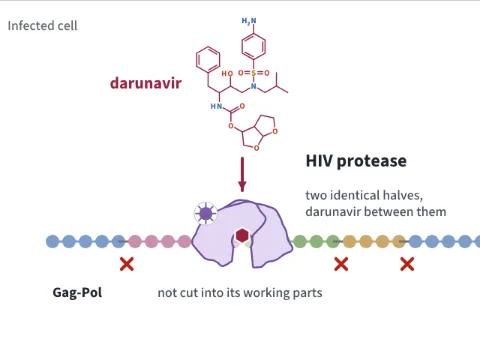
Darunavir targets HIV protease
Blocks HIV protease, so the virus's proteins are not cut and new virus cannot mature.7
Used forHIV-1 infection: adults and children 3 and older
What the label says
“Darunavir is an inhibitor of the HIV-1 protease. It selectively inhibits the cleavage of HIV-1 encoded Gag-Pol polyproteins in infected cells, thereby preventing the formation of mature virus particles.”
Source 7“is indicated for the treatment of human immunodeficiency virus (HIV-1) infection in adult and pediatric patients 3 years of age and older”
Source 7
See also
Body systems: infections and immune system.
Other conditions: hepatitis B.
Sources
- 1HIV infectionDeeks SG et al. Nat Rev Dis Primers 2015 (abstract). Saved copy
- 2Fuzeon (enfuvirtide): FDA labelIndications and Usage; 12.4 Mechanism of Action. Saved copy
- 3Sunlenca (lenacapavir): FDA label1 Indications and Usage; 12.1 and 12.4 Mechanism of Action. Saved copy
- 4Viread (tenofovir disoproxil fumarate): FDA label1 Indications and Usage; 12.1 and 12.4 Mechanism of Action. Saved copy
- 5Pifeltro (doravirine): FDA label1 Indications and Usage; 12.1 and 12.4 Mechanism of Action. Saved copy
- 6Isentress (raltegravir): FDA label1 Indications and Usage; 12.1 and 12.4 Mechanism of Action. Saved copy
- 7Prezista (darunavir): FDA label1 Indications and Usage; 12.1 and 12.4 Mechanism of Action. Saved copy
- 8HIV-1 reverse transcriptase (p66 with p51) on DNA, with tenofovir's active form (tenofovir diphosphate)PDB 1T05; Tuske, S. et al. Nat.Struct.Mol.Biol. 2004;11:469-474. The reverse transcriptase outline in the drawing is traced from this structure. Saved copy
- 9HIV-1 intasome core with dolutegravirPDB 9C9M; Li, M. et al. Viruses 2024;16. The integrase outline in the drawing is traced from this structure. Saved copy
- 10HIV-1 protease (its two halves) with darunavirPDB 4LL3; Kozisek, M. et al. Febs J. 2014;281:1834-1847. The HIV protease outline in the drawing is traced from this structure. Saved copy
Notes and limits
- Even with effective treatment, the risk of heart, bone, liver, kidney and nerve disease stays higher than expected.1
- In 2015, most people with HIV were not on effective treatment, because of limited testing, cost and side effects.1
Notes that apply to every page are on How to read a page.
Spotted a mistake? Report an error (hello@openmechanism.com). Since launch, every published error we fix is listed on the corrections page.
Cite this page
Tran D. HIV infection [Internet]. OpenMechanism; 2026 [updated 2026 Oct 18; cited 2026 Oct 18]. Available from: https://openmechanism.com/conditions/hiv