Primaquine
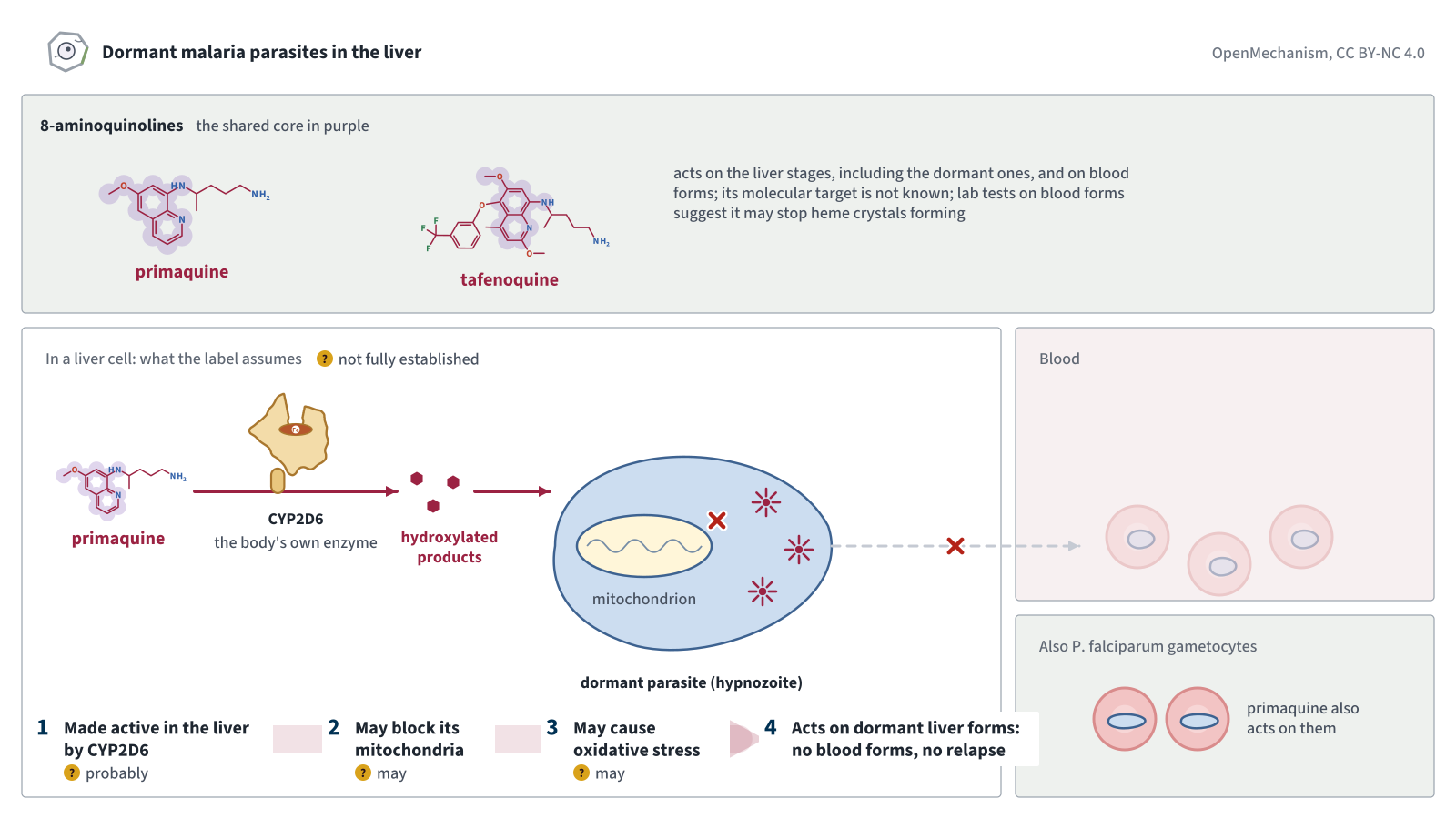
Primaquine acts on the dormant liver forms of P. vivax (), so the blood forms that cause relapses do not develop, and on P. falciparum gametocytes. Its activity probably comes from products the liver makes from it (by ). The label says the mechanism is not fully established: it may block the dormant parasite's mitochondria and cause oxidative stress.
- Acts on
- Dormant liver forms of P. vivax (hypnozoites); the mechanism has not been fully established
- Where
- Dormant malaria parasites in the liver
- Medicine type
- Small molecule
- Used for
- Infections
Not fully established
The primaquine label says: The mechanism of action has not been fully established. … The major assumptions are an inhibition of the mitochondrial system of dormant parasites, and an oxidative stress generated through reactive metabolites in infected cells.
Source 1: Primaquine phosphate tablets: FDA label, Mechanism of Action; Microbiology
Clinical study: In a randomized, double-blind, placebo-controlled trial in 2336 people with vivax malaria in Afghanistan, Ethiopia, Indonesia and Vietnam, 7 or 14 days of primaquine were compared with placebo; the trial measured recurrent vivax malaria over 12 months, not how primaquine works: The incidence rate of symptomatic recurrent P vivax malaria was 0·18 (95% CI 0·15 to 0·21) recurrences per person-year for 935 patients in the 7-day primaquine group and 0·16 (0·13 to 0·18) for 937 patients in the 14-day primaquine group, a difference of 0·02 (-0·02 to 0·05, p=0·3405). … The incidence rate for 464 patients in the placebo group was 0·96 (95% CI 0·83 to 1·08) recurrences per person-year.
Taylor WRJ et al., Lancet 2019 (PMID 31327563)
This study was picked with a literature search and is not yet checked by our reviewer.
Step 1: probably
The primaquine label says: In humans, primaquine phosphate activity is probably related to hydroxylated metabolites generated intrahepatically by CYP2D6.
Source 1: Primaquine phosphate tablets: FDA label, Mechanism of Action; Microbiology
Clinical study: In a randomized, double-blind, placebo-controlled trial in 2336 people with vivax malaria in Afghanistan, Ethiopia, Indonesia and Vietnam, 7 or 14 days of primaquine were compared with placebo; the trial measured recurrent vivax malaria over 12 months, not how primaquine works: The incidence rate of symptomatic recurrent P vivax malaria was 0·18 (95% CI 0·15 to 0·21) recurrences per person-year for 935 patients in the 7-day primaquine group and 0·16 (0·13 to 0·18) for 937 patients in the 14-day primaquine group, a difference of 0·02 (-0·02 to 0·05, p=0·3405). … The incidence rate for 464 patients in the placebo group was 0·96 (95% CI 0·83 to 1·08) recurrences per person-year.
Taylor WRJ et al., Lancet 2019 (PMID 31327563)
This study was picked with a literature search and is not yet checked by our reviewer.
Step 2: may
The primaquine label says: The major assumptions are an inhibition of the mitochondrial system of dormant parasites, and an oxidative stress generated through reactive metabolites in infected cells.
Source 1: Primaquine phosphate tablets: FDA label, Mechanism of Action; Microbiology
Clinical study: In a randomized, double-blind, placebo-controlled trial in 2336 people with vivax malaria in Afghanistan, Ethiopia, Indonesia and Vietnam, 7 or 14 days of primaquine were compared with placebo; the trial measured recurrent vivax malaria over 12 months, not how primaquine works: The incidence rate of symptomatic recurrent P vivax malaria was 0·18 (95% CI 0·15 to 0·21) recurrences per person-year for 935 patients in the 7-day primaquine group and 0·16 (0·13 to 0·18) for 937 patients in the 14-day primaquine group, a difference of 0·02 (-0·02 to 0·05, p=0·3405). … The incidence rate for 464 patients in the placebo group was 0·96 (95% CI 0·83 to 1·08) recurrences per person-year.
Taylor WRJ et al., Lancet 2019 (PMID 31327563)
This study was picked with a literature search and is not yet checked by our reviewer.
Step 3: may
The primaquine label says: The major assumptions are an inhibition of the mitochondrial system of dormant parasites, and an oxidative stress generated through reactive metabolites in infected cells.
Source 1: Primaquine phosphate tablets: FDA label, Mechanism of Action; Microbiology
Clinical study: In a randomized, double-blind, placebo-controlled trial in 2336 people with vivax malaria in Afghanistan, Ethiopia, Indonesia and Vietnam, 7 or 14 days of primaquine were compared with placebo; the trial measured recurrent vivax malaria over 12 months, not how primaquine works: The incidence rate of symptomatic recurrent P vivax malaria was 0·18 (95% CI 0·15 to 0·21) recurrences per person-year for 935 patients in the 7-day primaquine group and 0·16 (0·13 to 0·18) for 937 patients in the 14-day primaquine group, a difference of 0·02 (-0·02 to 0·05, p=0·3405). … The incidence rate for 464 patients in the placebo group was 0·96 (95% CI 0·83 to 1·08) recurrences per person-year.
Taylor WRJ et al., Lancet 2019 (PMID 31327563)
This study was picked with a literature search and is not yet checked by our reviewer.
Key terms in this drawing
- CYP2D6
- Cytochrome P450 2D6. A liver enzyme that breaks down several medicines; for tramadol it makes the active metabolite M1.
- hypnozoite
- Dormant liver-stage malaria parasite. A malaria parasite that stays dormant in a liver cell; primaquine and tafenoquine act on it.
How it works
Made active in the liver by CYP2D6. In humans, primaquine's activity is probably related to hydroxylated metabolites generated in the liver by CYP2D6.1
May block its mitochondria. One major assumption is an inhibition of the mitochondrial system of dormant parasites.1
May cause oxidative stress. The other major assumption is an oxidative stress generated through reactive metabolites in infected cells.1
Acts on dormant liver forms: no blood forms, no relapse. Primaquine is active against the dormant liver forms of P. vivax (hypnozoites) and other exoerythrocytic stages, so the blood forms responsible for relapses of vivax malaria do not develop; it is also active against gametocytes of P. falciparum.1
For teachers: download this drawing.
See also
Condition pages: malaria.
More medicines for infections: acyclovir; albendazole; amoxicillin; amoxicillin and clavulanate; amphotericin B; artesunate; atovaquone; azithromycin; and 51 more.
Explained: primaquine and G6PD deficiency.
Body system: infections.
Sources
- 1Primaquine phosphate tablets: FDA labelMechanism of Action; Microbiology
- 2ChEMBL CHEMBL506Target and action classification: Unknown
- 3Short-course primaquine for the radical cure of Plasmodium vivax malaria: a multicentre, randomised, placebo-controlled non-inferiority trialTaylor WRJ et al. Lancet 2019 (abstract)
Also used for the drawing
The drawing also shows tafenoquine, the other 8-aminoquinoline. These sources support that part; the steps above, their uncertainty and panel a come from the sources listed above. The CYP2D6 outline is traced from the crystal structure below.
- 4Krintafel (tafenoquine): FDA label12.4 Microbiology: Mechanism of Action; Antimicrobial Activity
- 5Arakoda (tafenoquine): FDA label12.4 Microbiology: Mechanism of Action
- 6Structure: ChEMBL (tafenoquine CHEMBL298470)canonical structure from the Atlas catalog snapshot
- 7Human CYP2D6 with quinidinePDB 4WNU; Wang, A. et al. J.Biol.Chem. 2015; 290:5092-5104
Spotted a mistake? Report an error (hello@openmechanism.com). Since launch, every published error we fix is listed on the corrections page.
Notes and limits
- A schematic teaching drawing: not to scale, not exact structures, binding poses or a complete pathway, and not a guide to dosing, treatment or how a person will respond.
- The label says the mechanism of action of primaquine has not been fully established; these are its major assumptions.
All recorded limits are on the evidence page, and notes that apply to every page are on How to read a page. Version 1.0.0, not yet medically reviewed.
Cite this page
Tran D. Primaquine [Internet]. OpenMechanism; 2026 [updated 2026 Oct 16; cited 2026 Oct 16]. Available from: https://openmechanism.com/medicines/primaquine