Thrush and vaginal yeast infections
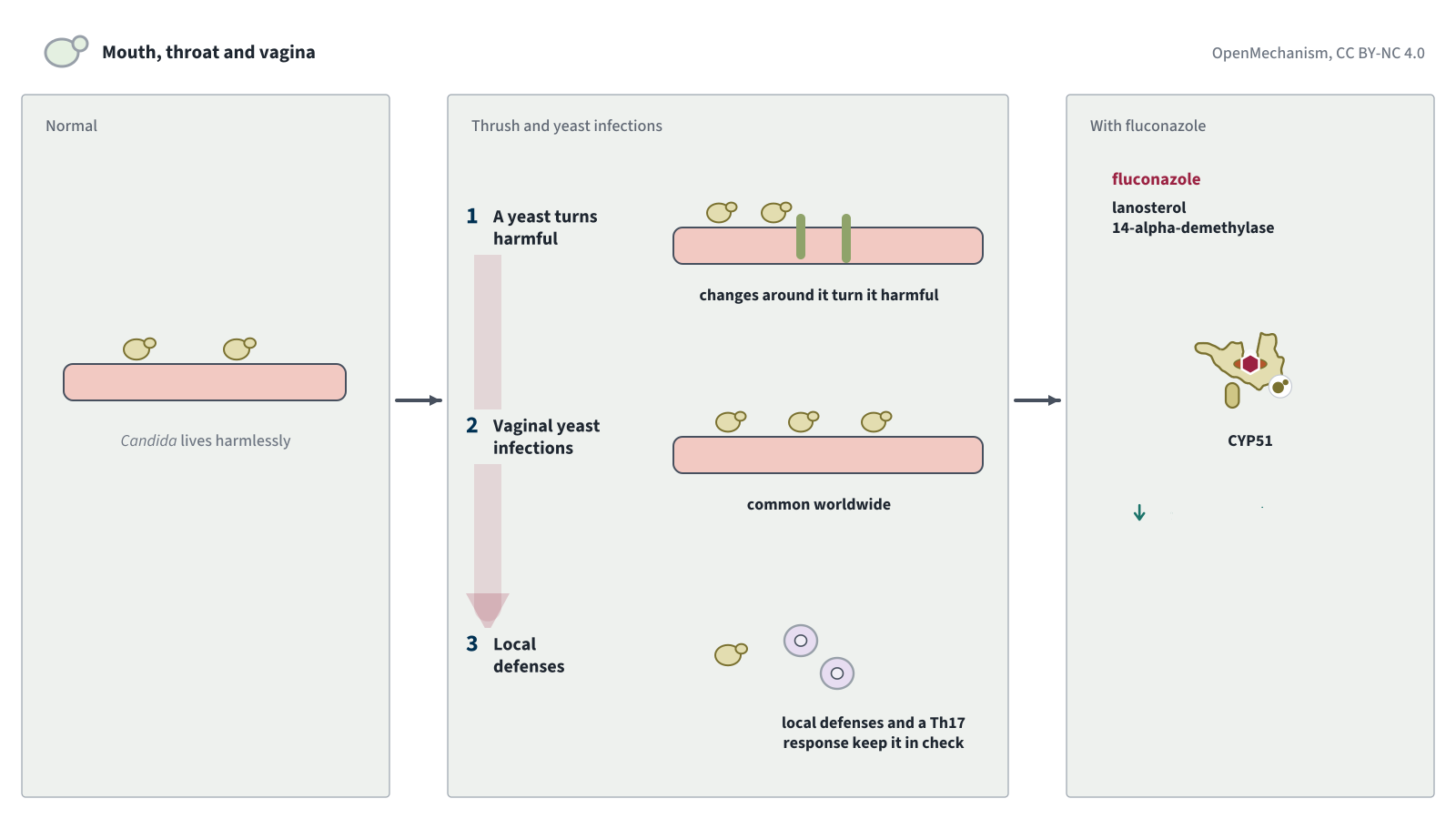
Candida albicans usually lives harmlessly on the body, but changes around it can turn it into a cause of infection: thrush in the mouth and vaginal yeast infections, a common problem worldwide. Local immune defenses normally keep it in check. Fluconazole blocks the fungus making ergosterol for its membrane.
- Where
- Mouth, throat and vagina
- Body systems
- Infections, Bladder & reproductive organs
- Medicines
- 1 medicine
For teachers: download this drawing.
Key terms in this drawing
- CYP51
- Lanosterol 14α-demethylase. The fungal enzyme that azoles block. It removes the 14α-methyl group from lanosterol (14α-demethylation), an early step in making ergosterol, a sterol that fungal cell membranes need.
- Th17
- T helper 17 cell. A type of helper T cell; its response mainly guards the body's linings, for example by holding back the growth of Candida yeast.
What goes wrong
A yeast turns harmful. Thrush is an opportunistic fungal infection of the mouth's lining. Its main cause, Candida albicans, usually lives harmlessly with us, but changes around it can turn it harmful.1
What the source says
“is an opportunistic fungal infection that commonly affects the oral mucosa.”
Source 1“The main causative agent, Candida albicans, is a highly versatile commensal organism that is well adapted to its human host; however, changes in the host microenvironment can promote the transition from one of commensalism to pathogen.”
Source 1Vaginal yeast infections. Vaginal yeast infection remains a common problem worldwide, in every part of society.2
What the source says
“Despite therapeutic advances, vulvovaginal candidosis remains a common problem worldwide, affecting all strata of society.”
Source 2Local defenses. Local immune defenses keep Candida harmless, and a immune response limits its growth and stops it invading.1
What the source says
“local innate immune defenses play a central role in maintaining Candida in its commensal state.”
Source 1“The T helper 17 (Th17)-type adaptive immune response is mainly involved in mucosal host defenses, controlling initial growth of Candida and inhibiting subsequent tissue invasion.”
Source 1
Where medicines act
- A
Fluconazole: ergosterol making blocked
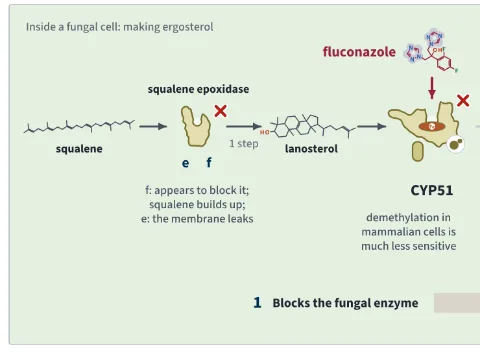
Fluconazole blocks a fungal enzyme (lanosterol 14-alpha-demethylase) that makes ergosterol for the fungal membrane. It treats vaginal yeast infections and thrush of the mouth, throat and esophagus.3
What the source says
“Fluconazole is a highly selective inhibitor of fungal cytochrome P450 dependent enzyme lanosterol 14-α-demethylase. This enzyme functions to convert lanosterol to ergosterol.”
Source 3“Vaginal candidiasis (vaginal yeast infections due to Candida ).”
Source 3“Oropharyngeal and esophageal candidiasis.”
Source 3
See also
Body systems: infections and bladder & reproductive organs.
Other conditions: invasive fungal infections; syphilis; trichomoniasis and bacterial vaginosis; and urinary tract infections.
Side effects: why inhaled steroids can cause thrush and why SGLT2 inhibitors can cause genital yeast infections.
Sources
- 1Oral candidiasis: a disease of opportunityVila T et al. J Fungi 2020 (abstract). Saved copy
- 2Vulvovaginal candidosisSobel JD. Lancet 2007 (abstract). Saved copy
- 3Diflucan (fluconazole): FDA labelIndications and Usage; Mechanism of Action. Saved copy
- 4Yeast CYP51 with fluconazolePDB 4WMZ; Sagatova, A.A. et al. Antimicrob.Agents Chemother. 2015;59:4982-4989. The CYP51 outline in the drawing is traced from this structure. Saved copy
Notes and limits
- How vaginal yeast infections start is still not well understood.2
- Resistance to the few antifungal medicines is rising.1
Notes that apply to every page are on How to read a page.
Spotted a mistake? Report an error (hello@openmechanism.com). Since launch, every published error we fix is listed on the corrections page.
Cite this page
Tran D. Thrush and vaginal yeast infections [Internet]. OpenMechanism; 2026 [updated 2026 Oct 20; cited 2026 Oct 20]. Available from: https://openmechanism.com/conditions/thrush-and-vaginal-yeast-infections