Hepatitis B
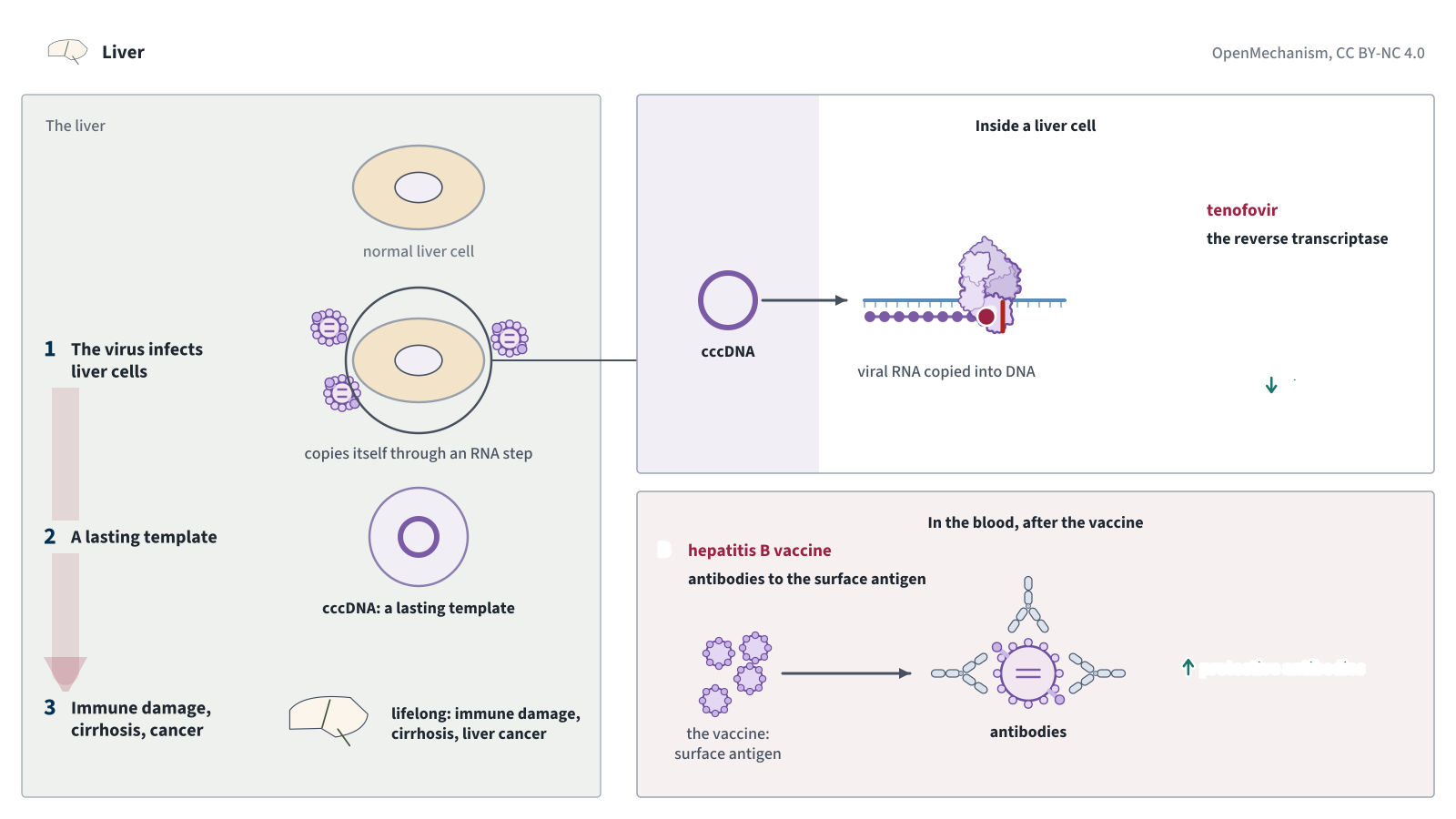
Hepatitis B virus infects liver cells and copies itself through an RNA step; in the nucleus its DNA becomes a stable circle (cccDNA), the template for viral messages. If the immune system cannot clear it, infection becomes lifelong, and immune damage can lead to cirrhosis and liver cancer. Tenofovir blocks viral DNA copying; the hepatitis B vaccine raises protective antibodies.
- Where
- Liver
- Body systems
- Infections; Stomach, gut & liver
- Medicines
- 2 medicines
For teachers: download this drawing.
Key terms in this drawing
- cccDNA
- Covalently closed circular DNA. A closed loop of hepatitis B virus DNA in the liver cell's nucleus; it is the template for the virus's messenger RNA.
- DNA
- Deoxyribonucleic acid. The molecule that stores genes.
- RNA
- Ribonucleic acid. A molecule copied from DNA; messenger RNA carries a gene's instructions.
What goes wrong
The virus infects liver cells. Hepatitis B is a small virus that infects liver cells and copies itself by reverse transcription of an copy.1
What the source says
“Human hepatitis B virus (HBV) is the prototype of a family of small DNA viruses that productively infect hepatocytes, the major cell of the liver, and replicate by reverse transcription of a terminally redundant viral RNA, the pregenome.”
Source 1A lasting template. In the nucleus, the viral DNA becomes a covalently closed circle (), the template for viral messages.1
What the source says
“Upon infection, the circular, partially double-stranded virion DNA is converted in the nucleus to a covalently closed circular DNA (cccDNA) that assembles into a minichromosome, the template for viral mRNA synthesis.”
Source 1Immune damage, cirrhosis, cancer. If the immune system cannot clear it, infection becomes lifelong; immune damage to the liver can lead to cirrhosis and liver cancer.1
What the source says
“Infection of the liver may be either transient (<6 months) or chronic and lifelong, depending on the ability of the host immune response to clear the infection. Chronic infections can cause immune-mediated liver damage progressing to cirrhosis and hepatocellular carcinoma (HCC).”
Source 1
Where medicines act
- A
Tenofovir: DNA copying stopped
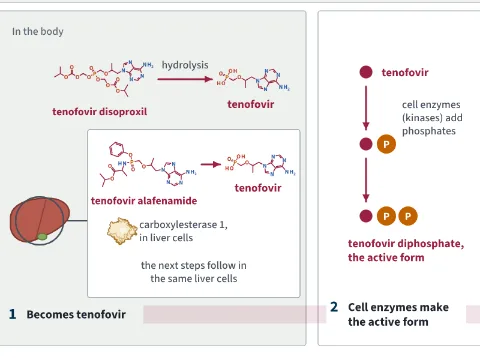
Tenofovir's active form blocks the hepatitis B reverse transcriptase and ends the growing DNA chain. It treats chronic hepatitis B.2
What the source says
“Tenofovir diphosphate inhibits the activity of HIV-1 reverse transcriptase (RT) and HBV RT by competing with the natural substrate deoxyadenosine 5'-triphosphate and, after incorporation into DNA, by DNA chain termination.”
Source 2“VIREAD is indicated for the treatment of chronic hepatitis B virus (HBV) in adults and pediatric patients 2 years of age and older weighing at least 10 kg”
Source 2 - B
Hepatitis B vaccine: protective antibodies
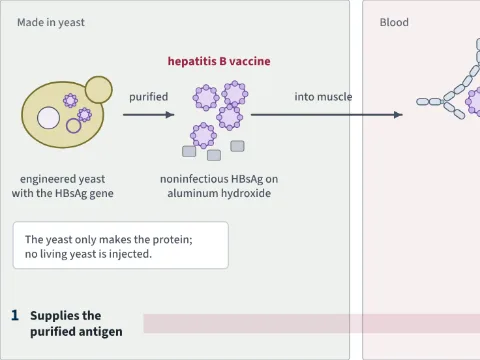
The vaccine raises antibodies against the hepatitis B surface antigen; levels of 10 or more are recognized as protective. It immunizes against all known subtypes.3
See also
Body systems: infections; and stomach, gut & liver.
Related medicines: bulevirtide.
Other conditions: hepatitis D; HIV infection; C. difficile infection; cryptosporidiosis; giardiasis and amebiasis; and hepatitis C.
Side effects: why rituximab can bring hepatitis B back.
Sources
- 1Molecular biology of hepatitis B virus infectionSeeger C, Mason WS. Virology 2015 (abstract). Saved copy
- 2Viread (tenofovir disoproxil fumarate): FDA label1 Indications and Usage; 12.1 and 12.4 Mechanism of Action. Saved copy
- 3Engerix-B (hepatitis B vaccine): FDA label1 Indications and Usage; 12.1 and 12.4 Mechanism of Action. Saved copy
- 4HIV-1 reverse transcriptase (p66 with p51) on DNA, with tenofovir's active form (tenofovir diphosphate)PDB 1T05; Tuske, S. et al. Nat.Struct.Mol.Biol. 2004;11:469-474. The hepatitis B virus reverse transcriptase outline in the drawing is traced from this structure. Saved copy
Notes and limits
- Antivirals delay the harm but cannot cure the infection, because cccDNA stays in liver cells.1
- How hepatitis B leads to liver cancer is unclear.1
Notes that apply to every page are on How to read a page.
Spotted a mistake? Report an error (hello@openmechanism.com). Since launch, every published error we fix is listed on the corrections page.
Cite this page
Tran D. Hepatitis B [Internet]. OpenMechanism; 2026 [updated 2026 Oct 21; cited 2026 Oct 21]. Available from: https://openmechanism.com/conditions/hepatitis-b