Enfuvirtide
Enfuvirtide binds the protein on and stops it changing shape. The virus cannot fuse its membrane with the host cell, so it cannot get in.
- Acts on
- HIV-1 gp41
- Where
- HIV-1 meeting a host cell
- Medicine type
- Protein
- Used for
- Infections
- Drug class
- Antivirals
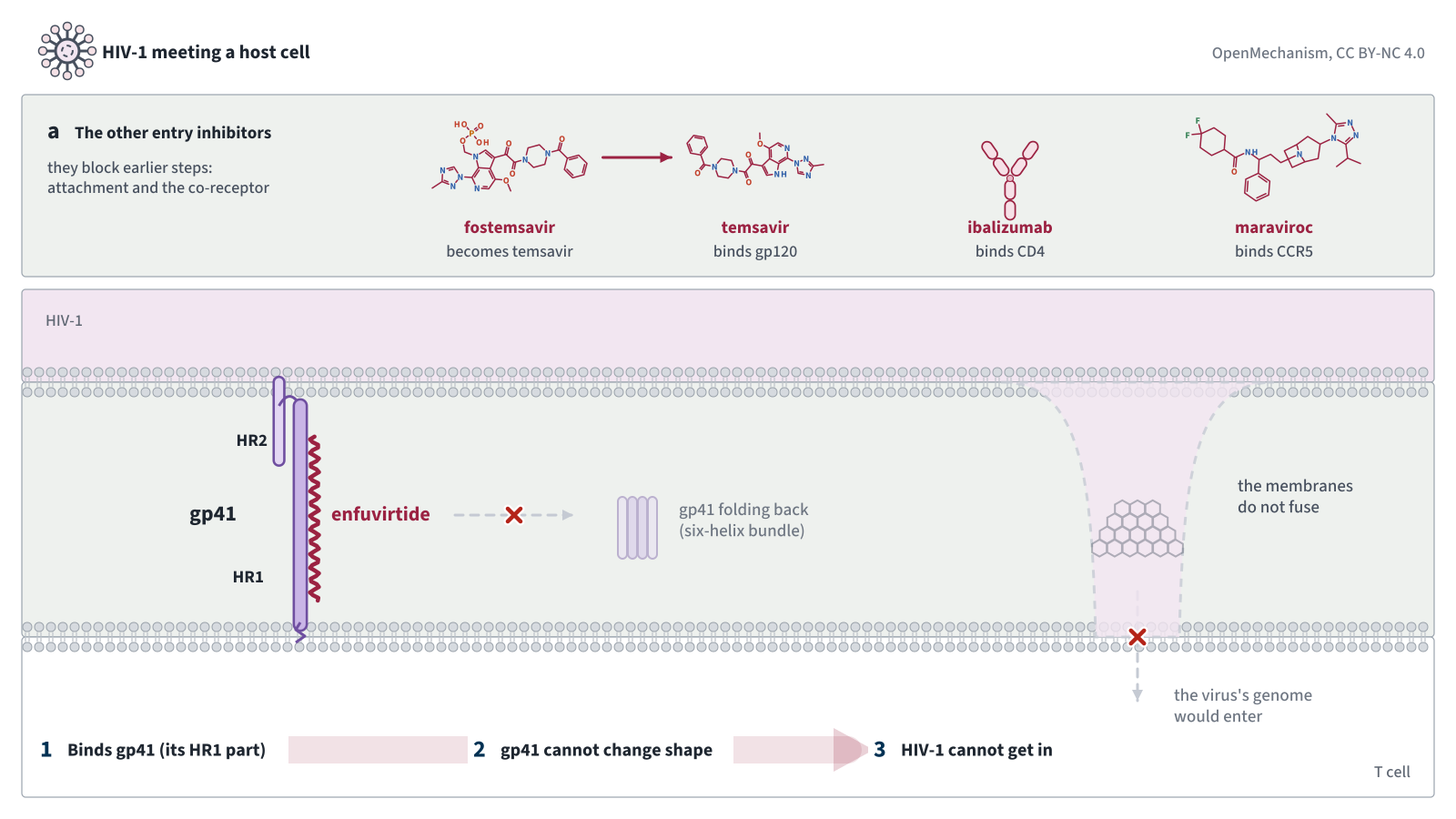
Key terms in this drawing (8)
- CCR5
- C-C chemokine receptor type 5. A receptor on some immune cells that CCR5-using HIV-1 needs to enter; maraviroc binds it.
- CD4
- CD4 receptor. A protein on some immune cells that HIV-1's gp120 binds first; ibalizumab binds it too.
- gp41
- Glycoprotein 41. An HIV-1 surface protein that helps the virus fuse with a cell.
- HIV-1
- Human immunodeficiency virus type 1. A retrovirus. Its capsid encloses the viral genome and helps deliver it into new host cells.
- HR1
- Heptad repeat 1. A region of gp41; enfuvirtide binds it.
- HR2
- Heptad repeat 2. A region of gp41 that folds back onto HR1; enfuvirtide is made like part of it.
- six-helix bundle
- gp41 six-helix bundle. The folded shape gp41 takes when HR2 packs onto HR1, pulling the virus and cell membranes together.
- T cell
- T lymphocyte. A white blood cell of the immune system.
How it works
Binds gp41 (its HR1 part). Enfuvirtide binds the HR1 region of viral gp41.1
gp41 cannot change shape. This prevents gp41 conformational changes needed for membrane fusion.1
HIV-1 cannot get in. Viral and cellular membranes cannot complete fusion, inhibiting HIV-1 entry.1
For teachers: download this drawing or build a slide deck.
See also
Condition pages: HIV infection.
Other antivirals: acyclovir; baloxavir marboxil; bulevirtide; darunavir; doravirine; glecaprevir and pibrentasvir; lenacapavir; nirmatrelvir; and 6 more.
Body system: infections.
Sources
- 1FDA prescribing information · Enfuvirtide: prevent viral membrane fusion12.4 Microbiology: Mechanism of Action; FDA PDF page13
- 2ChEMBL CHEMBL525076Target and action classification: Transmembrane glycoprotein gp41 inhibitor
Also used for the drawing
The drawing also shows the other medicines that block HIV-1 entry, each at the step it blocks, and the steps of entry. These sources support those parts; the numbered steps come from the sources listed above.
- 3Rukobia (fostemsavir): FDA label12.4 Microbiology: Mechanism of Action
- 4Trogarzo (ibalizumab): FDA label12.4 Microbiology: Mechanism of Action
- 5Selzentry (maraviroc): FDA label12.4 Microbiology: Mechanism of Action
- 6HIV: cell binding and entryWilen CB et al., Cold Spring Harb Perspect Med 2012 (abstract)
- 7HIV-1 gp41 fusion intermediate: a target for HIV therapeuticsPan C et al., J Formos Med Assoc 2010 (abstract)
- 8Core structure of gp41 from the HIV envelope glycoproteinChan DC et al., Cell 1997 (abstract)
- 9Potent suppression of HIV-1 replication in humans by T-20, a peptide inhibitor of gp41-mediated virus entryKilby JM et al., Nat Med 1998 (abstract)
- 10Structures: ChEMBL (fostemsavir CHEMBL3301594, maraviroc CHEMBL256907, ibalizumab CHEMBL1743029, an antibody) and PubChem (temsavir CID 11317439)canonical structures and molecule types from the Atlas catalog snapshot; PubChem isomeric SMILES
Spotted a mistake? Report an error (hello@openmechanism.com). Since launch, every published error we fix is listed on the corrections page.
Notes and limits
- A schematic teaching drawing: not to scale, not exact structures, binding poses or a complete pathway, and not a guide to dosing, treatment or how a person will respond.
- Other medicines in the same family may not follow every step or share the same clinical endpoint.
- The steps are in the order that explains them; one step is said to cause the next only where the source says so.
- The selected FDA label is a 2019 archived document; no claim of latest labeling or activity against HIV2 is made.
- Protein rearrangement is a labeled schematic concept, not a solved drug-bound intermediate.
- Checked selected FDA product records are marked Discontinued. This mechanism-history example does not imply present availability or safety withdrawal.
All recorded limits are on the evidence page, and notes that apply to every page are on How to read a page. Version 1.0.0, not yet medically reviewed.
Cite this page
Tran D. Enfuvirtide [Internet]. OpenMechanism; 2026 [updated 2026 Oct 15; cited 2026 Oct 15]. Available from: https://openmechanism.com/medicines/enfuvirtide