Amphotericin B
Amphotericin B binds ergosterol in the membranes of susceptible fungi. The membrane becomes leaky, ions escape, and the fungal cell dies.
- Acts on
- Ergosterol
- Where
- Fungal cell membranes
- Medicine type
- Small molecule
- Used for
- Infections
- Drug class
- Antifungals
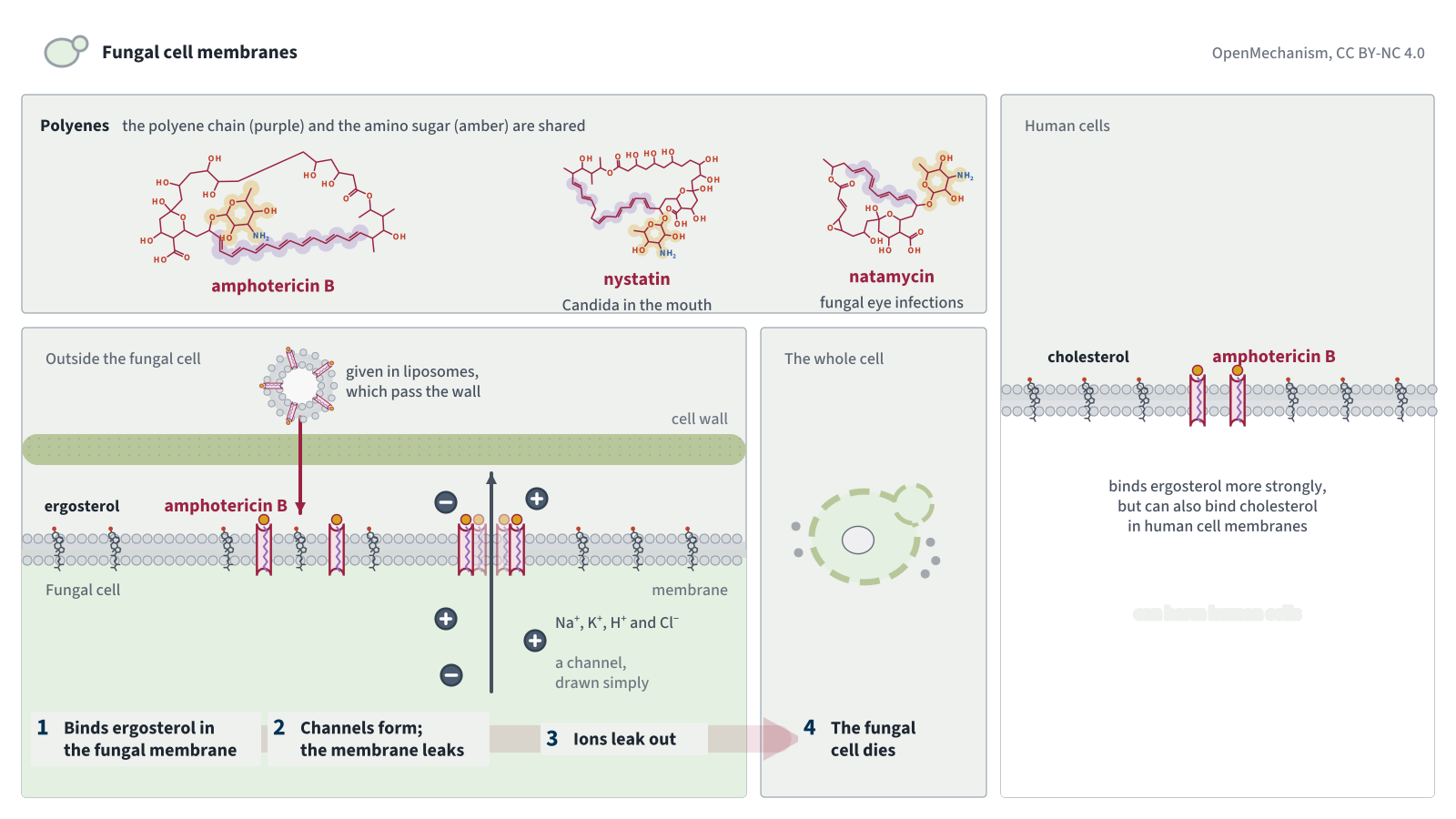
How it works
Binds ergosterol in the fungal membrane. Amphotericin B binds ergosterol in susceptible fungal cell membranes.1
Channels form; the membrane leaks. The label describes transmembrane channels and increased permeability.1
Ions leak out. Monovalent ions leak through the altered membrane.1
The fungal cell dies. Loss of membrane integrity and ion leakage result in cell death.1
For teachers: download this drawing or build a slide deck.
See also
Condition pages: invasive fungal infections and leishmaniasis.
Other antifungals: caspofungin, fluconazole and ketoconazole.
More medicines for infections: acyclovir; albendazole; amoxicillin; amoxicillin and clavulanate; artesunate; atovaquone; azithromycin; baloxavir marboxil; and 49 more.
Explained: why amphotericin B can harm the kidneys.
Body system: infections.
Sources
- 1Amphotericin B liposome: FDA labelMicrobiology: Mechanism of Action
- 2ChEMBL CHEMBL267345Target and action classification: Ergosterol sequestering agent
Also used for the drawing
The drawing also shows the other polyenes, nystatin and natamycin. These sources support those parts; the steps above, the liposome and the cholesterol panel come from the sources listed above.
- 3Nystatin oral suspension: FDA labelDescription; Microbiology
- 4Natacyn (natamycin): FDA labelClinical Pharmacology; Indications and Usage
- 5
Spotted a mistake? Report an error (hello@openmechanism.com). Since launch, every published error we fix is listed on the corrections page.
Notes and limits
- A schematic teaching drawing: not to scale, not exact structures, binding poses or a complete pathway, and not a guide to dosing, treatment or how a person will respond.
- Other medicines in the same family may not follow every step or share the same clinical endpoint.
- The steps are in the order that explains them; one step is said to cause the next only where the source says so.
- The selected source is a liposomal product; the active amphotericin and its formulation are separate roles.
- Exact channel stoichiometry or ergosterol extraction geometry is not reconstructed. Mammalian cholesterol binding and cytotoxicity are possible.
All recorded limits are on the evidence page, and notes that apply to every page are on How to read a page. Version 1.0.1, not yet medically reviewed.
Cite this page
Tran D. Amphotericin B [Internet]. OpenMechanism; 2026 [updated 2026 Oct 17; cited 2026 Oct 17]. Available from: https://openmechanism.com/medicines/amphotericin-b