Isoniazid
Isoniazid's activated form binds , an enzyme tuberculosis bacteria need to make mycolic acids, an essential part of their cell wall. Actively growing bacteria, inside and outside cells, are killed.
- Acts on
- InhA, an enzyme Mycobacterium tuberculosis needs to make mycolic acids
- Where
- Tuberculosis bacteria (Mycobacterium tuberculosis)
- Medicine type
- Small molecule
- Used for
- Infections
- Drug class
- Antibiotics
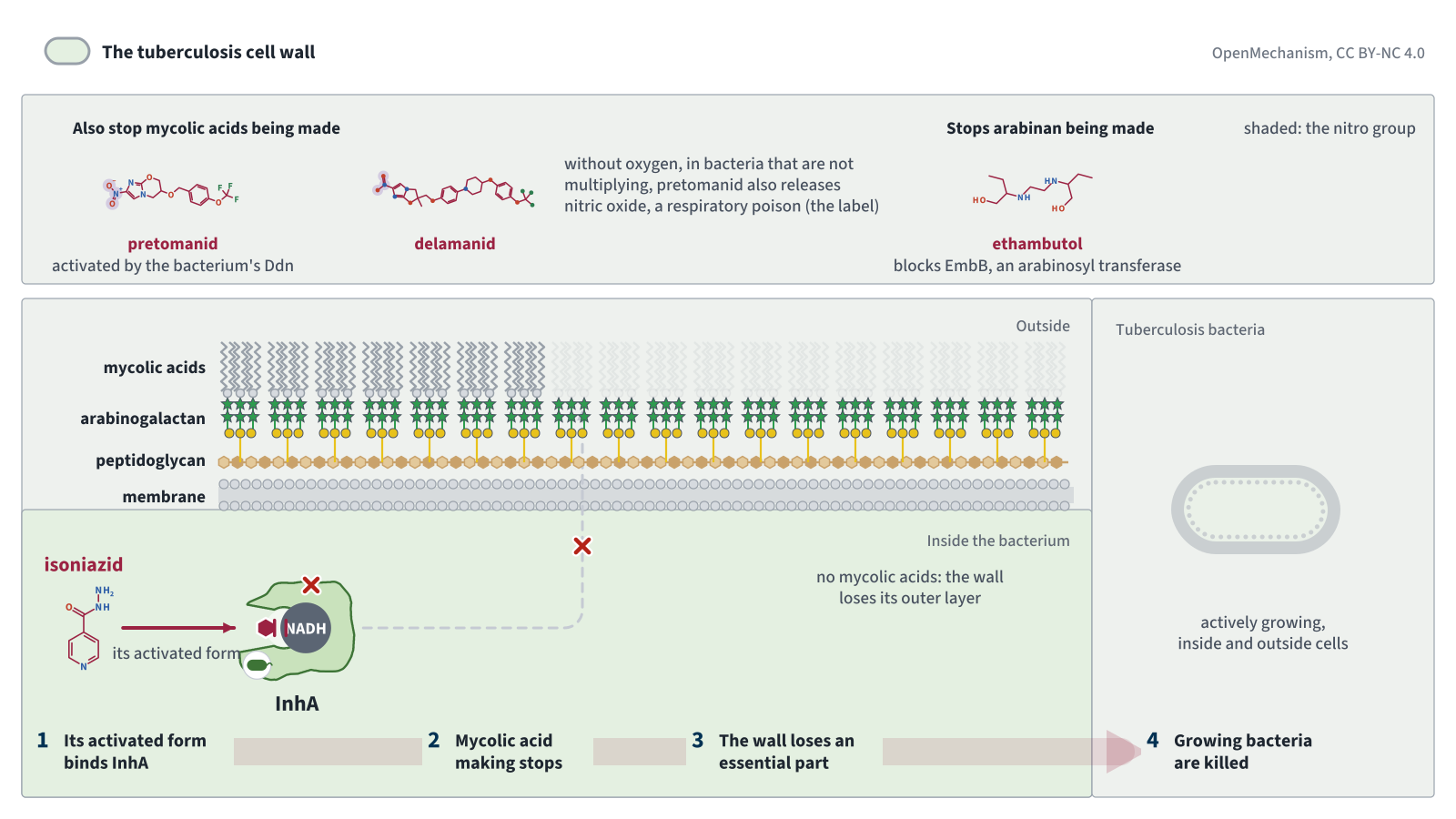
Key terms in this drawing (5)
- Ddn
- Deazaflavin-dependent nitroreductase. The tuberculosis enzyme that activates pretomanid by reducing its nitro group.
- EmbB
- Arabinosyl transferase EmbB. One of the tuberculosis enzymes that join arabinose into the wall's arabinan; ethambutol blocks them.
- InhA
- Enoyl-acyl carrier protein reductase (InhA). A Mycobacterium tuberculosis enzyme essential for making mycolic acids; isoniazid's activated form binds it.
- NADH
- Nicotinamide adenine dinucleotide (reduced). A helper molecule that sits in InhA's working site; activated isoniazid attaches to it.
- NO
- Nitric oxide. A signal molecule released by nerve endings and the cells lining blood vessels; it makes smooth muscle cells produce cGMP.
How it works
Its activated form binds InhA. The activated form of isoniazid attaches covalently to the nicotinamide ring of the bound in the active site of InhA, a long-chain enoyl-acyl carrier protein reductase of Mycobacterium tuberculosis.1
Mycolic acid making stops. InhA is essential for mycolic acid biosynthesis, and isoniazid inhibits the synthesis of mycolic acids.1,2
The wall loses an essential part. Mycolic acids are an essential component of the bacterial cell wall.2
Growing bacteria are killed. At therapeutic levels isoniazid is bactericidal against actively growing intracellular and extracellular Mycobacterium tuberculosis organisms.2
For teachers: download this drawing.
See also
Condition pages: tuberculosis.
Other antibiotics: amoxicillin; amoxicillin and clavulanate; azithromycin; bedaquiline; ceftazidime and avibactam; ceftriaxone; cephalexin; ciprofloxacin; and 14 more.
Explained: isoniazid and phenytoin; and why isoniazid can damage nerves.
Body system: infections.
Sources
- 1Modification of the NADH of the isoniazid target (InhA) from Mycobacterium tuberculosisRozwarski DA et al., Science 1998 (abstract)
- 2Isoniazid tablets: FDA labelClinical Pharmacology: Mechanism of Action
- 3ChEMBL CHEMBL64Target and action classification: Enoyl-[acyl-carrier-protein] reductase inhibitor
Also used for the drawing
The drawing also shows pretomanid, delamanid and ethambutol, and the layers of the tuberculosis wall. These sources support those parts; the steps above come from the sources listed above. The InhA outline is traced from the crystal structure below.
- 4Pretomanid tablets: FDA labelMechanism of Action
- 5OPC-67683 (delamanid), a nitro-dihydro-imidazooxazole derivative with promising action against tuberculosis in vitro and in miceMatsumoto M et al., PLoS Med 2006 (abstract)
- 6The emb operon, a gene cluster of Mycobacterium tuberculosis involved in resistance to ethambutolTelenti A et al., Nat Med 1997 (abstract)
- 7The embAB genes of Mycobacterium avium encode an arabinosyl transferase involved in cell wall arabinan biosynthesis that is the target for the antimycobacterial drug ethambutolBelanger AE et al., Proc Natl Acad Sci U S A 1996 (abstract)
- 8Structures and mechanism records: ChEMBL (isoniazid CHEMBL64, pretomanid CHEMBL227875, delamanid CHEMBL218650, ethambutol CHEMBL44884)canonical structures; ethambutol's arabinosyltransferase mechanism record
- 9Symbol Nomenclature for Glycans (SNFG)standard symbols: arabinose (green star), galactose (yellow circle)
- 10Mycobacterium tuberculosis InhA with isoniazid's active form joined to NADHPDB 1ZID; Rozwarski, D.A. et al. Science 1998; 279:98-102
Spotted a mistake? Report an error (hello@openmechanism.com). Since launch, every published error we fix is listed on the corrections page.
Notes and limits
- A schematic teaching drawing: not to scale, not exact structures, binding poses or a complete pathway, and not a guide to dosing, treatment or how a person will respond.
- The FDA label states only that isoniazid inhibits mycolic acid synthesis; the enzyme target (InhA) and the activated form come from a 1998 crystallography and mass-spectrometry study.
- How isoniazid is activated is not described in these sources.
- The label's statement covers actively growing organisms.
All recorded limits are on the evidence page, and notes that apply to every page are on How to read a page. Version 1.0.0, not yet medically reviewed.
Cite this page
Tran D. Isoniazid [Internet]. OpenMechanism; 2026 [updated 2026 Nov 6; cited 2026 Nov 6]. Available from: https://openmechanism.com/medicines/isoniazid